Ozempic / Mounjaro Weight Regain: What Happens When You Stop (India)
Why two-thirds of GLP-1 weight loss returns within a year of stopping (STEP-1 trial). The off-ramp protocol: muscle building during treatment, sustainable eating habits, and tapering under your doctor.
⚠ Lifestyle coaching information only. Not medical advice. Stopping GLP-1 medications must be done under your doctor's supervision — never stop abruptly. The strategies here (muscle building, eating habits, tapering protocols) are general guidance; your doctor will tailor the approach based on your individual health profile.
Quick answer: Studies such as the STEP-1 trial extension show that most people regain roughly two-thirds of their weight loss within a year of stopping GLP-1 drugs like Ozempic, Mounjaro, or Wegovy. However, this regain is not inevitable. The protective strategy is straightforward: (1) build and keep muscle during treatment via strength training, (2) establish sustainable Indian eating habits while on the drug, (3) taper only under your doctor's guidance. The drug creates the calorie deficit; your habits decide whether you keep the results. Below: how regain happens and how to prevent it.
GLP-1 Weight Regain Risk At a Glance
The STEP-1 Trial: Why Weight Regain Happens
The most-cited study on GLP-1 withdrawal is the STEP-1 trial extension. Researchers followed 1,961 people who took semaglutide (Ozempic) 2.4 mg once weekly for 68 weeks, then stopped. The results are sobering but predictable:
- During treatment: 17.3% mean body weight loss (approximately 15-20 kg for someone starting at 100 kg)
- One year after stopping: Participants regained roughly two-thirds of that weight (approximately 10-13 kg back)
- Remaining loss: Only 5.6% net weight loss after one year off the drug — nearly back to baseline
Why? Because the medication was doing the heavy lifting. GLP-1 drugs (semaglutide, tirzepatide, liraglutide) suppress appetite by mimicking hormones that signal fullness. When you stop, that signal vanishes. Your appetite returns to normal. If you haven't built new eating habits, you'll eat like you did before — and the weight comes back with it.
Appetite Returns; Metabolism Doesn't (Without Muscle)
Here's the harder part: even if you could control your appetite perfectly after stopping the drug, regain still accelerates because your metabolism has changed. Here's why:
The Metabolic Penalty of Rapid Fat Loss
When you lose weight fast (as GLP-1 enables), a large share of that loss is muscle, not pure fat. Studies show that roughly 25-40% of total weight loss from GLP-1 drugs is lean mass (muscle + bone + water), meaning only 60-75% is actually fat.
Muscle is metabolically expensive. It burns calories at rest. Lose 20 kg, and 5-8 kg might be muscle. That muscle was burning an extra 100-150 calories daily just by existing. Lose it, and your baseline metabolic rate drops. Your body now burns 100-150 fewer calories per day at rest than it did before the drug.
Once the appetite suppression is gone, those 150 "missing" calories add up: ₹150 × 365 days = 54,750 excess calories per year. At 7,000 calories per kg of fat, that's 7-8 kg of regain per year — guaranteed, even if you "stick to your diet."
Why the Regain Is Predictable (And Avoidable)
The STEP-1 regain wasn't random. It happened because most participants did not strength train during the drug phase. They lost weight but also lost muscle, reducing their resting metabolic rate. When appetite returned, their bodies felt "lighter" and wanted to rebuild their previous mass — a process called "metabolic adaptation."
The solution is simple but requires discipline during treatment: build muscle while you're on the drug. More muscle = higher metabolism after you stop. That makes weight regain harder, not easier.
| Scenario | Weight Loss (12 weeks) | Muscle Lost | Metabolism After | Regain Risk (Year 1) |
|---|---|---|---|---|
| GLP-1 alone, no training | 15 kg | 3-6 kg | DOWN by 150-200 cal/day | 10+ kg regain |
| GLP-1 + 3x/week strength training | 15 kg | 1-2 kg | DOWN by 25-50 cal/day | 3-5 kg regain |
| GLP-1 + training + habit built | 15 kg | 1-2 kg | STABLE | 2-3 kg (mostly water) |
The difference is dramatic: same drug, same weight loss, but the trained person regains 3-5 kg versus the untrained person regaining 10+ kg. The mechanism is muscle preservation + established eating habits.
The Three-Part Off-Ramp Protocol
Part 1: Build Muscle During Treatment (Weeks 1-12 and Beyond)
Start strength training before your appetite drops to zero. Many people begin GLP-1 and immediately stop training because "I feel too nauseous" or "I'm eating too little." This is a mistake.
What to do instead:
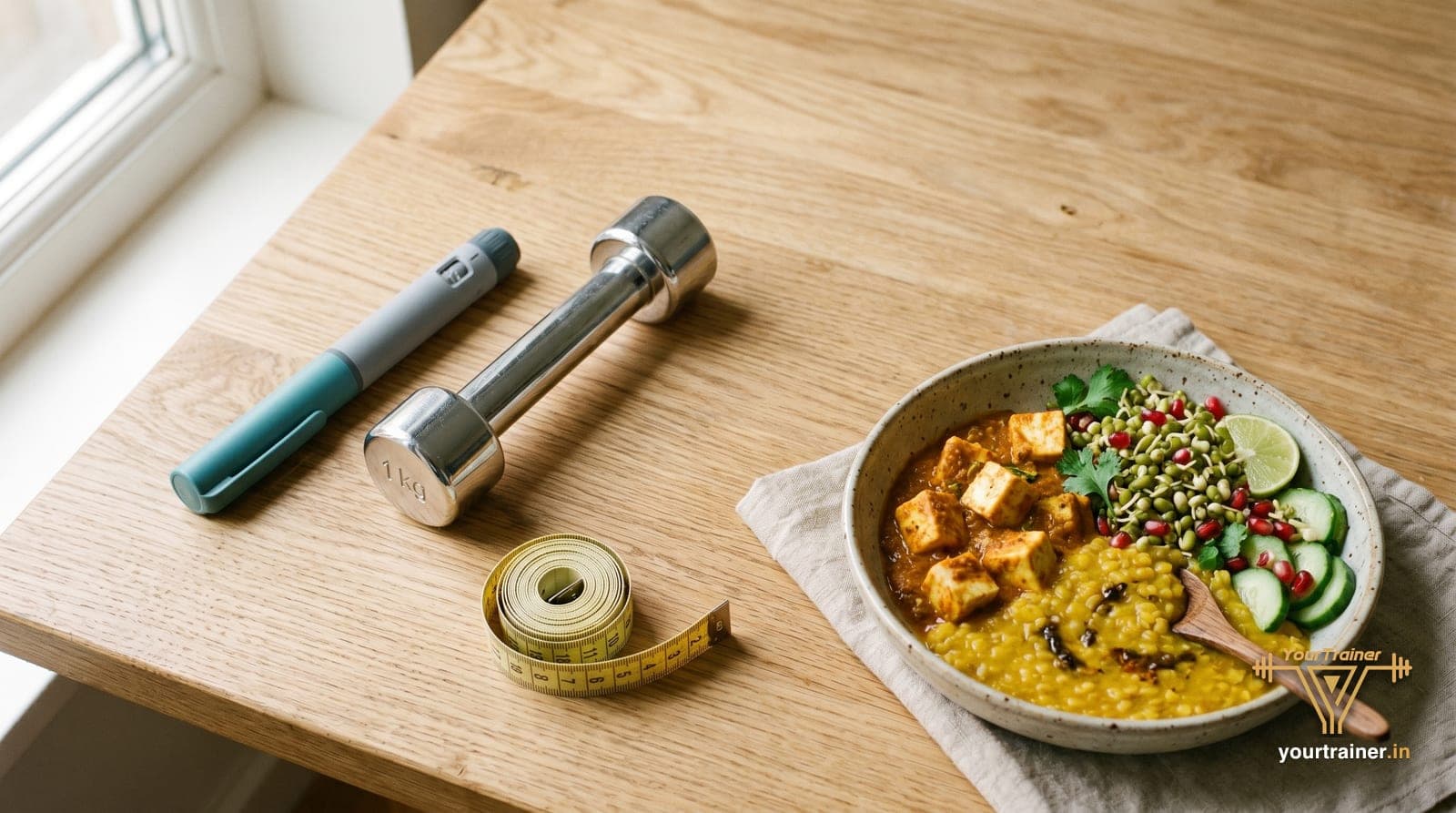
- Strength train 3-4x per week, 30-45 minutes each session (compound lifts: squats, deadlifts, rows, presses). Even light training signals your body to keep muscle.
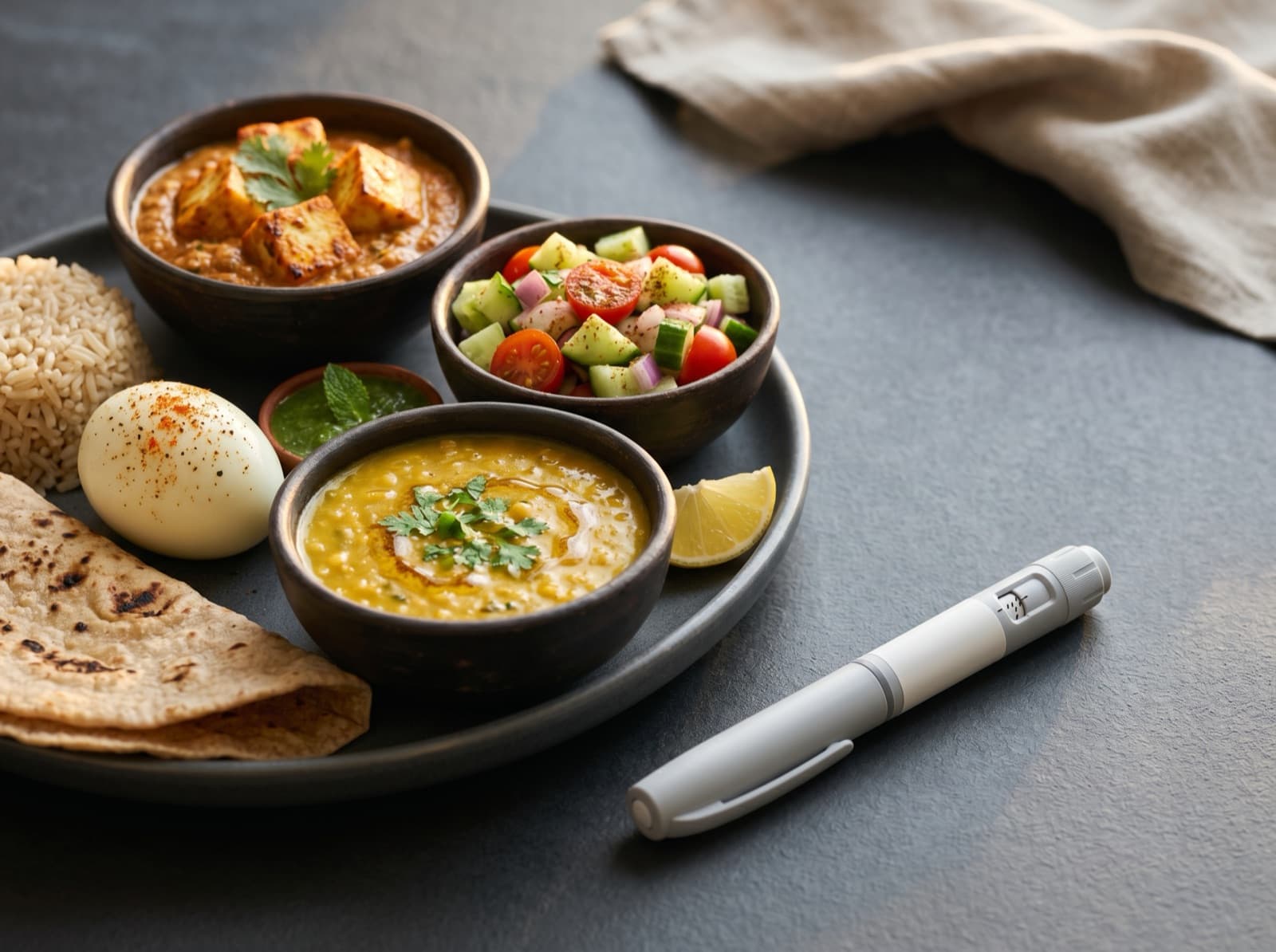
- Target 1.8-2.2g protein per kg of body weight daily. High-protein Indian diet: paneer (25g per 100g), eggs (13g per large egg), dal + rice (combined 12-15g), chicken (26g per 100g), Greek yogurt (10g per 100g), soya chunks (12g per 100g).
- Eat in a modest calorie deficit, not extreme. GLP-1 is already creating a huge deficit via appetite suppression. Add another 500 cal cut, and you're guaranteed muscle loss. Eat at your natural hunger level + high protein, and let the drug do most of the work.
- Supplement basics: Multivitamin, B12 (common GLP-1 side effect: B12 absorption issues), and possibly iron if female. Hair loss is common; dermatologist's input helps.
Part 2: Build Sustainable Eating Habits (During Treatment)
The drug makes it easy to eat less, but it does NOT teach your brain to want healthy food. You must deliberately build the habit while you have the "easy mode" of the appetite suppressant.
What to do:
- Pick 2-3 high-protein breakfasts and eat them daily. Example: paneer bhurji with roti, or 3 eggs with toast. No variety for 6-8 weeks. Routine = habit.
- Plan your dinners 1 week ahead. Pick 4-5 high-protein Indian dinners (dals, paneer curries, chicken, fish) and rotate them. Remove the decision-making.
- Eat the same lunch most days. Chicken + rice, or paneer + roti. Boredom is a feature; it locks in the habit.
- Record everything in a food diary or app (MyFitnessPal, Health Mate). You don't need to restrict; just track. Awareness = behaviour change.
- Build a relationship with protein-rich snacks. Boiled eggs, Greek yogurt, roasted chickpeas, mozzarella sticks. When you're off the drug and hungry again, these should feel "normal" to reach for, not forbidden.
Part 3: Taper Only Under Your Doctor's Supervision
Never stop cold turkey. Work with your endocrinologist on a taper plan:
- If you've been on the drug 12+ months and hit your goal, ask your doctor about reducing the dose by 25-50% and holding for 4-6 weeks before further reduction.
- During the taper, keep strength training. This is when muscle preservation becomes critical. Your body is adjusting; strength training signals "keep the muscle."
- Increase calories slowly (reverse diet). Add 100-200 calories every 2 weeks, mostly from carbs and protein. This allows your metabolism to adapt without sudden fat regain.
- Monitor weight weekly. If weight creeps up > 2-3 kg over a month, pause the taper and discuss with your doctor. You may need to stay on a lower dose longer.
- Plan for maintenance dosing. For many people, stopping entirely is unrealistic. Ask your doctor about a low-dose maintenance (e.g., 0.5-1.0 mg Ozempic or 5 mg Mounjaro monthly) to keep weight regain at 2-3 kg/year instead of 10+.
The honest truth: Most people who stop GLP-1 drugs completely DO regain weight, because the lifestyle hasn't fundamentally changed. The drug was a tool to create a deficit; it was never meant to be the entire solution. If you build muscle and habits, regain slows dramatically. If you don't, the STEP-1 data is your future.
India-Specific Context: Why Regain Hits Harder Here
In India, GLP-1 regain is especially risky because:
- Food culture is high-calorie-density: Ghee, oil, refined carbs (white rice, maida) are staples. Portion control isn't culturally normal. When appetite returns, old eating patterns snap back quickly.
- Gym access is less normalized: In the West, buying a GLP-1 script often includes a gym membership. In India, you're buying the drug only. Strength training becomes a separate, costly decision.
- Metabolic differences in Indian bodies: South Asian bodies have higher visceral fat (belly fat) tendency and lower muscle-to-fat ratio by default. GLP-1 makes this worse if you don't strength train. Regain comes back as belly fat, not muscle.
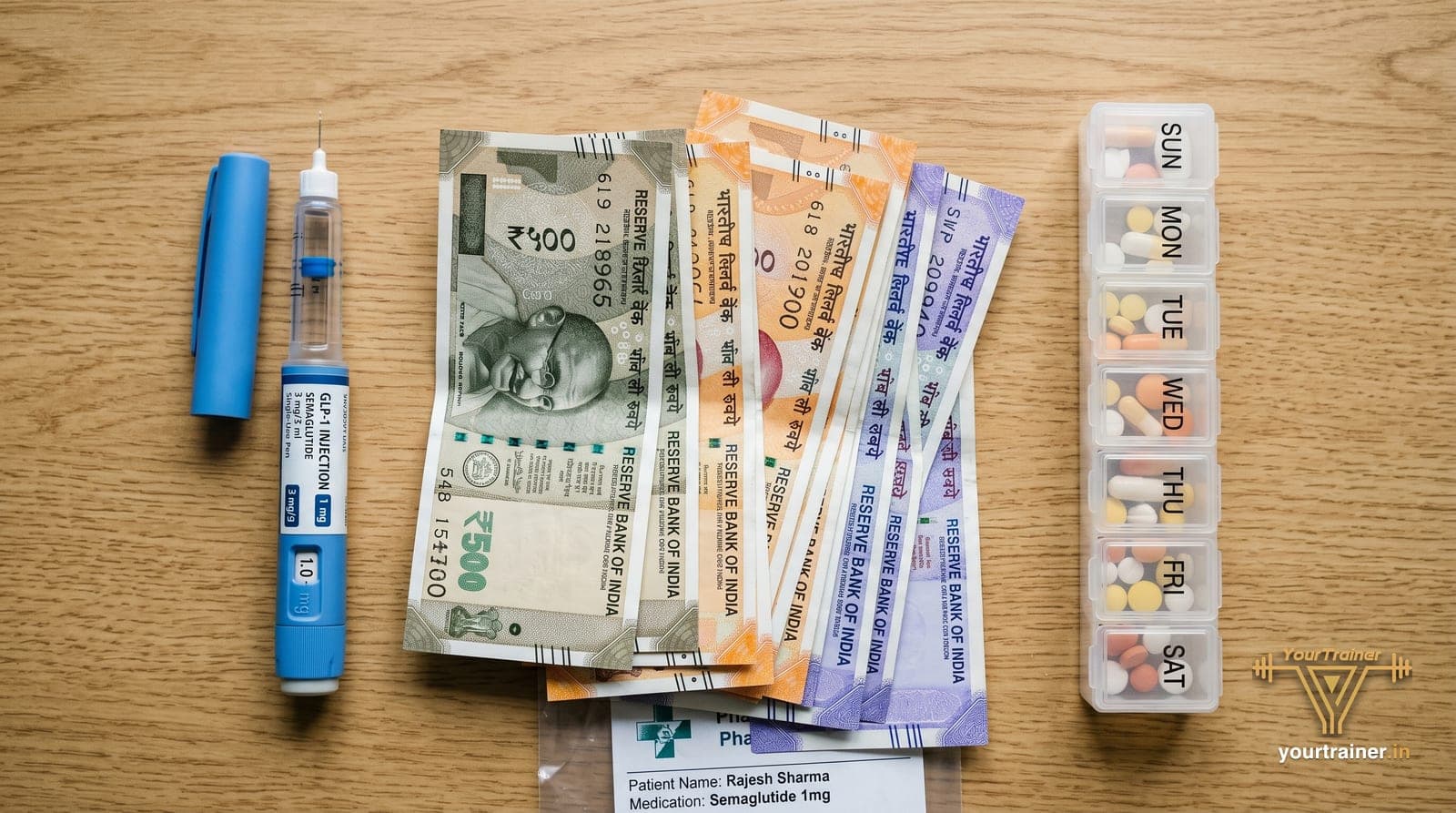
- Cost + availability of consistent coaching: ₹5K-12K/month online coaching is an ongoing cost. Most people stop after 3-4 months "to save money," then lose accountability. Regain starts.
Real-World Data: Not Everyone Regains Two-Thirds
The STEP-1 number (66% regain) is dramatic but not universal. Newer real-world studies show a more hopeful picture: people who strength train, keep protein intake high, and taper slowly regain only 20-30% of their weight loss (or stay near their new weight with maintenance dosing).
The difference between those who regain 20% and those who regain 70% is not genetics or willpower — it's whether they built muscle and established habits during treatment.
FAQ: Weight Regain After Stopping GLP-1
Q: Can I stay on the drug forever?
A: Possibly, if your doctor approves it and you can afford it (₹1.9-3.0L annually for Ozempic/Mounjaro/Wegovy). Some people switch to maintenance dosing (lower dose, less frequent). But GLP-1 is not a "cure for obesity" — it's a tool. If the goal is to build a life where you don't need it, strength training + habit building are non-negotiable.
Q: How long does regain take?
A: The STEP-1 study tracked regain over 52 weeks post-cessation. Most of the weight came back in months 6-12. But if you've built strength and habits, regain is slower (spread over 18-24 months) and smaller in magnitude.
Q: What if I've already lost muscle?
A: Muscle is regainable, but it takes 6-12 months of consistent strength training + high protein to rebuild 5-10 kg. Start now. It's easier to maintain muscle during treatment than rebuild it after stopping.
Q: Is regain inevitable?
A: No. If you've built strong habits, eat high-protein regularly, strength train 3x/week, and either stay on maintenance dosing or taper very slowly, regain can be kept to 5-10% (a manageable 5-7 kg for someone who lost 70 kg). It's not "inevitable"; it's just that most people don't do the work to prevent it.
Q: Should I do keto or IF while stopping the drug?
A: No. Use basic calorie awareness + high protein + strength training. Extreme diets often fail during and after GLP-1; you're better off with a boring, sustainable approach.
The Why Weight Regain Happens Timeline
Weeks 1-6 (Immediate): Appetite returns. Hunger hormones rebalance. You notice it within days. Calorie intake creeps up 200-500 cal/day if you're not paying attention.
Weeks 6-24 (Metabolic Adjustment): Body senses lower metabolic rate (from muscle loss during treatment) and tries to "rebind" weight to normal. Water retention increases, appetite stays elevated, and fat regain accelerates.
Weeks 24-52 (Plateau): Regain typically plateaus around 65-75% of weight lost within 12 months. Most people have then rebuilt to a "new normal" that's slightly lower than baseline (hence the 5.6% net loss in STEP-1) but significantly worse than their treated state.
Related Reads
- Ozempic in India 2026: Cost, Where to Get It, Results & Honest Risks
- Mounjaro in India 2026: Full Cost, Results, Side Effects — The Honest Guide
- Wegovy in India 2026: Cost, Availability, Results & Honest Risks
- Best Indian Diet on Mounjaro/Wegovy: High-Protein Protocol
- Protein & Strength Training on GLP-1: How to Keep Muscle (India Protocol)
Serious about GLP-1 without the regain?
Start your free protocol consultation
YourTrainer's GLP-1 off-ramp protocol starts DURING treatment, not after. We build your strength, establish your habits, and guide your taper — so when you stop (or go on maintenance), your results stick. Free 30-min discovery call with Coach Anish.
- Coach Anish, YourTrainer · Lifestyle coaching content, not medical advice. Always consult your doctor before starting, changing, or stopping any medication. Weight regain is common but preventable with the right protocol.
Did you find this helpful?

About Anish Agarwal
Founder & Head Coach, YourTrainer · NASM & K11 Certified Personal Trainer · 6+ years experience
Anish Agarwal is a NASM and K11 certified personal trainer with 6+ years of experience coaching fat loss, body transformation, strength, and nutrition for clients across India. He founded YourTrainer to make expert, science-based coaching accessible online and in Bengaluru. More about Anish.
Ready to Transform?
Get personalized training and nutrition guidance tailored to your goals. Free 30-minute consultation, no obligation.