Indian Veg Diet Plan for Muscle Gain: 12 Weeks, Protein Per Meal
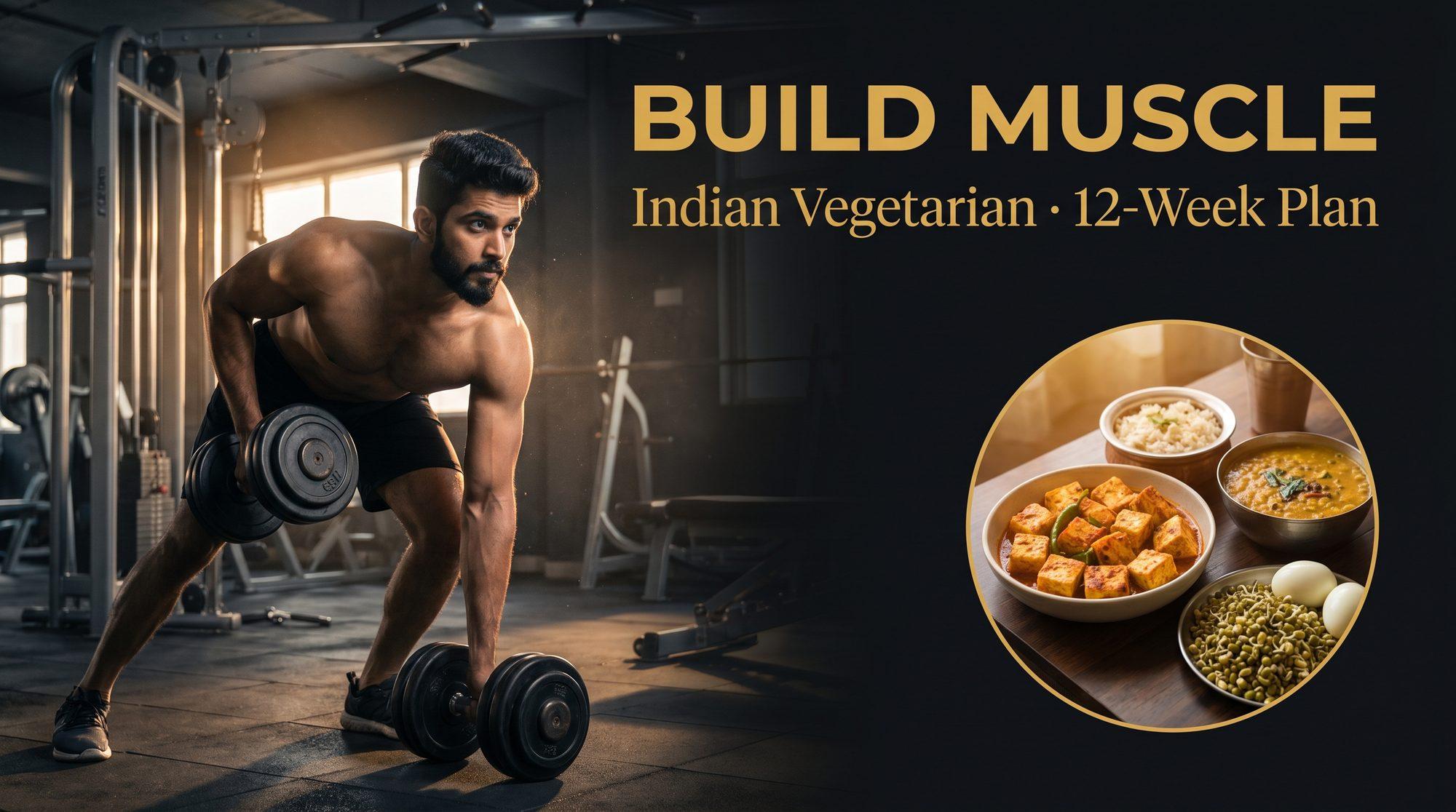
Indian veg diet plan for muscle gain: 250 to 400 kcal above maintenance, 1.6 to 2.2 g protein per kg from paneer, dal, soya and curd. 12 weeks, 4 strength days.
Take it with you
Save this 12 week plan as a PDF or print it for the fridge. The meals, the grocery list and the swaps come through, the menus and adverts do not.
Quick answer: To build muscle as an Indian vegetarian, eat 250-400 kcal above maintenance, hit 1.6-2.2g protein per kg body weight (paneer, dal, soya, eggs, Greek yogurt, ± a veg protein powder), strength-train 4 days a week with progressive overload, and sleep 7-8 hours. With consistency, expect 0.5 kg lean muscle gain per month, about 6 kg in a year. Vegetarian or not, the principles are identical.
What our members actually do
82 g
median protein on a fully logged day
53%
of fully logged days reached 80 g
88%
of sampled home sessions used bodyweight moves
2.5 to 5 kg
the dumbbells most clients owned
From our own coaching data
Source: A sample of member food logs from the YourTrainer app, 19 April to 6 November 2026. Members only, aggregated. A fully logged day means three or more meals and 800 to 4,500 kcal.; A sample of YourTrainer coaching sessions reviewed as case studies, 17 Aug to 7 Sep 2026, client names removed; equipment counted in the sampled sessions with an exercise list
Two lessons for a vegetarian plan: protein comes from ordinary food members already eat (dal, curd, paneer, eggs), and progress started with light dumbbells and bodyweight, not a full home gym. The typical paneer entry was 50 g, about 9 g of protein, so plan portions in grams rather than "a serving".
Protein in common vegetarian portions
These are cooked portions from our household table, so you can plan a day in katoris and rotis rather than grams. Soya and dal carry the most protein per portion. Sabzi and rice carry very little, so build the meal around the protein foods and fill the rest with vegetables.
| Food | Portion | kcal | Protein |
|---|---|---|---|
| Soya chunks (cooked) | 1 katori (100 g) | 172 | 26 g |
| Paneer (raw cubes) | 100 g | 265 | 18 g |
| Greek yogurt (plain) | 1 katori (150 g) | 88 | 15 g |
| Dal (chana) | 1 katori (150 g) | 165 | 9.5 g |
| Dal (toor) | 1 katori (150 g) | 140 | 8 g |
| Milk (toned) | 1 glass (250 ml) | 145 | 8 g |
| Roasted chana | 1 katori (40 g) | 145 | 8 g |
| Curd (full fat) | 1 katori (150 g) | 90 | 5 g |
| Wheat roti | 1 roti (40 g) | 120 | 3.5 g |
| Cooked white rice | 1 katori (150 g) | 195 | 4 g |
| Mixed veg sabzi | 1 katori (150 g) | 125 | 3.2 g |
Source: YourTrainer household table, cooked weights. Use the protein calculator to turn your body weight into a daily target.
The myth that "you need chicken and eggs to build muscle" has kept Indian vegetarians small for two generations. It's wrong. Plenty of competitive vegetarian bodybuilders prove it. The challenge isn't biology, it's planning. This is the complete plan we use with vegetarian clients at YourTrainer.
The 4 Requirements for Muscle Growth (Veg or Not)
1. Calorie surplus (~250-400 kcal above maintenance)
You cannot build significant muscle in a calorie deficit (with very rare exceptions for total beginners). Run our calorie calculator, then add 250-400 kcal. Larger surpluses (500+ kcal) add more fat per kg of muscle.
2. Protein: 1.6-2.2g per kg body weight
For a 70 kg vegetarian, that's 112-154g protein/day. Achievable with planning, see the meal plan below. Per the 2017 ISSN position stand, this range maximises muscle growth. More than 2.2g/kg gives no extra benefit.
3. Progressive overload strength training (4 days/week)
You build muscle by gradually doing more, heavier weight, more reps, or better form, over time. Random workouts plateau in weeks. A structured program with planned progression works for years.
4. Sleep 7-8 hours
Muscle is built during sleep. Sleeping under 6 hours reduces muscle protein synthesis by ~18% per a 2015 study. Non-negotiable.
The Best Vegetarian Protein Sources (Ranked)
| Food | Protein per serving | Notes |
|---|---|---|
| Whey isolate (1 scoop, 30g) | 24-27g | Highest-quality, fastest-absorbing |
| Paneer (100g, full-fat) | 18g | Complete protein, calorie-dense |
| Tofu (100g) | 10-12g | Complete vegan protein |
| Soya chunks (50g dry) | 26g | Highest-protein veg food per gram |
| Greek yogurt (1 katori) | 10-12g | Good slow-digesting protein |
| Eggs (2 whole) | 12g | Optional, high quality if you eat them |
| Moong dal (1 katori cooked) | 9g | Daily staple |
| Chana dal / rajma (1 katori cooked) | 10-11g | Daily staple |
| Vegan protein powder (1 scoop) | 20-25g | Pea + brown rice blend; for dairy-free |
| Almonds (30g) | 6g | Snack-tier protein |
You don't need ALL of these, pick 4-5 staples you'll actually eat consistently. See our protein deep-dive for amino acid quality and combinations.
Sample Vegetarian Bulk Day (~3,000 kcal, 140g protein)
For a 70 kg male targeting muscle gain. Scale to your calorie + macro targets.
- Breakfast (8 AM): 2 paneer bhurji rolls + 1 cup milk + 1 banana → ~38g protein
- Mid-morning (11 AM): 1 katori Greek yogurt + 1 tbsp peanut butter + 10 almonds → ~22g
- Lunch (1 PM): 1.5 katori rice + 1.5 katori chana dal + 1 katori curd + 100g paneer sabzi + salad → ~36g
- Pre-workout (4 PM): 1 banana + 5 almonds + 1 cup chai → ~6g
- Post-workout (6:30 PM): 1 scoop whey in milk + 1 banana → ~32g
- Dinner (8 PM): 3 atta roti + 1 katori rajma + 1 katori sprouts salad + 50g paneer → ~30g
Total: ~3,000 kcal, ~140g protein. Add 1 tbsp ghee to dal/sabzi if you need more calories.
The 12-Week Strength Training Program
4 days/week, Upper / Lower split (proven for muscle growth). 45-60 min per session. Works at a gym or apartment clubhouse with basic equipment (barbell or dumbbells + bench + pull-up bar).
Weekly schedule
- Mon: Upper A (heavy push focus)
- Tue: Lower A (heavy legs)
- Wed: Rest / 30-min walk
- Thu: Upper B (heavy pull focus)
- Fri: Lower B (legs + glutes)
- Sat/Sun: Rest, walking, light yoga
Upper A (Push focus)
- Barbell bench press (or dumbbell), 4 × 6-8
- Overhead press, 4 × 8-10
- Incline dumbbell press, 3 × 10-12
- Lateral raises, 3 × 12-15
- Tricep dips, 3 × 8-12
Lower A (Heavy legs)
- Barbell back squat, 4 × 6-8
- Romanian deadlift, 4 × 8
- Walking lunges, 3 × 10/leg
- Leg curl (or hamstring bridge), 3 × 12
- Standing calf raise, 3 × 15
Upper B (Pull focus)
- Pull-ups (band-assisted if needed), 4 × max
- Barbell row, 4 × 8
- Seated cable row (or one-arm dumbbell row), 3 × 10
- Face pulls, 3 × 15
- Barbell or dumbbell curl, 3 × 10
Lower B (Glutes + legs)
- Conventional deadlift, 4 × 5
- Hip thrust, 4 × 10
- Bulgarian split squat, 3 × 8/leg
- Leg press, 3 × 12
- Hanging knee raise, 3 × 10
Progression rules
- Every week, add 2.5-5 kg to your top set if you hit all reps with good form
- If you can't progress weight, add 1-2 reps
- Every 4 weeks, deload (50-60% weight) for 1 week to recover
- Track every set + rep + weight in a notes app or notebook, non-negotiable
Prateek, a member, described the same kind of change: “The weight that I was lifting before and the amount of weight that I am lifting right now has considerably increased.”
Train it with a coach
A plan on paper builds less muscle than a plan someone checks every week.
The 12-week online strength program gives you live coached sessions, form checks and a vegetarian-friendly diet, adjusted as you get stronger.
Start Your JourneyStart from here:12-week online strength program·Online personal trainer in India·Online strength training in the USA
What to Realistically Expect in 12 Weeks
- Week 1-2: Strength jumps fast (neurological adaptation, not muscle yet). Soreness is normal.
- Week 3-6: Visible muscle definition starts. Shirts fit shoulders tighter.
- Week 6-12: Real mass gains. ~2-3 kg lean muscle for a beginner, ~1.5 kg for intermediate. Some fat gain alongside is normal.
- Months 4-12: Continued steady progress at ~0.5 kg muscle/month. Year 1 total: ~6 kg muscle, very achievable for a vegetarian.
Take front + side photos and measurements (chest, arms, waist, thigh) every 4 weeks. Scale weight alone misleads, measurements + photos show real progress.
5 Mistakes That Keep Indian Vegetarians Skinny
- Under-eating calories. "I eat a lot" usually means 1,800 kcal when you need 2,800. Track for 7 days using our Indian food calorie chart, most discover they need to eat far more.
- Treating dal as "enough protein." Dal is good but you need 4-5 different protein sources daily, paneer, yogurt, soya, dal, ± whey/eggs. One dal at lunch and dinner = 15g protein, far short.
- Too much cardio. Running 5 km daily while trying to bulk = caloric tug-of-war. Cap cardio at 20-30 min, 2-3x/week.
- Random workouts with no progression. Doing 50 push-ups every day plateaus in 4 weeks. Add weight, add reps, add difficulty, track it.
- Skipping sleep. 5-hour nights wreck muscle gain. Protect 7-8 hours.
Protein Requirements: The Math You Actually Need
For muscle building, research suggests roughly 1.6 g of protein per kg of body weight per day. Some studies support going up to 2.2 g/kg, but gains plateau quickly above 1.8 g/kg for most people, so 1.6 to 1.8 is the sweet spot.
Example: An 80 kg male needs 128 to 144 g of protein per day. Spread across 4 meals (breakfast, mid-morning snack, lunch, post-workout snack, dinner), that's roughly 25 to 30 g per meal.
Most vegetarians fail here. A typical Indian breakfast of paratha + curd might deliver only 15 g protein. Lunch of dal-rice gives 12 g. Dinner of vegetable sabzi with roti is 8 g. Total: 35 g instead of 130 g. The gap is massive and completely invisible to the eater.
First step: Track your protein for one week using a free app (MyFitnessPal, Cronometer). You'll be shocked at how far below 1.6 g/kg you actually are. This awareness is the first step to fixing it without calorie-counting everything, you'll just know to add a paneer dish here, a glass of milk there.
Optional: Creatine Monohydrate (If Interested)
Creatine is not a steroid; it's a natural compound made by your body and found in meat. Vegetarians have naturally lower creatine stores, so supplementing can help. Research shows creatine monohydrate (₹400 to 800 for 3 months supply) safely increases muscle gain by 5 to 10% when combined with training. Dose: 5 g per day (no loading phase needed). Drink plenty of water. It's entirely optional and safe; most gains come from food and training, not supplements.
NRI context: If you're abroad, whey protein is cheaper and more convenient than shipping paneer or soya chunks. Use it. If you're in India, whole foods are more affordable and fresher, skip the powder and rely on paneer, curd, milk, and dal. Either way works; adapt to your location's food economy.
Not gaining muscle? Check these six things, in order
If you have trained for months with little to show, the cause is almost always one of six. Check them in this order, because the first ones are the most common.
- The surplus is not real. Log every bite for seven days against your TDEE. "I eat so much" usually turns out to be about 2,000 kcal with six-hour gaps. Add 300 to 500 kcal with full-fat milk, nuts, ghee, a bigger rice portion or a banana and peanut shake, and eat every 3 to 4 hours.
- Protein is dal-only. A katori of dal gives 8 to 12 g. Make paneer, soya, eggs, curd or whey the anchor of each meal and let dal support it. The protein sources ranked make this concrete.
- The weights stopped going up. If your dumbbells are the same as six months ago, your body has no reason to grow. Having no logbook is the diagnosis by itself.
- Junk volume. Two hours of half-effort machines loses to 45 minutes of compound lifts taken close to failure. Aim for 10 to 20 genuinely hard sets per muscle each week. If you can chat through a set, it is not building anything.
- Sleep under seven hours. The lifter sleeping 8 hours on 3 sessions a week out-grows the one sleeping 5 hours on 6.
- The clock. Visible change takes 8 to 12 weeks, and other people notice after months. Most "nothing is working" is a working plan abandoned around week five.
"My genetics cannot gain" usually means a small appetite plus a lot of daily movement. Genetics set your ceiling and your speed, not whether the first 5 to 10 kg of muscle is possible. Fix the first leak you find, then run eight more weeks before you judge the plan.
Read next
Want a Plan Built for Your Body?
If you want a coach to set your exact calorie target, design your weekly training, and build your Indian vegetarian meal plan around your taste and schedule, that's our Personal Training programme. Or our YourTrainer Go online coaching if you train independently. Start with a ₹499 trial, we'll review your current state, set your numbers, and give you a 4-week starter program.
Building muscle as an Indian vegetarian is a 12-month project, not a 6-week one. But the principles are simple and the result compounds: by month 6 you'll look noticeably different. By year 1, friends will ask what you've been doing.
📚 More from YourTrainer
Build your protein game (essential for muscle gain)
- What Indians Get Wrong About Protein, the foundational read
- High-Protein Indian Breakfast (No Whey), practical recipes
- Muscle-Building Indian Recipes
- Will Protein Powder Damage Your Kidneys? (myth-busted)
- Indian Food Calories Chart, 60 Dishes (calculate your surplus)
Lock in your numbers
- Calorie Calculator, set your surplus target
- Macro Calculator, protein, carbs, fat
- Ideal Weight Calculator, set a realistic muscle-gain ceiling
Want a coach to build the program?
- 1-on-1 Personal Training (home / apartment gym)
- YourTrainer Go, Online Coaching (if you train independently)
- Nutrition Coaching (vegetarian-specialized)
- Book a ₹499 trial session
Coach Anish, Founder & Head Coach at YourTrainer
Certified Personal Trainer · Strength & Conditioning Specialist · Bengaluru, 5+ years coaching
Sources
- Guidelines on physical activity and sedentary behaviour (2020) · World Health Organization
- ISSN Position Stand: Protein and Exercise · Journal of the International Society of Sports Nutrition (2017)
Coaching guidance on this site is educational and is not a substitute for medical advice. See how we use sources.
Did you find this helpful?

About Anish Agarwal
Founder & Head Coach, YourTrainer · NASM & K11 Certified Personal Trainer · 5+ years coaching
Featured in NRI Pulse, Dietitians.io, Fitness Interview, The MASALA Study. Press and media
Anish Agarwal is a NASM and K11 certified personal trainer coaching fat loss, body transformation, strength, and nutrition for clients across India, with 5+ years coaching. He founded YourTrainer to make expert, science-based coaching accessible online and in Bengaluru. Coach Anish's profile and the YourTrainer story.
Online 1-on-1 Coaching
Start Your Journey
Get a personalised training + Indian nutrition plan built around your goal, coached online, anywhere in India or abroad.
Trusted by 1,000+ clients coached across India & abroad
Free 30-min discovery call · No obligation