7-Day PCOS Diet Plan for Indian Women (Vegetarian + Egg-Friendly, 2026)
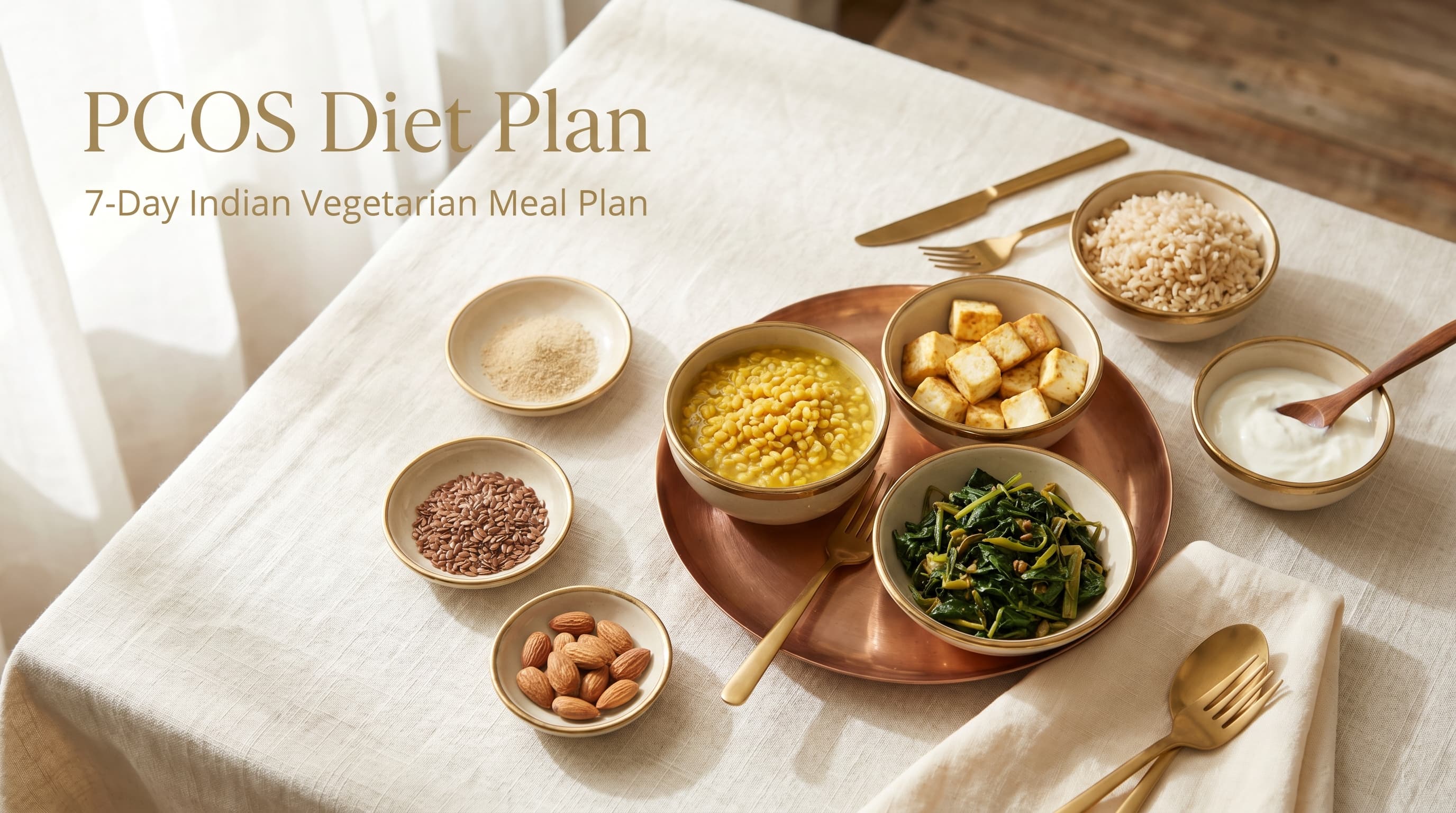
A 7-day PCOS diet plan on Indian vegetarian food, built to lower insulin and support fat loss without crash dieting. Grocery list, swap chart, what to avoid.
Take it with you
Save this 7 day PCOS plan as a PDF or print it for the fridge. The meals, the grocery list and the swaps come through, the menus and adverts do not.
Quick answer: The best PCOS diet for Indian women is moderate-carb, high-protein (1.2-1.6g per kg body weight), high-fibre, with low-glycemic carbs (millets, whole grains, dal, not white rice or maida) and minimal sugar. Eat protein at every meal, pair carbs with fibre + fat, and don't skip meals. Strict keto, crash diets, and "no rice ever" rules backfire long-term. This 7-day vegetarian plan does all of it with normal Indian food.
If you've been told to "just lose weight" for PCOS, or handed a generic 1,200-calorie plan that ignored that you don't eat chicken and broccoli, this is the practical version that actually works. Built around what Indian women actually eat, refined across 100+ PCOS clients at YourTrainer.
The 5 PCOS Diet Principles (Before the Meal Plan)
1. Lower the insulin spike at every meal
~70% of women with PCOS have underlying insulin resistance per the 2023 International PCOS Guideline. Excess insulin tells your ovaries to make more androgens, which drive the acne, hair growth, and missed periods. Lowering post-meal insulin spikes is the single most important dietary lever.
How: protein + fibre at every meal, low-GI carbs over refined ones, and never eat carbs alone (idli with just sambar = spike; idli with sambar + paneer or egg = controlled).
2. Hit 1.2-1.6g protein per kg body weight
Most Indian PCOS clients eat 30-50g protein/day, far too low. Target ~80-100g for a 60-70 kg woman. Vegetarians can hit this with paneer, dal, Greek yogurt, tofu, soya, and (optional) eggs. See our protein guide for sources.
3. Don't fear carbs: choose better ones
"PCOS = no rice" is wrong and unsustainable. Switch most of your refined carbs to whole grains and millets, jowar, bajra, ragi, foxtail millet, brown rice, and keep portions sensible. Your body needs carbs for hormone production.
4. Add specific PCOS-supportive foods
- Flax seeds (1 tbsp/day): lignans help bind excess androgens
- Cinnamon (½ tsp/day): improves insulin sensitivity
- Spearmint tea (1-2 cups/day): small studies show modest androgen reduction
- Inositol (myo + d-chiro, 4g/day): evidence-backed PCOS supplement; discuss with your doctor
- Vitamin D (most Indians are deficient): test and supplement to keep blood levels above 30 ng/mL
5. Don't crash-diet
Severe calorie restriction worsens PCOS, it raises cortisol, lowers thyroid hormones, and crashes periods. Aim for a modest 300-500 kcal deficit. Use our calorie calculator for your exact maintenance.
Foods to Eat / Limit / Avoid
| Eat freely | Eat measured | Limit / Avoid |
|---|---|---|
| Spinach, methi, palak, lauki, karela, bhindi, cabbage | Brown / red / hand-pounded rice (½ katori/meal) | White rice in large portions |
| Paneer, tofu, Greek yogurt, dahi | Jowar, bajra, ragi roti (1-2/meal) | Maida (naan, kulcha, biscuits, kachori) |
| Moong dal, chana dal, masoor dal, rajma, sprouts | Banana, mango (half-portion with protein) | Fruit juice (any kind) |
| Eggs (if you eat them) | Almonds, walnuts (8-10/day) | Sugary chai, sweetened lassi, coke |
| Apple, pear, guava, papaya, berries | Ghee, mustard oil, peanut oil (1-2 tbsp/day) | Burfi, jalebi, kheer, gulab jamun |
| Flax, chia, sesame, pumpkin seeds (1 tbsp/day) | Cheese, butter (small amounts) | Packaged snacks, namkeen, chips |
The 7-Day Indian Vegetarian PCOS Meal Plan
~1,600-1,800 kcal, ~90g protein. Adjust portions to your calorie + macro targets. Vegetarian throughout; add 1-2 eggs daily if egg-friendly (boosts protein by ~12g).
Monday
- Wake (7 AM): warm water + 1 tsp methi seeds soaked overnight
- Breakfast (8 AM): 2 besan chilla + 100g paneer bhurji stuffing + mint chutney
- Mid-morning: 1 katori dahi + 1 tbsp flax + 8 almonds
- Lunch: 1 katori brown rice + moong dal + palak paneer + cucumber raita + green salad
- Snack: 1 fistful roasted chana + spearmint or green tea
- Dinner: 2 jowar roti + bhindi sabzi + 100g tofu/paneer + dahi
- Bedtime: 1 cup warm milk with ½ tsp cinnamon (optional)
Tuesday
- Breakfast: vegetable poha (peanuts + curry leaves) + 1 boiled egg or 30g paneer
- Mid-morning: 1 apple + 1 tbsp peanut butter
- Lunch: 2 atta roti + rajma + cabbage-carrot sabzi (cooked) + dahi
- Snack: sprouted moong chaat (1 katori) + lemon
- Dinner: khichdi (moong + brown rice 1:1) + ghee + curd + sliced beetroot
Wednesday
- Breakfast: 2 idli + sambar + coconut chutney + 1 tsp ghee on top + 1 boiled egg or paneer side
- Mid-morning: Greek yogurt + chia + cinnamon
- Lunch: red rice (1 katori) + chole + cucumber-onion salad
- Snack: roasted makhana (1 katori, dry-roasted in ghee + black salt)
- Dinner: 2 ragi roti + methi-aloo (limit aloo to 1 small) + curd
Thursday
- Breakfast: oats porridge (½ katori) in milk + chia + cinnamon + 5 almonds
- Mid-morning: 1 pear + 5 walnuts
- Lunch: 2 bajra roti + masoor dal + lauki sabzi + dahi
- Snack: whey/pea protein shake in unsweetened almond milk OR 1 katori Greek yogurt + 1 tbsp flax
- Dinner: paneer tikka (5 pieces) + grilled vegetables + 1 small jowar roti
Friday
- Breakfast: vegetable upma (broken wheat or millet rava) + 1 boiled egg or 30g paneer + tomato chutney
- Mid-morning: 1 katori sprouts chaat with lemon + 1 amla
- Lunch: millet pulao (foxtail) + raita + green salad + 100g paneer cubes
- Snack: 2 dates + 8 almonds + green tea
- Dinner: 2 jowar roti + chole + sautéed methi + curd
Saturday
- Breakfast: moong dal cheela + paneer stuffing + green chutney
- Mid-morning: 1 guava + 1 tbsp peanut butter
- Lunch: brown rice biryani (vegetable + paneer), 1 plate, no more, with raita and salad
- Snack: 2 khakhra with hummus or curd dip
- Dinner: vegetable soup + grilled paneer + sautéed greens
Sunday (planned-treat day)
- Breakfast: 2 dosa + paneer bhurji stuffing + chutney
- Mid-morning: seasonal fruit bowl
- Lunch: Sunday thali, 1 katori rice + dal + 2 sabzis + raita + 1 small piece sweet (this is your weekly buffer)
- Snack: coconut water + 1 fistful peanuts
- Dinner: light khichdi + ghee + curd + papad
PCOS, coached
PCOS responds to the same few habits, done every week: strength training, protein at each meal and steady sleep.
Our women's coaches and clinical nutritionist build that week around your cycle, your cravings and Indian food, online, alongside your gynaecologist.
Start Your Journey →Start from here:PCOS coaching·For Indians in the USA
PCOS Grocery List (Bangalore Kitchen)
- Grains: brown basmati, red rice, foxtail millet, ragi flour, jowar flour, bajra flour, whole atta
- Pulses: moong dal, chana dal, masoor dal, rajma, chickpeas, sprouted moong
- Dairy: full-fat paneer, Greek yogurt (Epigamia, Nestle a+), full-fat milk
- Seeds: flax (essential), chia, sesame, pumpkin
- Nuts: almonds, walnuts, peanuts
- Fats: ghee, cold-pressed groundnut or mustard oil, virgin coconut oil
- Vegetables: spinach, methi, palak, cauliflower, broccoli, lauki, bhindi, beans, cabbage, beetroot
- Spices: cinnamon, turmeric, methi seeds, jeera, mustard seeds
- Tea: spearmint (Tulsi or imported brand), green tea
What to Avoid (and Why)
- Sugary chai with sugar: 2 cups/day = ~80 kcal of pure sugar, spikes insulin every time. Switch to ½ tsp jaggery max, or unsweetened.
- Fruit juice, even fresh: a glass = 4 oranges' sugar with no fibre. Eat whole fruit.
- Maida items: naan, biscuits, samosa, kachori, pav, fast insulin spikes.
- "Diabetic" / "sugar-free" packaged snacks: usually still maida + artificial sweeteners that maintain insulin response.
- Excessive dairy if you have acne: some PCOS women see acne improve on a 6-week dairy-light trial. Optional, test it.
- Soya in excess: small amounts fine; large daily intake can affect thyroid in some women.
Combine With Exercise (Critical)
Diet alone produces ~40% of possible PCOS improvement. Adding strength training 3x/week + 8,000+ daily steps + 2 yoga sessions covers the rest. See our full PCOS workout plan, designed to pair with this diet.
Frequently Asked Questions
How long until I see results?
Energy and bloating improve within 2 weeks. Period regularity typically takes 2-4 months. Visible body change at 3-6 months. PCOS is a long game.
Can I follow this diet if I'm on Metformin?
Yes, and it works synergistically with Metformin (both improve insulin sensitivity). Always coordinate medication changes with your endocrinologist.
What if I have lean PCOS (normal weight)?
The same principles apply. You may not need a calorie deficit, just maintenance with strong protein, low-GI carbs, and the PCOS-supportive foods. Strength training matters even more for lean PCOS.
Is keto good for PCOS?
Short-term keto can dramatically lower insulin and help symptoms, but most Indian women can't sustain veg keto past 6-8 weeks, and regain is common. A moderate-carb, high-protein approach (like this plan) gives 80% of the benefit at 100% sustainability.
Can I drink alcohol?
Occasionally, with food, in modest amounts (1 glass wine/beer 1-2x a week max). Alcohol worsens insulin sensitivity and hormonal balance.
What about pre-workout / post-workout?
Pre: half banana + 10 almonds 30-45 min before. Post: protein-rich meal within 1-2 hours (the planned meal is fine).
Want a Plan Built for Your Body?
This 7-day template works for most women. For a plan tailored to your specific weight, AMH, fasting insulin, food preferences, and schedule, that's our PCOS coaching programme. Or start with a ₹499 trial, we'll review your reports, adjust this plan to your numbers, and tell you honestly whether you need full coaching or can run this on your own.
PCOS isn't a "lose weight and it'll go away" problem. It's a metabolic and endocrine condition that responds beautifully to the right inputs. This diet is one of the most powerful ones, pair it with strength training, sleep, and stress management and the results compound over 6-12 months.
📚 More from YourTrainer
Pair this diet with the right training
- PCOS Workout Plan for Indian Women (4-week home routine), designed to pair with this diet
- Thyroid Diet Plan for Indian Vegetarians, sister condition
- Diabetes Management: 7-Day Indian Veg Diet Plan
- Indian Food Calories Chart, 60 Common Dishes
- Indian Protein Sources (how to hit 90g+ as a vegetarian)
Set your numbers
Want a coach to personalize it?
- Coach Nancy, Women's Health & PCOS Specialist at YourTrainer
Certified Nutrition Coach · Working with Indian women at YourTrainer
Sources
- High prevalence of metabolic obesity in India: the ICMR-INDIAB national study · Indian Journal of Medical Research
- Healthy diet · World Health Organization
- Nutrient Requirements for Indians (RDA and EAR) · ICMR, National Institute of Nutrition
Figures for Indian foods follow IFCT 2017 (ICMR-NIN). Coaching guidance on this site is educational and is not a substitute for medical advice. See how we use sources.
Did you find this helpful?
About Coach Nancy
Coach Nancy coaches YourTrainer members live on video and in Bengaluru, with training and Indian-food nutrition plans built around each member's week and reviewed with Coach Anish. Read the YourTrainer story for how the team works.
Online 1-on-1 Coaching
Start Your Journey
Get a personalised training + Indian nutrition plan built around your goal, coached online, anywhere in India or abroad.
Trusted by 1,000+ clients coached across India & abroad
Free 30-min discovery call · No obligation