
1. Why fat loss is different for Indians
Open any Western fat loss book and the advice looks identical: calorie deficit, protein, lift weights, sleep. All true. But Indians who follow it word-for-word still fail at a higher rate than the people the book was written for. There are three real reasons, and once you know them, every recommendation in this guide makes more sense.
1 in 5
Indian women have PCOS: most fat loss programs ignore this
75%
of urban Indians are vitamin D deficient: silently stalling fat loss
2x
protein per kg needed in fat loss vs typical Indian intake
One: South Asian insulin resistance is real. Research from the Madras Diabetes Research Foundation and AIIMS shows Indians develop Type 2 diabetes at significantly lower BMIs than Europeans, sometimes at BMI 24, well within the "normal" Western range. This means our carb tolerance is genetically lower, and fat storage in the belly is easier. The WHO recognized this in 2004 and lowered the Asian-Indian BMI thresholds (overweight at 23, obese at 25, see our BMI Calculator India).
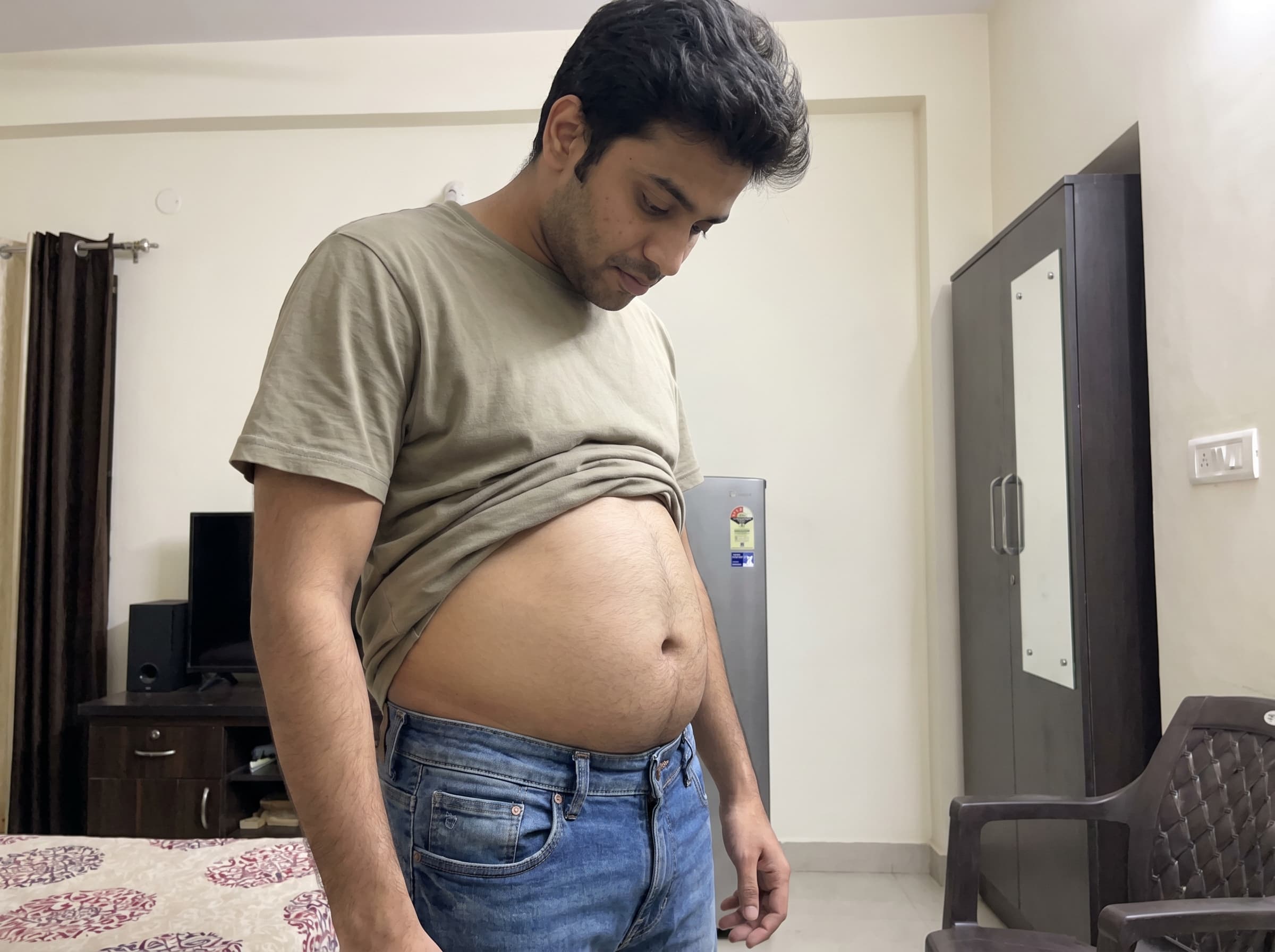
Two: visceral fat distribution. At the same body weight, Indians carry more fat around the organs (visceral) and less under the skin (subcutaneous) than Europeans. This is the dangerous fat: it sits around your liver, pancreas, and intestines, and drives inflammation, insulin resistance, and cardiovascular disease. It's also why an Indian with a "normal" BMI can be metabolically obese.
Why Indian Belly Fat is More Dangerous
Not all belly fat is the same
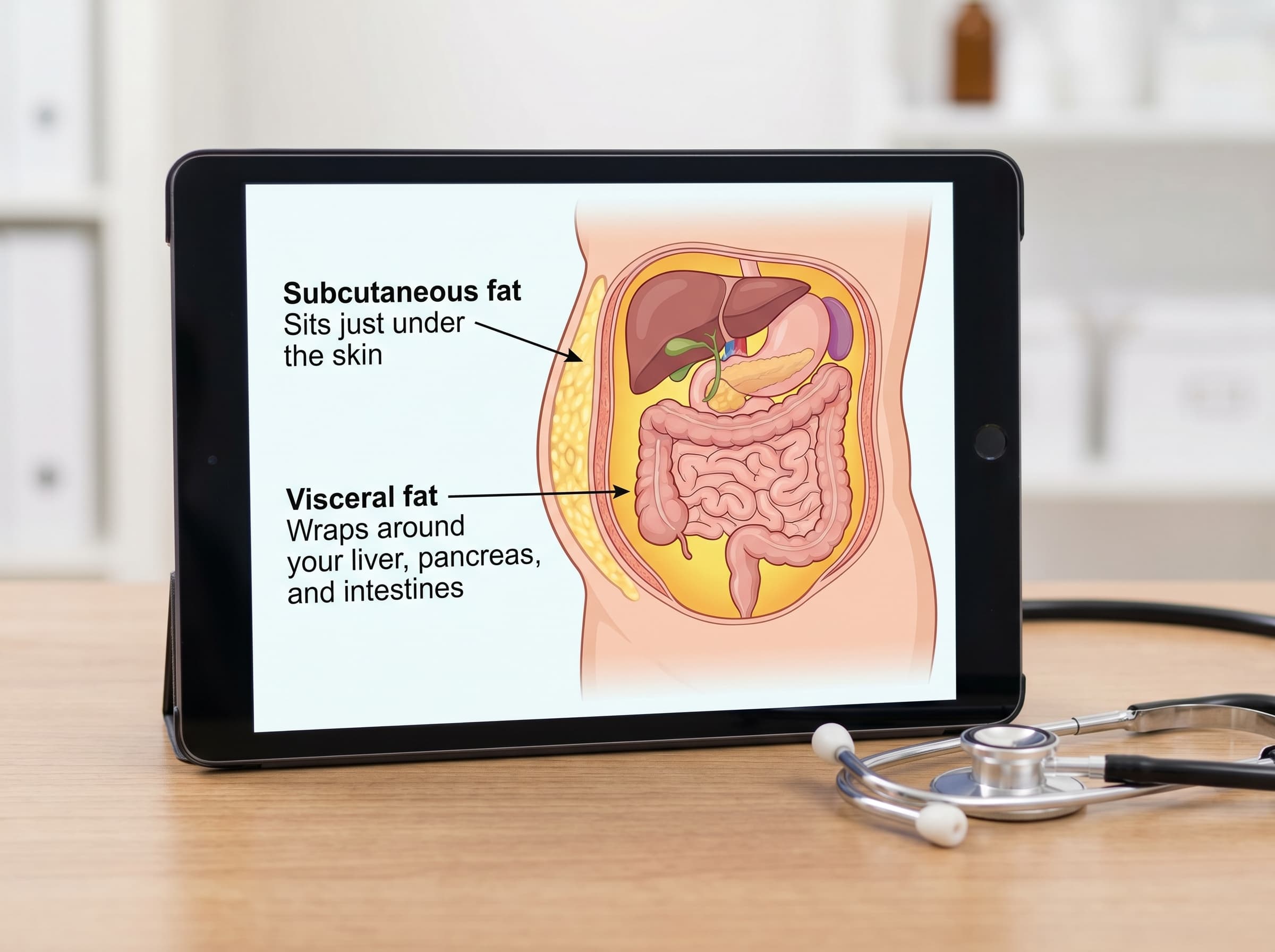
Anatomy view
Subcutaneous fat sits under the skin · Visceral fat wraps the organs
Subcutaneous fat
LESS DANGEROUSSits just under the skin: what you can pinch with your fingers. Aesthetically annoying but metabolically less harmful. This is most of the fat on hips, thighs, and arms.
Visceral fat
HIGH RISKWraps around your liver, pancreas, and intestines. Drives insulin resistance, Type 2 diabetes, fatty liver, and cardiovascular disease. Indians genetically store more of this at lower BMIs than Europeans.
The key number: waist circumference predicts diabetes and heart disease risk better than BMI for Indian bodies. Measure your waist, that's the number that matters most.
Three: the traditional Indian diet is carb-dominant and protein-poor. A typical idli-dal-rice-roti-biscuit day for an average Indian adult delivers around 50-60g of protein. The protein requirement for fat loss with muscle retention is 1.8-2g per kg of body weight: for a 70 kg adult, that's 125-140g. So the average Indian eating their normal cultural diet is at half the protein they need. This isn't a moral failing of Indian food: it's just what dietary patterns evolved around (rice + dal as a complete protein, but in quantities calibrated for agricultural workers, not desk-bound IT employees).
These three factors compound. A 35-year-old Bengaluru IT professional eating a normal Indian diet has lower carb tolerance, more visceral fat, and insufficient protein: three forces pushing toward fat gain and away from fat loss simultaneously. Solving this requires Indian-specific programming, not Western templates.
2. The calorie math (and why everyone gets it wrong)
The first thing to understand: fat loss is caused by a calorie deficit, eating less than you burn, over a sustained period of weeks. There is no diet, no exercise plan, no supplement, no miracle that overrides this. Keto, intermittent fasting, paleo, vegan: every approach that works, works because it creates a deficit. Every approach that fails, fails because it didn't create a sustained deficit.
So the question becomes: what's your deficit number? Use our Calorie Calculator India to get a personalized estimate. The math:
- BMR (Basal Metabolic Rate): Calories you burn at complete rest. Calculate using the Mifflin-St Jeor formula (the most accurate for Indians per recent validation studies).
- TDEE (Total Daily Energy Expenditure): BMR × activity multiplier (1.2 for sedentary, 1.375 light, 1.55 moderate, 1.725 very active).
- Fat loss target: TDEE minus 500 kcal/day. That's a ~3,500 kcal weekly deficit, or 0.4-0.5 kg of fat loss per week.
The Calorie Math (Visual)
The sweet spot: 500 kcal below maintenance. Faster deficits work short-term but cost muscle, hormones, and lead to rebound. Slow is the only sustainable path.
For most sedentary Indian adults, fat loss targets land in these ranges:
- Sedentary woman, 25-40 years: ~1,400-1,700 kcal/day for fat loss
- Lightly active woman: ~1,600-1,900 kcal/day
- Sedentary man, 25-40 years: ~1,800-2,100 kcal/day
- Lightly active man: ~2,000-2,400 kcal/day
The single biggest mistake Indians make with calorie counting: overestimating their activity level. If you go to the gym 3x/week but otherwise sit at a desk, take cabs, take elevators, and walk less than 5,000 steps/day: you are lightly active, not moderately active. Pick the lower category for your first 2 weeks. If your weight isn't dropping after 14 days, drop another 100-150 kcal. Adjust based on real-world results, not categories you wish were true.
The second biggest mistake: under-counting what you eat. Indian portions are visually deceptive, "one katori" of dal is anywhere from 150 to 350g depending on who's serving it. A "handful" of nuts is 100-300 calories. A "tablespoon" of ghee in your roti is often 2 tablespoons. For the first 2-3 weeks, weigh your food on a kitchen scale (₹500 on Amazon). After 2-3 weeks you'll have an intuition for portions and you can stop weighing.
3. Protein: the non-negotiable
If you skip every other piece of advice in this guide and only do one thing, eat more protein. Higher protein during fat loss is the single most important variable for keeping the weight off and looking good after.
Two people both lose 8 kg in 12 weeks. Person A ate 60g protein per day. Person B ate 140g per day. Person A's weight loss: ~4.5 kg fat + 3.5 kg muscle. Final body: smaller but soft, weaker, lower metabolism. Person B's weight loss: ~7.5 kg fat + 0.5 kg muscle. Final body: tighter, stronger, higher metabolism for the next cycle. Same calories. Different outcomes.
Protein targets for fat loss:
- Minimum: 1.6g per kg of body weight
- Optimal: 1.8-2.0g per kg of body weight
- Upper end (athletes, advanced): 2.2g per kg
Protein in Indian Food (per realistic serving)
Roti and rice are not protein sources (grey). The protein comes from dal, paneer, eggs, curd, sprouts, chicken, soya, whey. Build every meal around one of these.
For a 70 kg adult, that's 110-150g of protein per day. The detailed Indian protein playbook is in this myth-busting article. The short version: paneer (18g/100g), dal (12g/katori), curd (8g/cup), eggs (6g each), chicken (31g/100g for non-veg), soya chunks (26g/50g dry), and whey if needed (24g/scoop). Build every meal around a protein anchor, then add carbs and fat.
The protein-kidney myth is dead. We've published a full breakdown of 30 years of research : high protein intake does not damage healthy kidneys. Your nani is wrong, but lovingly. Don't let it stop you.
4. Carbs are not the enemy
The keto-paleo crowd will tell you Indian carbs are killing you. They're wrong, and they're especially wrong for active Indians. Roti, rice, dal, oats, fruit, sweet potato, regular potato: all fine. The real culprits are refined carbs (sugar, sweets, biscuits, white bread, fried snacks, sugar-sweetened drinks). The category "carbs" is too broad to be useful.
Carbs fuel high-intensity training, restore muscle glycogen, support thyroid and reproductive hormone function, and frankly make eating tolerable for 12+ weeks. Cutting them aggressively during fat loss usually backfires: you crash energy by week 3, your training quality drops, your hunger spikes, and your cortisol rises.
The smart approach for Indians:
- Time your carbs around training (more on training days, less on rest days)
- Choose whole-food sources: brown rice, millet roti, oats, fruit, dal, sweet potato
- Limit refined sources to 10-15% of total carb intake
- Don't fear roti or rice, they're fine in calorie-appropriate portions
The honest truth: most Indians do fine on 150-250g of carbs per day during fat loss. Going lower (sub-100g keto-style) works for some but is unnecessary and often unsustainable.
5. Fat: the most-feared, most-misunderstood macro
The 1990s low-fat era did a number on Indian nutrition advice. People still believe that ghee, coconut oil, and ghani-pressed oils are evil. Total fiction. Dietary fat is essential for hormone production (testosterone, estrogen, progesterone), vitamin absorption (A, D, E, K), and satiety. Cutting it too low during fat loss often crashes sex hormones, energy, and mood within 4-6 weeks.
Target: ~20-30% of total calories from fat. For a 1,800 kcal fat loss day, that's 40-60g of fat. Sources we recommend for Indians:
- Ghee in moderation (1-2 teaspoons/day): adds flavor, fat-soluble vitamins, satisfies the cultural palate
- Cold-pressed mustard, groundnut, or sesame oil: high in monounsaturated fats, traditional Indian
- Whole eggs: egg yolk is the most maligned food in modern nutrition; it's fine
- Nuts and seeds: almonds, walnuts, flax, chia, sunflower (see our guide to Indian seeds)
- Fatty fish if non-veg: rohu, salmon, mackerel for omega-3s
Limit refined oils (refined sunflower, refined soybean) and trans fats (vanaspati, hydrogenated oils, deep-fried snacks). These drive inflammation and are the actual fat villains, not ghee.
6. Building an Indian fat loss day (full template)
Here's a realistic 1,800 kcal Indian fat loss day for a 70 kg active adult. ~140g protein, ~180g carbs, ~50g fat. Vegetarian (egg-veg). Adjust portions up or down based on your calculated target.
A 1,800 kcal Indian Fat Loss Day, Macro Split
Protein
140g · 31% of kcal
Carbs
180g · 40% of kcal
Fat
50g · 25% of kcal
Breakfast, 7:30 AM
3-egg paneer chilla (3 eggs + 50g paneer + besan): ~30g protein, ~380 kcal
Hits protein hard, anchors the day, keeps you full till 11 AM.
Mid-morning, 11 AM
1 cup curd + 1 fruit (apple/orange): ~12g protein, ~180 kcal
Hunger control + micronutrients.
Lunch, 1 PM
1 katori dal + 2 rotis + 1 katori sabzi + small salad: ~25g protein, ~550 kcal
The Indian thali, calibrated. Add 1 katori curd for extra protein.
Pre-workout, 4 PM
1 cup black coffee + 1 small banana: ~110 kcal
Energy for training without spiking insulin too high.
Post-workout, 7 PM
1 scoop whey + water (or 1 katori chana): ~24g protein, ~120 kcal
Fast protein for muscle recovery.
Dinner, 8:30 PM
100g paneer bhurji + 1 roti + 1 katori veg curry: ~35g protein, ~460 kcal
Slow protein for overnight recovery.
Daily total: ~1,800 kcal, ~140g protein, ~180g carbs, ~50g fat. Every meal has protein. No starvation. Tastes like Indian food, because it is.
Non-veg swap: replace dinner paneer with 120g grilled chicken (32g protein). Vegan swap: paneer → tofu or soya chunks; curd → coconut curd; whey → pea protein.
7. Training: why strength beats cardio for fat loss
The #1 misconception in Indian fat loss culture: more cardio = more fat loss. Wrong. Cardio burns calories during the session and stops. Strength training burns calories during the session AND builds muscle that burns more calories every day for the next year. The compounding favors weights, not running.
Minimum effective dose for fat loss training:
- 3 strength sessions per week: 45-60 minutes each. Full-body or upper/lower split.
- 8,000-10,000 steps daily: daily walking is far more useful than 1 hour of running 3x/week
- Optional: 1-2 cardio sessions per week: for heart health, not fat loss directly
Core strength exercises every fat loss program needs:
- Squat (or split squat / leg press variation)
- Deadlift (or Romanian deadlift / hip hinge)
- Push movement (push-up, bench press, overhead press)
- Pull movement (pull-up, row, lat pulldown)
- Carry / core (farmer carry, plank, hanging knee raise)
Progress these every week by either adding 1-2 reps or 2.5 kg of weight. This is "progressive overload", the engine of physical change. Without it, you can train 5x/week for a year and look the same.
8. Women, PCOS, and hormonal fat loss
Roughly 1 in 5 Indian women have PCOS, Polycystic Ovary Syndrome. It's the single most common driver of stalled fat loss in women under 40. Generic fat loss advice fails for PCOS women because:
- Insulin resistance is severe, high-carb meals spike insulin and fat storage harder
- Inflammation is elevated, over-training pushes cortisol up and worsens symptoms
- Androgen excess affects body fat distribution (more belly fat)
- Cycle irregularity makes calorie/water/hunger highly variable across the month
PCOS-specific adjustments:
- Lower carbs slightly (40-45% of calories vs 50-55% for non-PCOS): not keto, just lower
- Strength train 3x/week, NOT cardio 6x/week: high cardio elevates cortisol
- Adequate protein 2-2.2g/kg (preserves muscle, supports hormones)
- Strategic supplements: inositol, vitamin D, magnesium, omega-3 (evidence-backed)
- Sleep 7-9 hours, non-negotiable for PCOS hormonal balance
- Track cycle, expect 5-7 day water fluctuations around period
If you have PCOS, our PCOS coaching program is built around this framework. The reason generic gyms fail PCOS women: programming designed for non-PCOS bodies, no hormonal awareness, calorie targets that are too aggressive.
9. Men: visceral fat and the Indian body type
The classic Indian male body type: arms and legs look okay, but the belly is rounded. That's visceral fat: fat around organs, the most dangerous kind. Indian men accumulate it earlier and faster than European men because of the genetic factors covered in section 1.
Targeting belly fat for Indian men:
- You cannot spot-reduce belly fat, crunches don't burn belly fat. Full stop.
- What works: overall calorie deficit + strength training + 8,000+ daily steps
- Belly is often the LAST fat to leave (frustratingly). Be patient through weeks 6-10.
- Alcohol is the single biggest belly-fat saboteur for Indian men, even 2 drinks/week stalls visible progress
- Late-night meals (post 10 PM) drive belly fat retention more than the calories alone
The honest truth: getting from "dad bod" to "flat stomach" for an Indian man typically takes 6-9 months of disciplined work. Visible abs require body fat under 12-13%, that's a serious commitment. Most Indian men should target "flat" (15-18% body fat) first, then decide if they want abs.
10. Sleep, stress, and the cortisol problem
You can't out-train bad sleep. After two nights of 5-hour sleep, your hunger hormones (ghrelin up, leptin down) push you to eat 300-500 extra calories the next day. Your insulin sensitivity drops by 20-30%. Your training quality crashes. Your cortisol stays elevated, which directly drives belly fat retention.
Indian work culture (long commutes, late dinners, screen time, family obligations) makes consistent sleep harder than it needs to be. But this is the single highest-ROI lifestyle change for fat loss after calorie deficit and protein. Target 7-9 hours per night, consistently.
Practical sleep fixes:
- No screens 60 min before bed (the hardest one, the most impactful)
- Bedroom temperature below 24°C (run the AC if needed)
- No caffeine after 2 PM (chai included, Indians underestimate caffeine sensitivity)
- Heavy meals 3+ hours before bed
- Wake up at the same time every day, even weekends
- 10 min of breathwork or simple meditation before sleep
11. Supplements: 3 that work, 20 that don't
The Indian supplement industry sells you 20 things you don't need. Here's the honest, evidence-backed list of what actually helps Indian fat loss:
Worth taking (evidence-strong):
- Vitamin D3: 75% of urban Indians are deficient (avoid sun, dark skin). 2,000-4,000 IU/day. Get tested first.
- Whey or pea protein: if you can't hit protein from food (most can with effort)
- Creatine monohydrate: 3-5g/day. Improves training output, modest but real fat loss benefit. Safest, most-studied supplement in the world.
Worth considering for specific cases:
- Omega-3 (fish oil or algal): if you don't eat fatty fish 2+ times/week
- Multivitamin: bridges nutritional gaps, especially for vegans and restrictive diets
- Inositol (myo + d-chiro): evidence-backed for PCOS
- Magnesium glycinate: sleep aid + muscle recovery
Skip (waste of money or actively harmful):
- Fat burners / thermogenics: overpriced caffeine + green tea extract. Skip.
- BCAAs: useless if your protein intake is already adequate (which it should be).
- Detox teas, "cleanse" products, weight loss potions: total scam category.
- CLA, raspberry ketones, garcinia cambogia: popular, ineffective.
- Pre-workout megamixes: black coffee does 90% of the same thing.
The supplement industry profits from confusion. The honest framework: supplements supplement a good diet. They cannot replace one. Food first.
12. How to track without obsessing
Tracking what you eat is essential for the first 2-4 weeks. After that, your goal should be tracking less, not more. Lifestyle is the actual long game.
Weeks 1-4, Full tracking:
- Use HealthifyMe or MyFitnessPal, both have Indian food databases
- Weigh food on a kitchen scale (the only honest way for Indian portions)
- Log everything for 14-28 days
- Take weekly photos (front, side, back): they show progress the scale hides
- Weigh yourself daily at the same time, average across the week: daily scale is misleading
- Measure waist circumference weekly
Weeks 5-12, Eyeball tracking:
- You'll know what 30g of protein looks like by now
- Log only on days when food is unfamiliar (restaurants, travel)
- Weekly weight + waist check + photo continues
Post-program, Lifestyle mode:
- No app logging
- Weekly weight + waist check (early-warning system)
- If weight creeps up 2 kg over baseline, return to 4 weeks of tracking
The endgame: intuitive eating with strong food awareness. Not lifelong calorie counting. Calorie counting is a temporary education tool.
13. 7 fat loss myths Indians still believe
- "Rice causes weight gain." Wrong. Excess calories cause weight gain. Calorie-appropriate rice is fine.
- "Ghee will give you cholesterol." Wrong. Modern research has rehabilitated saturated fats, refined oils and sugar are the actual cardiovascular villains.
- "Lemon water in the morning burns fat." Wrong. Pleasant ritual, zero fat loss effect.
- "Don't eat after 6 PM / 7 PM / 8 PM." Wrong. Total daily calories matter. Late-night meals are only a problem if they push you over your daily target.
- "Cardio is the best way to lose fat." Wrong. Strength training beats cardio for body composition.
- "Weight loss should be fast." Wrong. Anything above 0.7 kg/week typically includes muscle loss.
- "Skipping meals helps with weight loss." Wrong. Skipping often leads to overeating later. Spreading calories across the day with high protein works far better.
14. The 8-week plateau (and how to break it)
Almost every fat loss program hits a stall around weeks 6-10. The scale stops moving, motivation drops, people quit. Here's why it happens and how to push through.
Why plateaus happen:
- As you lose weight, your TDEE drops (smaller body needs fewer calories)
- Your body adapts and burns slightly fewer calories at rest (metabolic adaptation, real but small)
- Your tracking accuracy decays, you start "eyeballing" portions slightly bigger than you think
- Activity drops subconsciously (NEAT, Non-Exercise Activity Thermogenesis)
- Water retention from training adaptations masks fat loss for 1-2 weeks
How to break the plateau:
- Re-tighten tracking for 7 days. Weigh everything. Most plateaus are tracking creep.
- If tracking is honest and weight is genuinely stuck, drop calories by 100-150 kcal/day.
- Add 1,000-2,000 daily steps (NEAT boost without raising hunger).
- Consider a 7-10 day "diet break" at maintenance calories, sometimes the body needs a hormonal reset.
- Don't crash diet. 1,200 kcal sustained → muscle loss, hormone disruption, rebound.
The plateau is normal. People who push through it lose the next 5 kg. People who quit go back to baseline within 6 months.
15. The 12-week fat loss roadmap
If everything in this guide felt overwhelming, here's the simplified 12-week version:
The 12-Week Fat Loss Timeline
- 1
Week 1-2: Setup
-0-1 kgCalculate, scale, baseline photos
- 3
Week 3-4: Initial drop
-2-4 kgWater + glycogen, 2-4 kg fast loss
- 5
Week 5-8: Steady state
-2-3 kgReal fat loss at 0.4-0.6 kg/week
- 9
Week 9-10: Plateau zone
-0-0.5 kgScale stalls. Re-tighten. Push through.
- 11
Week 11-12: Finish
-1-2 kgFinal push. Lock in habits.
Realistic total: 6-9 kg in 12 weeks. Anyone promising 15 kg in 12 weeks is selling muscle loss + rebound.
Week 1-2, Setup
- • Calculate your calorie + protein targets (use our calculators)
- • Buy a kitchen scale. Start logging on HealthifyMe.
- • Set up your weekly training: 3 strength sessions, 8K daily steps
- • Take baseline photos, weight, waist measurement
Week 3-4, Execution
- • Hit calories + protein daily. Don't miss training sessions.
- • Sleep 7+ hours consistently
- • Expect 2-4 kg drop (water + early fat), DO NOT mistake this for ongoing rate
Week 5-8, Steady state
- • Real fat loss kicks in at 0.4-0.6 kg/week
- • Progressive overload in the gym, add weight or reps weekly
- • Stop logging if eyeball tracking feels accurate
Week 9-10, The plateau zone
- • Scale stalls. This is normal. Re-tighten tracking, adjust calories down 100-150.
- • Push past, the next 4 weeks are the highest-yield phase if you don't quit
Week 11-12, Finish strong
- • Final push. Tighten food choices, prioritize sleep, keep training
- • Final measurements + photos + weight
- • Plan the transition: move to maintenance calories, lower training to 2x/week if needed
What 12 weeks of this plan builds: fat loss at the rate your deficit allows, muscle retained or modestly gained, a smaller waist, better energy and sleep, and a foundation for the next cycle. Results vary with starting point and consistency.
This is the cycle our personal training program runs with every new client. The above is the playbook. If you can execute it solo, you don't need us. If you need someone designing the plan, watching your form, and calling when you skip: that's what we sell.
Tools and reads referenced in this guide
- Calorie Calculator India
- Macro Calculator India
- BMI Calculator India
- Ideal Weight Calculator
- Indian Protein Myths
- Protein Powder & Kidney Damage Myth
- Seeds: the Underrated Indian Superfood
- 5 High-Protein Indian Breakfasts
- PCOS Coaching Program
- 1-on-1 Personal Training
- Personal Trainer vs Cult.fit
- Personal Trainer vs Gym Membership