How to Actually Log Indian Food in a Calorie App
Calorie apps are built for single weighable items. Indian food is mixed, cooked in unseen oil, served in katoris. The four things to log, the rest to ignore.

Quick Answer
Calorie apps are built around single, weighable items, 100g chicken breast, one apple, two slices of bread. Indian food is mixed, cooked in oil you never see, and served in katoris nobody weighs. That mismatch, not your discipline, is why your log says 1,600 calories and the scale disagrees. The fix is not a better app. It is learning to log four things properly: the oil, the katori, the mixed dish, and the restaurant meal.
If your log shows far fewer calories than your plan, the gap is usually missing meals, not a fast metabolism: see why a food log says 900 calories when the plan says 1,650.
“My app says I am in a deficit, so the deficit must be wrong.” Almost always the deficit is real and the logging is not. Under-reporting of 20–40% is well documented in dietary-intake research, and Indian cooking makes it easier, not harder.
Why Generic Apps Fail on Indian Food
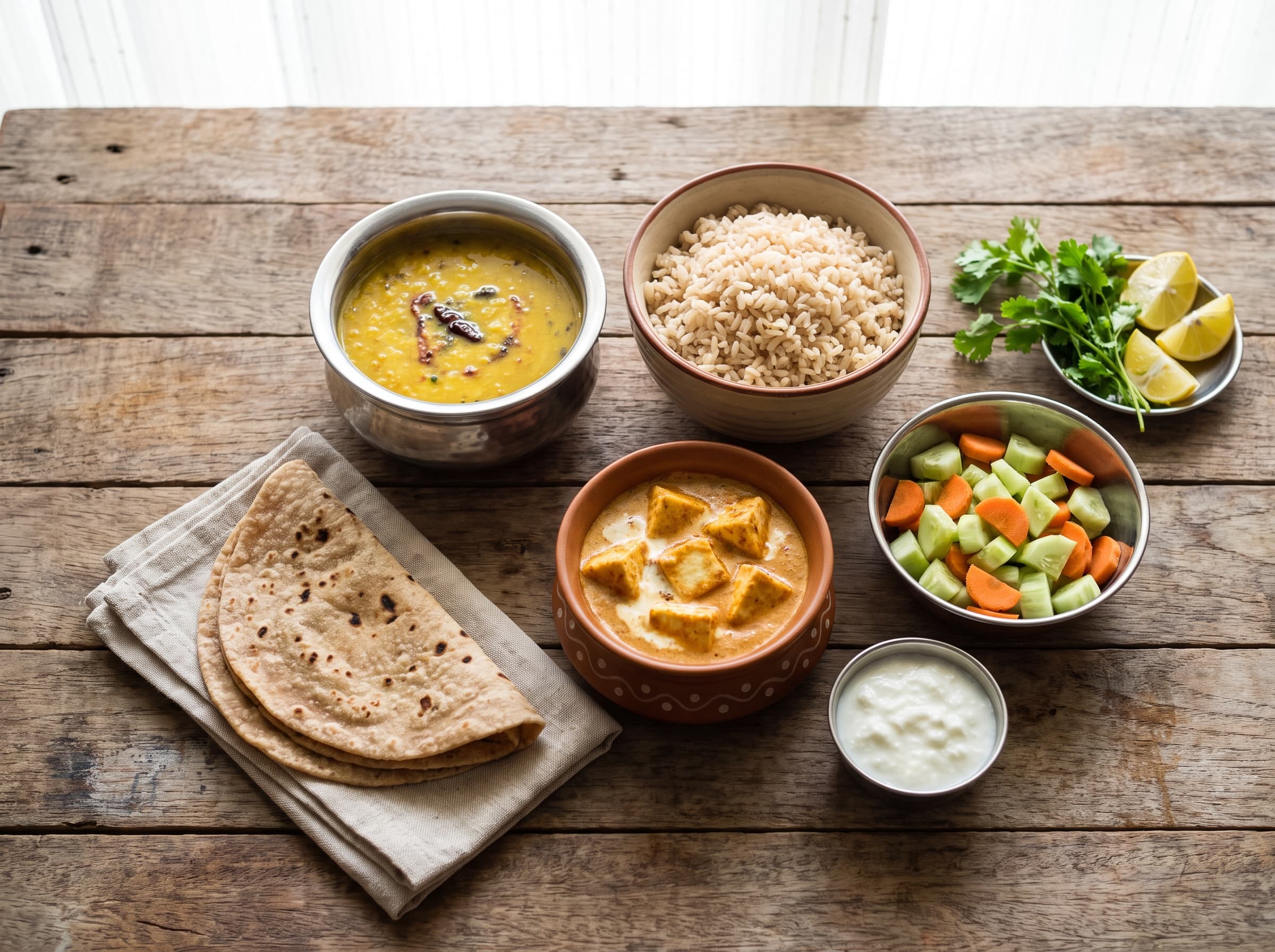
A Western food database assumes you eat components. Indian eating is combinations: dal that has been tempered, sabzi cooked in whatever oil the pan needed, rice served by hand into a bowl whose size nobody has ever measured. Every one of those is a place for calories to go missing.
The Four Things To Fix
Do not try to attribute oil per dish. Measure how much oil or ghee your household actually uses in a week, divide by the number of people and meals, and log that as a fixed daily entry. It is less precise per meal and far more accurate over a month, which is the timescale that matters.
Fill the bowl you actually use the way you actually fill it, and weigh the contents. Do it once for dal, once for rice, once for sabzi. Now “one katori” means a real number to you, and you can log by eye for months. See our katori and roti weights in grams for reference figures.
Rebuilding a rajma from its components takes four minutes and you will stop doing it by Thursday. Log it as one entry using a per-katori figure. Consistency beats precision: a slightly wrong number logged every day is far more useful than a perfect number logged twice.
A restaurant paneer butter masala and a home one share a name and very little else. Restaurant kitchens use far more oil, butter and cream because that is what makes it taste like a restaurant. Log outside meals generously rather than optimistically, see the Swiggy and Zomato calorie guide.
Coaching that does this for you
Reading is step one. A coach turns it into a plan built around your body, food & schedule.
100% online · Indian meal plans · weekly progress reviews · daily WhatsApp support.
Start Your Journey →What Actually Needs Logging: And What Does Not
| Log it carefully | Estimate it | Ignore it |
|---|---|---|
| Cooking oil and ghee | Sabzi and dal by katori | Green salad, cucumber, lemon |
| Rice and roti quantity | Curd and milk in tea | Spices, herbs, tadka leaves |
| Restaurant and delivery meals | Fruit | Black tea and coffee |
| Sweets, namkeen, packaged snacks | Paneer and egg portions | Water, buttermilk without sugar |
Four items, oil, grains, restaurant meals and snacks, account for the overwhelming majority of logging error in Indian diets. Get those four roughly right and you do not need to weigh a cucumber. People who try to log everything perfectly quit inside two weeks; people who log four things well are still doing it a year later.
Do You Even Need To Track Forever?
No, and the goal is to stop. Tracking is a calibration exercise, not a lifestyle. Most people need six to eight weeks of honest logging to learn what their normal portions actually cost them. After that, the estimates in your head are good enough, and you only return to logging when progress stalls or your routine changes.
If you are logging carefully and the scale still is not moving, the problem is usually one of the four above rather than your metabolism, we covered the common causes in why you are not losing weight in a calorie deficit.
Where an App With a Coach Differs
A database can tell you what a katori of rajma costs. It cannot tell you that your katori is unusually large, that you have been logging restaurant food at home-cooked values, or that the tadka you never mention is quietly adding 200 calories a day. That is a review problem, not a data problem, somebody has to read your week and spot the pattern.
YourTrainer Go is free to download on the App Store, and food logging is free to use, sign up and start tracking, no plan required. It is built around Indian eating: katoris, rotis and whole dishes rather than a database of Western single ingredients. If you later want somebody reading the log and telling you what is off, that is what the coaching plans add. Available on iPhone, iPad and Android.
Logging Indian Food Accurately
Your app is not lying to you and neither is the scale. Indian food is genuinely harder to log than the food these databases were designed for, and the gap hides in four predictable places. Fix the oil, weigh your katori once, log dishes whole, and treat restaurant meals as their own category. Six weeks of that teaches you more about your diet than a year of logging everything badly.
Go Deeper
- Indian Food Calories: Macro Chart for 60 Dishes
- Katori and Roti Portions in Grams
- How Accurate Is Your Fitness Tracker's Calorie Count?
- Free Indian Food Calorie Calculator
- Coach Anish, YourTrainer
Did you find this helpful?

About Anish Agarwal
Founder & Head Coach, YourTrainer · NASM & K11 Certified Personal Trainer · coaching since 2022
Featured in Dietitians.io, Fitness Interview, NRI Pulse. Press and media
Anish Agarwal is a NASM and K11 certified personal trainer coaching fat loss, body transformation, strength, and nutrition for clients across India since 2022. He founded YourTrainer to make expert, science-based coaching accessible online and in Bengaluru. Coach Anish's profile and the YourTrainer story.
Online 1-on-1 Coaching
Start Your Journey
Get a personalised training + Indian nutrition plan built around your goal, coached online, anywhere in India or abroad.
Trusted by 1,000+ clients coached across India & abroad
Free 30-min discovery call · No obligation