
Free Tool · 90+ Indian Foods
Indian Food Calorie Calculator
Build your actual plate: rotis, a katori of dal, sabzi, curd, whatever you ate. Get calories, protein and the macro split most Indian meals get wrong.
Quick answer
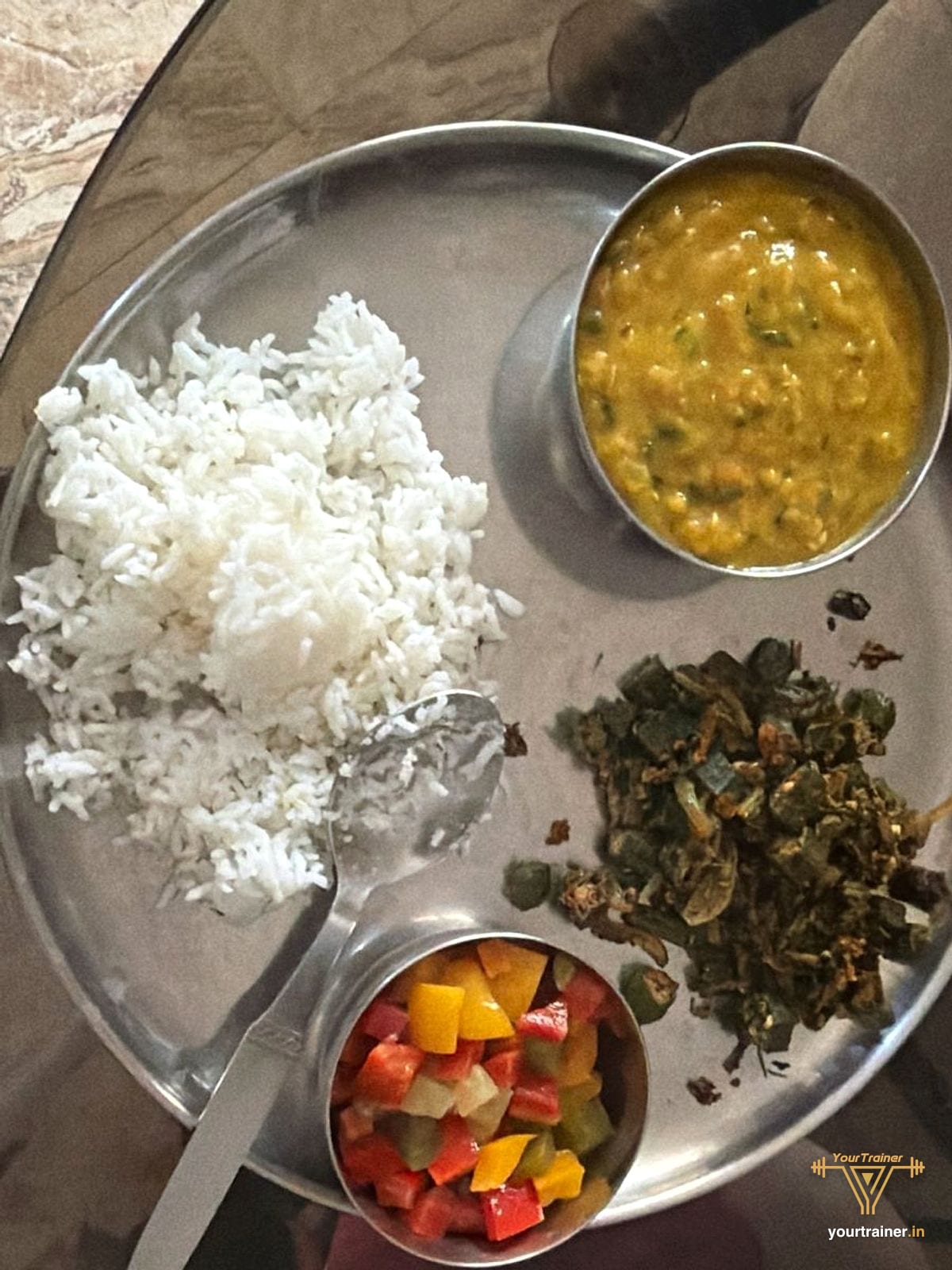
A standard home thali of 2 rotis, 1 katori dal, 1 katori sabzi and 1 katori curd is roughly 590 calories and 25 g protein. Add a katori of rice and it becomes about 785 calories.
That plate is about 11 percent protein by calories. For fat loss you want closer to 25 to 30 percent, which is why a katori of curd, sprouts or paneer changes the outcome more than cutting a roti does.
Your plate
Meal total
Reasonable protein share for an Indian meal. Most people benefit from pushing this higher at breakfast, which is usually the weakest protein meal of the day.
Start Your Journey →Turn the numbers into meals
Knowing the calories is the easy part. Eating to them through a normal Indian week is where most people slip.
A YourTrainer coach plans your week around the dal, roti, rice and sabzi you already eat, reviews your plate photos and adjusts every week. It runs fully online, so it works the same in Bengaluru or Boston.
Start Your Journey →Coached online, wherever you live:Online personal trainer in India·Coaching for Indians in the USA·Online coaching for NRIs
What a real day adds up to
Our members' food logs
1,532 kcal
median on a fully logged day
91 g
median protein on a fully logged day
375 kcal
median breakfast
467 kcal
median lunch
Source: A sample of member food logs from the YourTrainer app, 19 April to 17 September 2026. Members only, aggregated, each food logged by at least three members in the sample, using the app's food-database values for the portion logged
- Dinner29 g
- Breakfast24.6 g
- Lunch23 g
- Snack13 g
Source: A sample of member food logs from the YourTrainer app, 19 April to 17 September 2026. Members only, aggregated, each food logged by at least three members in the sample, using the app's food-database values for the portion logged
Build the same plate above to compare your numbers with our members'. Read the full food-log study.
How many calories does a typical Indian meal have?
In our members' food logs, the median lunch was 467 kcal, dinner 463 kcal, breakfast 375 kcal and a snack 234 kcal.
How many calories do coached Indians eat in a day?
A median of 1,532 kcal and 91 g of protein on fully logged days, in a sample of YourTrainer member food logs (April to September 2026).
The Indian Plate Problem Nobody Names
Indian food is not unhealthy. It is unbalanced in a specific, fixable way: the carbohydrate and fat are excellent and the protein is an afterthought. Dal is treated as the protein dish, but a katori delivers about 8 g. Two katoris of dal still leaves most adults short of a single meal's protein target.
Run your own typical lunch through the calculator above and look at the macro bar, not the calorie number. Most people see something close to this:
- Protein 10 to 12 percent. Should be 20 to 30 percent if you are training or losing fat.
- Carbs 55 to 65 percent. Not a problem by itself, but it crowds out the protein.
- Fat 25 to 35 percent. Almost entirely cooking oil, and almost entirely untracked.
The fix is additive, not subtractive. You do not need to stop eating rotis. You need a protein anchor in every meal: curd, sprouts, paneer, soya chunks, eggs or chicken. That single habit moves the protein share from 11 percent to 25 percent without removing anything from the plate.
Reference Numbers Worth Knowing
- 1 roti: 120 kcal, 3.5 g protein
- 1 katori rice (150 g): 195 kcal, 4 g protein
- 1 katori toor dal: 140 kcal, 8 g protein
- 1 katori mixed sabzi: 125 kcal, 3.2 g protein
- 1 katori toned curd: 68 kcal, 5.4 g protein
- 100 g paneer: 265 kcal, 18 g protein
- 1 katori cooked soya chunks: 172 kcal, 26 g protein
Soya chunks are the outlier on that list and the reason they show up in almost every budget muscle plan we write. For deeper context on where Indian protein actually comes from, see Indian protein sources ranked and how much protein an Indian actually needs.
Use This With the Other Tools
This tool tells you what you ate. To find out what you should be eating, run the TDEE calculator for your calorie target and the protein calculator for your daily protein floor. If you are unsure how big your katori actually is, calibrate it with the katori portion calculator first, because every number on this page depends on that assumption.
Free Consultation
Stop guessing what your plate does to you.
We build Indian meal plans around what your family already cooks. Start with a free call and a ₹499 trial session.