Indian Portion Sizes in Grams & Calories: Katori, Roti, Rice & Dal
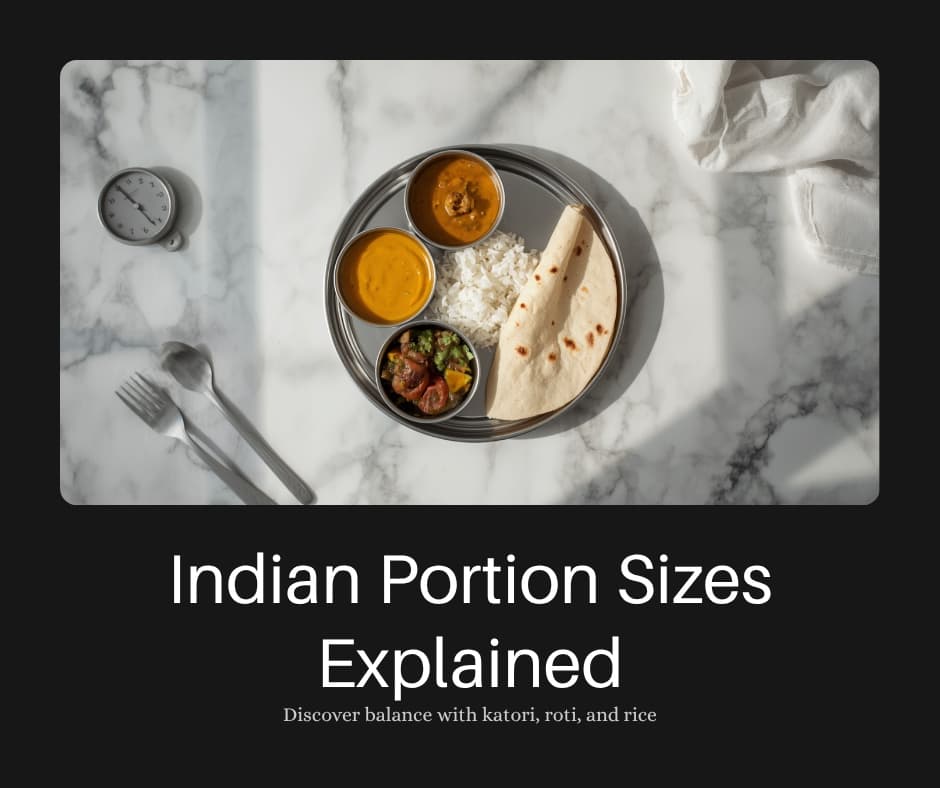
1 katori dal 135 kcal, 8 g protein. 1 katori rice 200 kcal. 1 katori sabzi 60 to 120. 1 roti 70 to 80. A 150 ml katori is about 150 g cooked. Chart for 1 to 3.
Free interactive tool
Convert your own katori, roti or glass into exact grams, calories and protein for 90+ Indian foods.
Open the katori converter →Quick answer: A standard katori (small bowl, ~150 ml) holds about 150 g of cooked dal (120-150 kcal), 150 g of cooked rice (200 kcal), or 100-150 g of sabzi (60-120 kcal). One medium roti (30 g atta) is 70-80 kcal. One tablespoon of ghee or oil is 120 kcal. Most overshoot comes from eating 3-4 rotis plus 2 katori rice at a meal, which stacks 600+ kcal in carbs alone. Here is the complete reference table for Indian portions in grams and calories, measure once to calibrate, then use your katori as your guide.
Common Indian Portion Sizes at a Glance
⚠ Lifestyle coaching information only. This article covers standard portion sizes and calorie estimates for common Indian foods measured in household containers (katori, roti, cup, spoon). These are approximate values based on typical recipes and cooking practices in India. Actual calories and macros vary by cooking oil, salt, and preparation method. Weigh your own portions once to calibrate your household bowls and spoons. This is not medical or nutritional advice. For medical concerns, consult your doctor or registered dietitian.
Rice is the portion most people worry about. Before cutting it, read what real Indian food logs show about rice and weight.
What our members actually log
206 kcal
1 cup of cooked rice, 4 g protein
104 kcal
1 regular roti or chapati (small roti: 80 kcal)
150 kcal
1 bowl of dal, 9 g protein
70 kcal
1 idli, 2 g protein
Source: A sample of member food logs from the YourTrainer app, 19 April to 17 September 2026. Members only, aggregated, each food logged by at least three members in the sample, using the app's food-database values for the portion logged
Our members logged a cup of rice at 206 kcal, lower than the heaped 200 g cup this guide uses. Cup sizes really do vary that much, which is why weighing yours once matters. Read the full food-log study.
The Katori: India's Most Imprecise Measurement
Every Indian kitchen has a katori, a small steel or ceramic bowl. But its size varies wildly. A Maharashtrian katori might be 120 ml. A Tamil household katori might be 200 ml. A Delhi katori might hold 180 ml. When someone says "eat one katori of dal," they could mean anywhere from 100 ml to 250 ml, which is a 100-calorie swing.
The fix: Buy or find a standard measuring cup (available at any supermarket, Wonderchef, Milton, Cello). Measure your most-used katori with water. Write the ml size on the bottom with a marker (dishwasher safe). Now you know exactly what "one katori" means in your home. A standard katori used in this guide = 150 ml.
If your katori is 120 ml, reduce portions by 20%. If it is 200 ml, increase by 33%. Simple math, massive impact on accuracy.
Cooked Dal (Lentils): The Protein Cornerstone
Dal is the backbone of Indian nutrition. One katori (150 ml) of cooked dal (toor, moong, masoor, chana) weighs about 150 g and contains:
- 120-150 kcal (varies by type: masoor dal higher, moong lower)
- 8-9.5 g protein (excellent for vegetarians)
- 20-24 g carbs (mostly fiber, low glycemic)
- 0.5-1 g fat (if cooked with water only; adds 30-40 kcal per teaspoon of oil/ghee)
This is per 150 ml katori or 150 g weight. A generous serving = 1 katori. Most Indians eat 1-1.5 katori per meal, which is perfect for fat loss, you get roughly 120-220 kcal and 8-14 g protein with minimal carb damage.
| Dal Type (Cooked) | 1 Katori (150 g) | Protein (g) | Fiber (g) |
|---|---|---|---|
| Toor dal | 130-140 kcal | 8 g | 6-7 g |
| Moong dal (yellow) | 115-120 kcal | 8.5 g | 5-6 g |
| Masoor dal (red) | 135-145 kcal | 9 g | 6-7 g |
| Chana dal (split chickpea) | 140-150 kcal | 9.5 g | 6-8 g |
| Urad dal (white lentil) | 145-155 kcal | 9-10 g | 5-6 g |
Note on oil/ghee: Plain boiled dal has the above calories. If you add 1 teaspoon of oil/ghee during cooking, add 40 kcal per katori. If you add 1 tablespoon (3 teaspoons), add 120 kcal. Most Indian dal is cooked with 0.5-1 tbsp per cup of dal, so expect 30-60 kcal extra from fat.
Cooked Rice: The Carbohydrate Question
Rice is where portion blindness runs deepest. A "cup" in India means different things in different homes. Here is the standard:
- 1 katori of cooked rice (~150 g): 200 kcal
- 1 cup of cooked rice (~200 g): 270 kcal
- 1 plate of cooked rice (standard thali, ~250 g): 330 kcal
Most Indians eat 1-1.5 cups (200-300 g) of rice at a meal, which is 270-400 kcal. Add dal, sabzi, and protein, and a single meal reaches 600-800 kcal from carbs alone. This is why Indians overshoot on carbs at lunch and dinner.
| Rice Type (Cooked) | 1 Katori (150 g) | 1 Cup (200 g) | Glycemic Load |
|---|---|---|---|
| White basmati | 200 kcal | 270 kcal | High (fast spike) |
| Brown rice (whole grain) | 190 kcal | 255 kcal | Moderate (slower spike) |
| Jasmine rice | 210 kcal | 280 kcal | High |
| Jowar/sorghum (cooked) | 180 kcal | 240 kcal | Lower (whole grain) |
For fat loss: Stick to 1 katori (150 g, 200 kcal) of rice per meal, not 1.5 or 2 cups. Pair with a large katori of sabzi (60-120 kcal) and 1 katori of dal (120-150 kcal). Total: ~480 kcal from a balanced plate. This prevents the carb-heavy meals that send most Indians into a metabolic stall.
Rotis and Breads: The Overlooked Calorie Bomb
A single medium roti (made from ~30 g atta, about the size of your palm) is 70-80 kcal. Most Indians eat 3-4 rotis at a meal, which is 210-320 kcal just from bread. Add the rice, dal, and sabzi, and you have easily overshot a 2000 kcal daily budget by lunch.
| Bread Type | Weight & Size | Calories | Protein (g) |
|---|---|---|---|
| 1 medium roti/chapati (wheat) | 30 g, 7-inch | 70-80 kcal | 2.5-3 g |
| 1 small roti (thin) | 25 g, 6-inch | 60-65 kcal | 2-2.5 g |
| 1 large roti/paratha (thick) | 35-40 g, 8-inch | 90-110 kcal | 3-3.5 g |
| 1 paratha (with ghee) | 40 g + ghee | 150-180 kcal | 3.5 g |
| 1 slice whole wheat bread | 28 g (store-bought) | 70-80 kcal | 3-4 g |
Portion hack: For fat loss, limit yourself to 2 medium rotis per meal. Most Indians think 3 is standard, but that is 210-240 kcal from bread alone. If you are over-fat-loss, 1.5 rotis per meal works fine paired with a protein source and vegetables.
Vegetables (Sabzi): The Underestimated Portion
Most Indians think vegetables are calorie-free. They are not, especially when cooked in oil. A standard katori (150 ml) of cooked sabzi (brinjal, spinach, cabbage, okra, cauliflower) weighs 100-150 g and contains:
- With minimal oil (1 tsp): 60-80 kcal
- With moderate oil (1 tbsp): 100-120 kcal
- With generous oil or cream (2 tbsp): 150-200 kcal
A common mistake: eating a large katori (250 g) of oil-heavy sabzi (paneer butter masala, malai kofta, aloo paratha stuffing) at 150-200 kcal per katori. If you eat 2 such portions, that is 300-400 kcal just from sabzi. Add dal, rice, and roti, and the meal explodes.
For fat loss: Eat a full katori (150 g) of cooked vegetables per meal, but choose low-oil preparations (boiled, steamed, dry curry). Limit creamy or oil-heavy sabzi to once or twice per week.
Oils, Ghee, and Fats: The Stealth Calorie
This is where most Indians sabotage themselves without realizing it. Fat is calorie-dense: 1 teaspoon of oil or ghee = 40-45 kcal. 1 tablespoon (3 teaspoons) = 120-135 kcal. A single tablespoon of ghee added to a plate of rice or dal nearly doubles the meal's calories.
| Fat Source | 1 Teaspoon | 1 Tablespoon | Per Day (2 tbsp) |
|---|---|---|---|
| Ghee | 45 kcal | 135 kcal | 270 kcal |
| Coconut oil | 40 kcal | 120 kcal | 240 kcal |
| Mustard oil | 40 kcal | 120 kcal | 240 kcal |
| Olive oil | 40 kcal | 120 kcal | 240 kcal |
| Butter | 45 kcal | 135 kcal | 270 kcal |
Track the oil used in cooking. If a curry calls for "2 tablespoons of ghee," that is 240 kcal of the meal's total. Most people eat 1-2 tbsp of cooking oil per day across all meals. For fat loss, aim for 1-1.5 tbsp (40-60 kcal) per meal, shared across all dishes.
Yogurt, Curd, and Dairy Portions
Curd (dahi) is a nutrition win for Indians, decent protein, probiotics, low calorie if unsweetened. Here is what a standard serving looks like:
- 1 katori of plain curd (150 g): 70-90 kcal, about 5 g protein
- 1 cup of Greek yogurt (150 g): 100-120 kcal, 15-18 g protein
- 1 cup of whole milk (200 ml): 140-150 kcal, 7-8 g protein
- 1 cup of skimmed milk (200 ml): 70-80 kcal, 8-9 g protein
Avoid sweetened flavored yogurt (adds 50-100 kcal per serving). Plain curd or Greek yogurt with a pinch of jaggery or honey is the same calories but much more satisfying.
The Balanced Fat-Loss Plate: Portions That Work
Here is what a fat-loss meal should look like for an average Indian (1800-2000 kcal daily):
- Half plate vegetables (cooked, ~200 g): 80-120 kcal
- Quarter plate protein (dal, paneer, eggs, or chicken): 120-150 kcal
- Quarter plate carbs (rice or 1.5 rotis): 200-250 kcal
- 1 tbsp oil/ghee for cooking (shared across meal): 120 kcal
- Total per meal: ~520-640 kcal
Eat 3 such meals = 1560-1920 kcal. Add a 150 kcal snack (curd, an apple, roasted chickpeas) and you have a clean 1800 kcal day.
The overshoot trap: Most Indians eat 1 katori of dal + 1.5 cups of rice + 3 rotis + a full katori of oil-heavy sabzi per meal. That is 700-850 kcal per meal, or 2100-2550 kcal daily. No wonder weight loss stalls. Measure once, adjust portions, and watch the difference.
1 Bowl Dal and Rice, Dal and Roti: Calories for Common Indian Meals
Most people search for a whole meal, not one food. These use the numbers from this guide: 1 katori (bowl) of toor dal is about 135 kcal and 8 g protein, 1 katori of cooked rice about 200 kcal and 4 g, a medium roti about 80 kcal and 3 g, a katori of dry sabzi made with 1 tsp oil about 70 kcal and 2 g, and a katori of curd about 80 kcal and 5 g. Add 40 kcal for every extra teaspoon of ghee or oil.
| Meal | Protein | Kcal |
|---|---|---|
| 1 bowl dal + 1 bowl rice | ~12 g | ~335 |
| 1 bowl dal + 2 rotis | ~14 g | ~295 |
| 1 bowl rice + dal + sabzi | ~14 g | ~405 |
| 2 rotis + 1 bowl sabzi | ~8 g | ~230 |
| 2 rotis + dal + sabzi | ~16 g | ~365 |
| Rice + dal + sabzi + 2 rotis | ~20 g | ~565 |
| 1 bowl rice + 1 bowl curd | ~9 g | ~280 |
Notice that none of these reach the 25 to 35 g of protein most adults need per meal. The easiest fixes are a second katori of dal, a katori of curd, some paneer, or eggs (see the egg bhurji calories and protein table). This protein gap is one of the first things our coaches look at: our online coaching plans your plate around dal, roti and rice instead of replacing them, and women managing PCOS in the US can see our PCOS coaching.
Turn the numbers into meals
Knowing the calories is the easy part. Eating to them through a normal Indian week is where most people slip.
A YourTrainer coach plans your week around the dal, roti, rice and sabzi you already eat, reviews your plate photos and adjusts every week. It runs fully online, so it works the same in Bengaluru or Boston.
Start Your Journey →Coached online, wherever you live:Online personal trainer in India·Coaching for Indians in the USA·Online coaching for NRIs
Calories in Roti and Sabzi: 1 to 5 Rotis
One medium roti (30 g atta, no ghee) is about 80 kcal, and one katori of home-style sabzi cooked in a little oil is about 100 kcal. So 2 rotis with 1 katori sabzi come to about 260 kcal, and 3 rotis with sabzi about 340 kcal. Each spoon of ghee on the roti adds about 45 kcal.
| Plate | Kcal (approx.) |
|---|---|
| 1 roti + 1 katori sabzi | ~180 |
| 2 rotis + 1 katori sabzi | ~260 |
| 3 rotis + 1 katori sabzi | ~340 |
| 4 rotis + 1 katori sabzi | ~420 |
| 5 rotis + 1 katori sabzi | ~500 |
1 roti is equal to how much rice?
One medium roti (about 80 kcal) equals roughly 60 g of cooked rice, about one third of a katori. A full katori of cooked rice (150 g, about 200 kcal) is close to 2.5 rotis.
1 Bowl or 1 Cup? Converting Rice and Dal to Grams
In most Indian homes, "1 bowl" means a katori. Use this when a diet chart or app asks for bowls or cups instead.
| Measure | Cooked rice | Cooked dal |
|---|---|---|
| 1 katori / small bowl (150 ml) | ~150 g, ~200 kcal | ~150 g, ~135 kcal |
| 1 US measuring cup (240 ml) | ~200 g, ~270 kcal | ~240 g, ~215 kcal |
| 1 large cereal bowl (~300 ml) | ~250 g, ~330 kcal | ~300 g, ~270 kcal |
So "1 cup dal in grams" is about 240 g if you mean a measuring cup, or about 150 g if you mean a katori. Rice weighs less per cup than dal because the grains trap air. When in doubt, weigh it once.
Bowl and Cup Sizes: Why Measurement Matters in India vs. US
Americans have standardized measuring cups (1 cup = 240 ml, precise). Indians use household bowls (katori, sambrani) that vary 30-50%. A "cup of rice" from a US measuring cup = 200 g cooked. A "cup" scooped into an Indian katori = anywhere from 120 g to 220 g. This is why portion blindness is endemic in India.
For NRIs abroad: You have access to precision measuring cups. Use them. In the USA, 1 cup = 240 ml (8 fl oz). One cup of cooked rice is 200 g and 270 kcal. A cup in India is 150-200 ml depending on your katori. If you return to India or are sending recipes home, clarify by weight (grams) or use a standard measuring cup. If you are cooking Indian food abroad and want help getting portions right, our online coaching for Indians abroad is built around exactly this kind of food.
Frequently Asked Questions
Q: Can I actually lose weight just by portion control without calorie counting?
A: Yes, if you weigh your portions once and memorize the katori size. After one week, you will instinctively know a portion without a scale. Reducing rice from 1.5 cups to 1 cup, rotis from 4 to 2, and sabzi oil from 2 tbsp to 1 tbsp drops daily intake from 2500 kcal to 1900 kcal. You lose 0.5-1 kg per week without explicit calorie tracking. But the first time, measure.
Q: My katori is different from 150 ml. How do I adjust?
A: Measure your katori with water using a measuring cup. Let's say it is 120 ml. Every portion in this guide drops by 20%. One katori of dal becomes 100 kcal instead of 125 kcal. One katori of rice becomes 160 kcal instead of 200 kcal. A 120 ml katori is actually ideal for fat loss, smaller portions, same fullness factor.
Q: Is 1 katori of dal + 1 katori of rice per meal enough protein?
A: That is 120-150 kcal dal (8 g protein) + 200 kcal rice (4 g protein) = 12 g protein. No. You need 25-35 g protein per meal. Add 1 medium paneer bhurji (150 g paneer scrambled) = 15-20 g more protein. Or 3 boiled eggs. Or 100 g chicken. Then you hit 25-30 g protein, which is what you need for satiety and muscle preservation during weight loss.
Q: What if I cook with more oil than I think?
A: This is the #1 hidden calorie sink. A restaurant dal makhani uses 3-4 tbsp of butter/cream per 2 cups dal. That is 360-480 extra kcal in one dish. A home-cooked dal should use 0.5-1 tbsp per 2 cups. Measure the oil before cooking: use a measuring spoon, not a pour "to feel." It takes 20 seconds and saves hundreds of calories.
Q: If I am already eating 2 rotis, 1 katori dal, 1 katori rice per meal, why am I not losing weight?
A: That meal is about 500 kcal before oil (2 medium rotis about 160, dal about 135, rice about 200). Eat 3 per day = about 1,500 kcal. Add breakfast (200 kcal), snacks (200 kcal), and oil/ghee added during cooking (100-150 kcal), and you are at roughly 2,000 kcal. If you are sedentary (no exercise), 2,000 kcal might be maintenance, not a deficit. Add 30 minutes of walking (250 kcal) or 30 minutes of strength training (300 kcal) per day, and you hit a real deficit.
Q: Do I need to weigh every meal forever?
A: No. Weigh portions for 2-4 weeks until you develop portion awareness. Your brain learns: "This katori is my rice portion, this is my dal portion." After that, you can eyeball meals (though occasional recalibration every 3 months is wise). Most successful Indians stop weighing after the habit sticks.
Q: What if my workplace or family cook does not know gram weights? How do I communicate portions?
A: Bring a measuring cup or scale to work / show them once. Say: "This katori is my dal portion (150 g cooked). One cup of rice is my rice portion (200 g cooked). One tablespoon of oil, no more." Most cooks remember after one or two instructions. If they resist, cook at home 5 days a week and eat out 2 days. You maintain control most of the time.
The Complete Portion Reference Table
| Food Item | Standard Portion | Approximate Grams | Calories | Protein (g) |
|---|---|---|---|---|
| Cooked dal (any type) | 1 katori (150 ml) | 150 g | 120-150 | 8-9.5 |
| Cooked rice (white or brown) | 1 katori | 150 g | 200-210 | 3-4 |
| Cooked rice | 1 cup (measuring cup) | 200 g | 270-280 | 4-5 |
| Medium roti (wheat) | 1 piece, 7-inch | 30 g | 75-85 | 2.5-3 |
| Cooked vegetables (minimal oil) | 1 katori | 150 g | 60-100 | 2-3 |
| Cooked vegetables (1 tbsp oil) | 1 katori | 150 g | 150-180 | 2-3 |
| Plain yogurt/curd | 1 katori | 150 g | 70-100 | 5-6 |
| Paneer (raw or fried) | 1 palm-sized piece | 80-100 g | 200-250 | 20-25 |
| Chicken breast (cooked) | 1 palm-sized piece | 100 g | 165 | 31 |
| Egg (boiled or scrambled) | 1 egg | 50 g | 70-80 | 6 |
| Oil/ghee/butter | 1 tsp | 5 g | 40-45 | 0 |
| Oil/ghee/butter | 1 tbsp | 15 g | 120-135 | 0 |
How Measuring Cups Differ: India vs. US vs. Metric
A final clarity on cups, since this causes the most confusion for NRIs and Indians cooking together across borders.
- US measuring cup: 1 cup = 240 ml = 8 fl oz (standard, precise)
- Metric cup: 1 cup = 250 ml (close to US, used in some countries)
- Indian katori: 1 katori = 120-200 ml (varies by household, imprecise)
- UK cup: 1 cup = 284 ml (less common)
When a recipe says "1 cup of cooked rice," always ask: measured cup (240 ml) or katori (150 ml)? The difference is 50 calories. For precision, use a measuring cup or scale. For Indians, buy a cheap measuring cup (100 rupees) and label your katori once. Everything you log after that gets more accurate.
Action Plan: Measure This Week
Do not overthink this. Take 30 minutes this weekend:
- Measure your most-used katori with water and a measuring cup. Write the ml size on the bottom.
- Measure one serving of dal, rice, sabzi as you normally cook them. Write down the weight (in grams, if you have a scale; or estimate by cup size).
- For the next week, eat the same measured portions at every meal. Notice how you feel.
- Weigh yourself weekly on the same day, same time. If weight is not moving after 2 weeks, reduce rice and oil by 20%, maintain dal and protein.
- After 4 weeks, you no longer need the scale, your brain learns portions.
Most Indians skip this step because it feels tedious. It is not. It is 30 minutes of precision that pays for itself in 10 kg of weight loss over 6 months.
Bottom line: Your katori, your portion, your weight loss. Measure once, adjust for life. A standard 150 ml katori is your anchor. One katori dal = 120-150 kcal + 10 g protein (good). One katori rice = 200 kcal (reasonable). Two rotis instead of four = save 150 kcal. One tablespoon of oil, not two = save 120 kcal. Total: 370 kcal saved per meal, or 1110 kcal per day. That is 0.5 kg per week without hunger, just portion awareness.
Real plates from our members
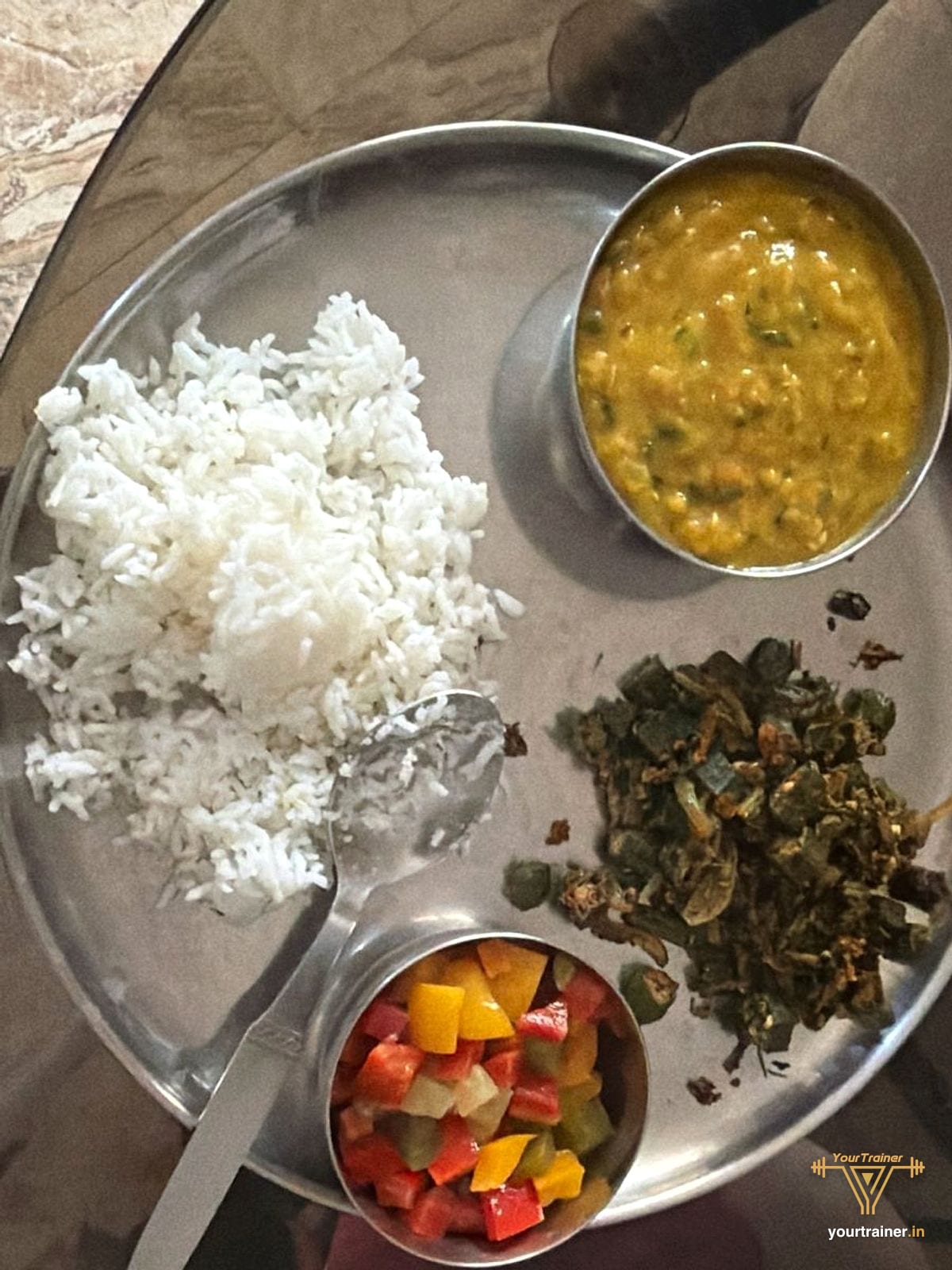
| Food | Typical portion | Calories, protein |
|---|---|---|
| Rice, cooked | 1 cup | 206 kcal, 4 g |
| Roti / chapati | 1.5 rotis | 156 kcal, 4.5 g |
| Roti, small | 2 small rotis | 160 kcal, 5 g |
| Dal | 1 bowl | 150 kcal, 9 g |
| Idli | 2 to 3 idlis | 158 kcal, 4.5 g |
| Poha | 1 plate | 250 kcal, 5 g |
| Paneer | 50 g | 133 kcal, 9 g |
| Soya chunks | 75 g dry | 248 kcal, 39 g |
| Dahi (curd) | 100 g | 61 kcal, 4 g |
| Boiled eggs | 2 eggs | 156 kcal, 13 g |
| Chicken breast | 150 g | 248 kcal, 46.5 g |
| Whey protein | 1 scoop | 120 kcal, 24 g |
Source: A sample of member food logs from the YourTrainer app, 19 April to 17 September 2026. Members only, aggregated, each food logged by at least three members in the sample, using the app's food-database values for the portion logged
Related Articles
- Indian Food Calories & Macros: 60-Dish Chart (Dal, Rice, Paneer, Rotis)
- Indian Diet for Weight Loss: Vegetarian & Non-Veg Meal Plans (1800 kcal)
- How Much Protein Should an Indian Eat? Veg & Non-Veg Chart
- Indian Macro Calculator: Find Your Daily Protein, Carb & Fat Targets
Ready to turn portions into results? Coach Anish's online fat loss coaching program includes portion tracking, meal planning, and weekly adjustments. Work 1-on-1 with a coach who understands Indian food, Indian kitchens, and Indian portion sizes. Start your journey today.
Sources
- Indian Food Composition Tables (IFCT) 2017 · ICMR, National Institute of Nutrition
- Nutrient Requirements for Indians (RDA and EAR) · ICMR, National Institute of Nutrition
- Healthy diet · World Health Organization
- Dietary profiles and metabolic risk factors in India (ICMR-INDIAB survey) · Nature Medicine
Coaching guidance on this site is educational and is not a substitute for medical advice. See how we use sources.
Did you find this helpful?

About Anish Agarwal
Founder & Head Coach, YourTrainer · NASM & K11 Certified Personal Trainer · coaching since 2022
Featured in Dietitians.io, Fitness Interview, NRI Pulse. Press and media
Anish Agarwal is a NASM and K11 certified personal trainer coaching fat loss, body transformation, strength, and nutrition for clients across India since 2022. He founded YourTrainer to make expert, science-based coaching accessible online and in Bengaluru. Coach Anish's profile and the YourTrainer story.
Free on iPhone and Android
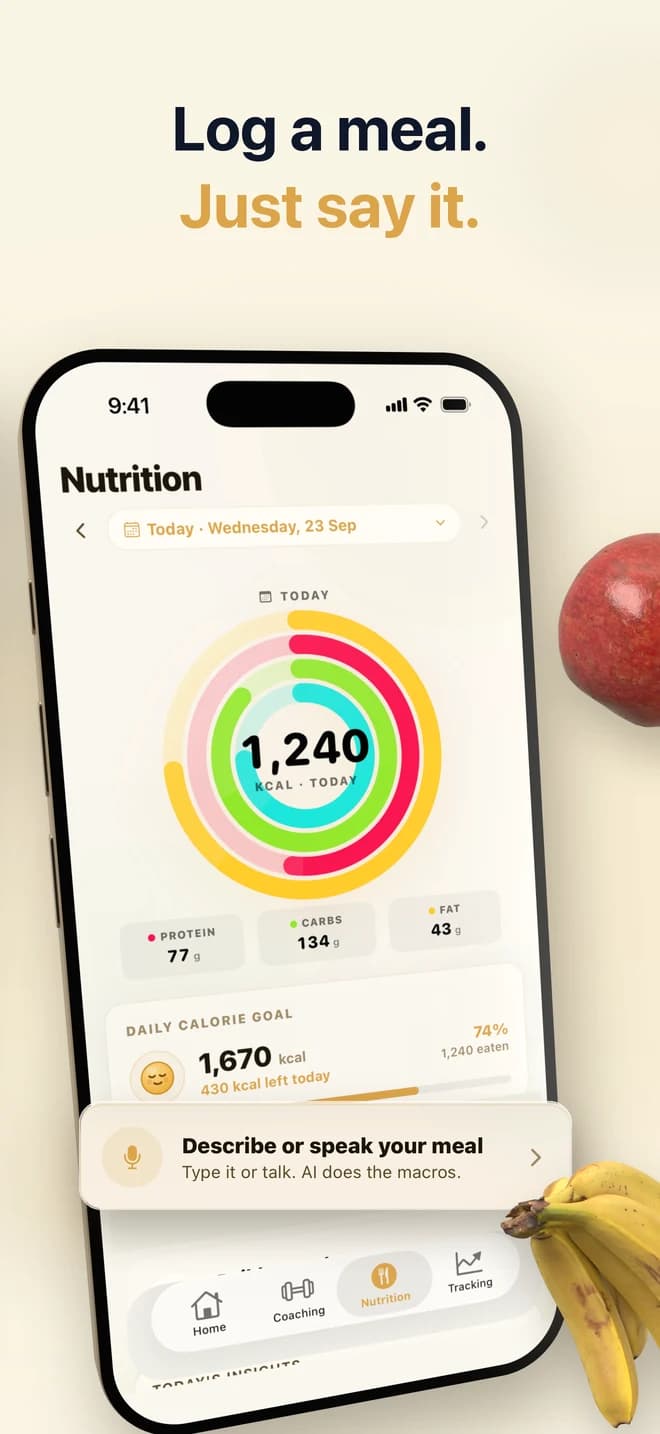
Log this in the YourTrainer app
Search or photograph an Indian dish, set your portion, and the app keeps your calories and protein for the day.
Online 1-on-1 Coaching
Start Your Journey
Get a personalised training + Indian nutrition plan built around your goal, coached online, anywhere in India or abroad.
Trusted by 1,000+ clients coached across India & abroad
Free 30-min discovery call · No obligation