
Free Tool · South-Asian Adjusted
Body Fat Calculator
A tape measure tells you more than the scale does. This gives you body fat percentage, lean mass, and waist-to-height ratio, which predicts metabolic risk in Indians better than BMI.
Quick answer
Healthy body fat for Indian men is about 8 to 15 percent and for Indian women about 16 to 24 percent. These sit below Western charts because South Asians develop insulin resistance at lower total body fat.
The single most useful number here is waist divided by height. Keep it below 0.5. Plenty of Indians with a normal BMI fail that test, which is exactly what skinny fat means.
Gender
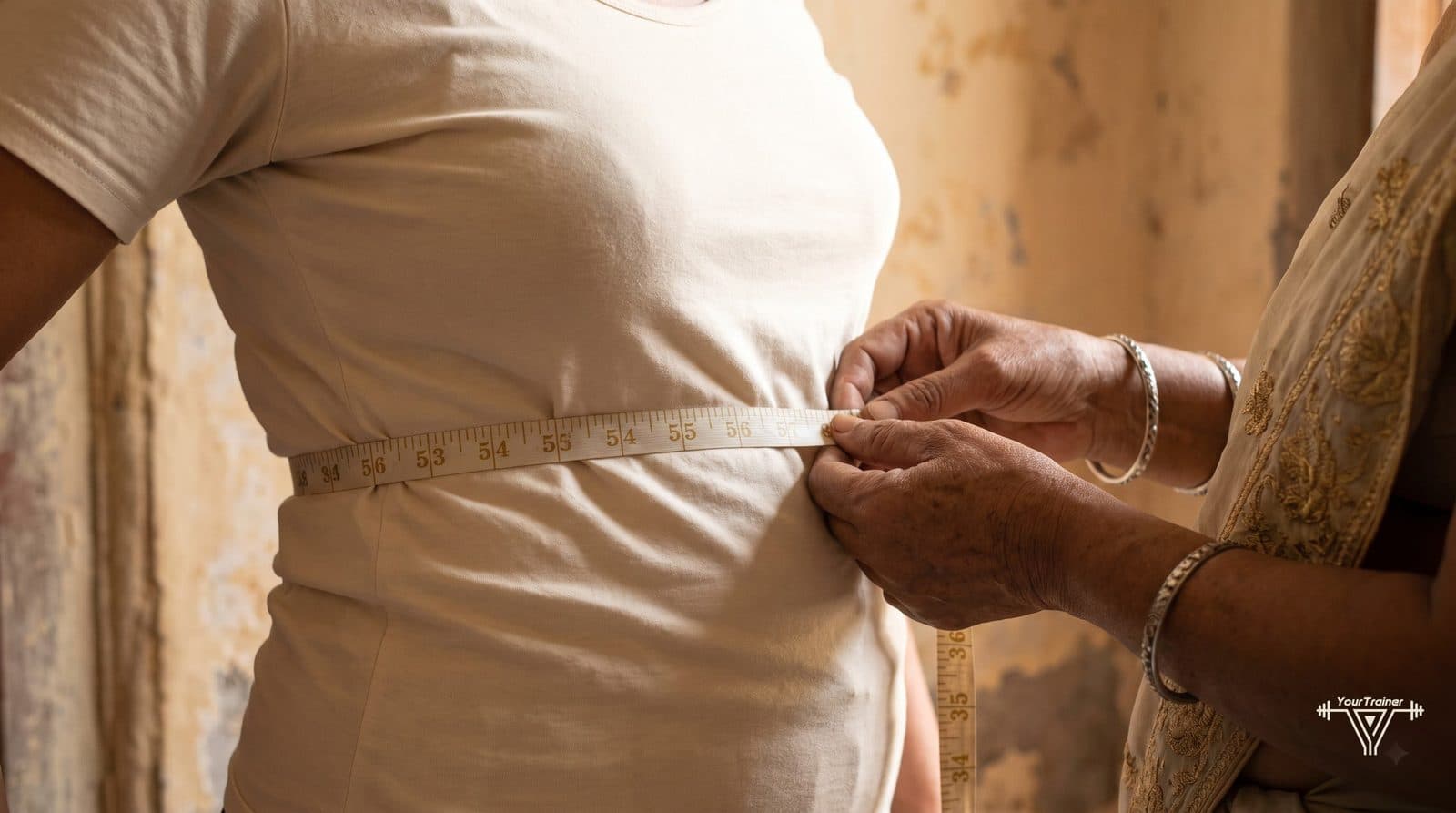
Measure the waist at navel level, relaxed, without pulling the tape tight. Neck just below the larynx. Same time of day each time you re-measure.
Estimated body fat
Elevated risk of insulin resistance and fatty liver, even at a normal BMI.
Above 0.5. For South Asians this signals rising visceral fat even when BMI looks normal. Waist is the number to move.
South Asians abroad: why the healthy range starts lower
South Asians tend to carry more body fat, and more of it around the waist, at the same BMI as white Europeans. That is why this calculator uses South-Asian-adjusted ranges, and why guidance abroad has moved the same way:
- The American Diabetes Association recommends screening Asian American adults for diabetes from a BMI of 23, not 25.
- A WHO expert consultation set lower BMI action points for Asian populations: 23 for increased risk and 27.5 for high risk (The Lancet, 2004).
Women in the US in our questionnaire sample
32%
ticked insulin resistance or pre-diabetes
24%
ticked PCOS / PCOD
76%
picked fat loss as a goal
Source: A sample of YourTrainer coaching questionnaires completed between 22 Jun and 17 Sep 2026, counted once per person; conditions self-reported, not diagnosed
If your number is above the range, waist first is the right target. See PCOS coaching for Indian women in the USA and online coaching for Indians in the USA.

Why the Scale Lies to Indians
A large share of Indian adults sit at a perfectly normal BMI while carrying enough visceral fat to be metabolically unwell. The phenotype has a name in the research literature, thin outside fat inside, and it explains why type 2 diabetes shows up in Indians a decade earlier and at lower body weights than in European populations.
The practical consequence: if you only track weight, you can lose 4 kg, lose muscle along with fat, and end up with a worse body composition than you started with while feeling successful. Body fat percentage and waist measurement catch that. The scale does not.
What to Measure and How Often
- Waist at navel: the number that matters most. Weekly.
- Neck below the larynx: needed for the formula. Monthly is enough.
- Hip at the widest point: women only, for the formula.
- Weight: same time of day, ideally morning, after the bathroom.
Take measurements relaxed, not sucked in, and use the same tape each time. What matters is the trend across six to eight weeks, not any single reading.
Where to Go From Here
Compare this against your BMI using Asian-Indian thresholds to see the gap between the two. Then set a calorie target with the TDEE calculator and a protein floor with the protein calculator, because protein is what decides whether the weight you lose is fat or muscle. To model how long the change will take, use the weight loss timeline calculator.
Further reading: beyond BMI, the metrics that matter for Indians and the skinny fat transformation.
Free Consultation
Change the composition, not just the number.
Losing fat while holding muscle needs strength training and enough protein. Start with a free call and a ₹499 trial session.
FAQ
Frequently asked questions
What is a healthy body fat percentage for Indian men and women?
For Indian men, roughly 8 to 15 percent is lean and fit, 15 to 21 percent is average, and above 21 percent carries rising metabolic risk. For Indian women, 16 to 24 percent is fit, 24 to 31 percent is average, and above 31 percent is high. These bands sit lower than Western charts because South Asians carry more visceral fat and develop insulin resistance at lower total body fat.
How accurate is the tape measure body fat method?
The US Navy circumference method typically lands within 3 to 4 percentage points of a DEXA scan. That is not precise enough to obsess over a single reading, but it is consistent, so the direction it moves over six to eight weeks is genuinely useful. Measure at the same time of day, relaxed, without pulling the tape tight.
What is waist-to-height ratio and why does it matter for Indians?
Waist-to-height ratio is your waist measurement divided by your height, in the same units. Below 0.5 is the healthy threshold. It predicts cardiometabolic risk in South Asians better than BMI because it captures visceral fat around the organs, which is the pattern Indians accumulate. Many Indians with a normal BMI still exceed 0.5, which is the skinny fat phenotype.
Why does my BMI look normal but my body fat is high?
This is the skinny fat or thin outside fat inside pattern, and it is common in Indians. BMI only compares weight to height, so someone with little muscle and significant abdominal fat can weigh normally while carrying a high fat percentage. It is why body fat and waist measurements are more informative than the scale for South Asians.
How fast can body fat percentage realistically drop?
About 0.5 to 1 percentage point per month is realistic and sustainable while retaining muscle. Faster drops usually mean losing lean tissue alongside fat, which lowers metabolic rate and makes the result harder to keep. Pairing a moderate calorie deficit with strength training and adequate protein is what preserves lean mass during the process.