How Indians Abroad Hit 100g Protein Vegetarian (A Full Day of Desi Meals)
How to hit 100 g protein a day on a vegetarian Indian diet: a meal plan with paneer, tofu, dals, Greek yogurt and soya chunks, with costs for the US and India.
Nutrition information only. Protein targets are evidence-based (1.6 g/kg for muscle building) but individual needs vary. If you have kidney disease, liver issues, or are on medication, consult your doctor or dietitian before significantly increasing protein intake. This guide is for healthy adults.
Quick answer: Vegetarians can absolutely hit 100 g protein daily on an Indian diet. The trick: layer 3–4 protein sources at each meal (dal + rice + paneer, or Greek yogurt + whey powder + granola), lean on soya chunks and tofu (15–20 g per serving), and don't skip dairy or a protein powder. A realistic day averages: breakfast with Greek yogurt or besan chilla (~20 g), lunch with dal and paneer or tofu (~30–35 g), a snack shake or roasted chana (~10–25 g), and dinner with rajma or chole plus tofu (~25–30 g). Without powder, you'll need to be strategic, add soya, tofu, paneer, and dals to every meal. Target 1.6 g per kilogram of bodyweight; for a 70 kg person, that's about 112 g.
In the US, the cheapest way to buy that protein is in our Indian grocery list for weight loss in the USA.
Why Protein Matters for Indians & NRIs
Muscle loss is silent. After 30, you lose about 3–5% of muscle per decade without resistance training. For Indians abroad, especially women, hormonal shifts, stress, and reduced physical activity compound the problem. Adding 100 g protein daily (vs the average 50–70 g most Indians eat) signals your body to build and keep muscle during strength training. You'll recover better, stay leaner, and have more energy. The challenge isn't whether protein works; it's finding enough high-protein vegetarian foods that fit your kitchen, budget, and taste.
The High-Protein Vegetarian Sources Ranked
Soya Chunks
52 g
per 100g dry
Tofu
15–18 g
per 200g serving
Greek Yogurt
20 g
per 200g (US/India)
Paneer
22 g
per 200g serving
Whey/Plant Powder
24 g
per scoop (25g)
Tempeh
19 g
per 100g serving
A Full Day: 100g Protein Vegetarian Meal Plan
Here's how a 70 kg person hits 100 g protein with readily available Indian and US-accessible foods:
| Meal | Foods | Protein (g) |
|---|---|---|
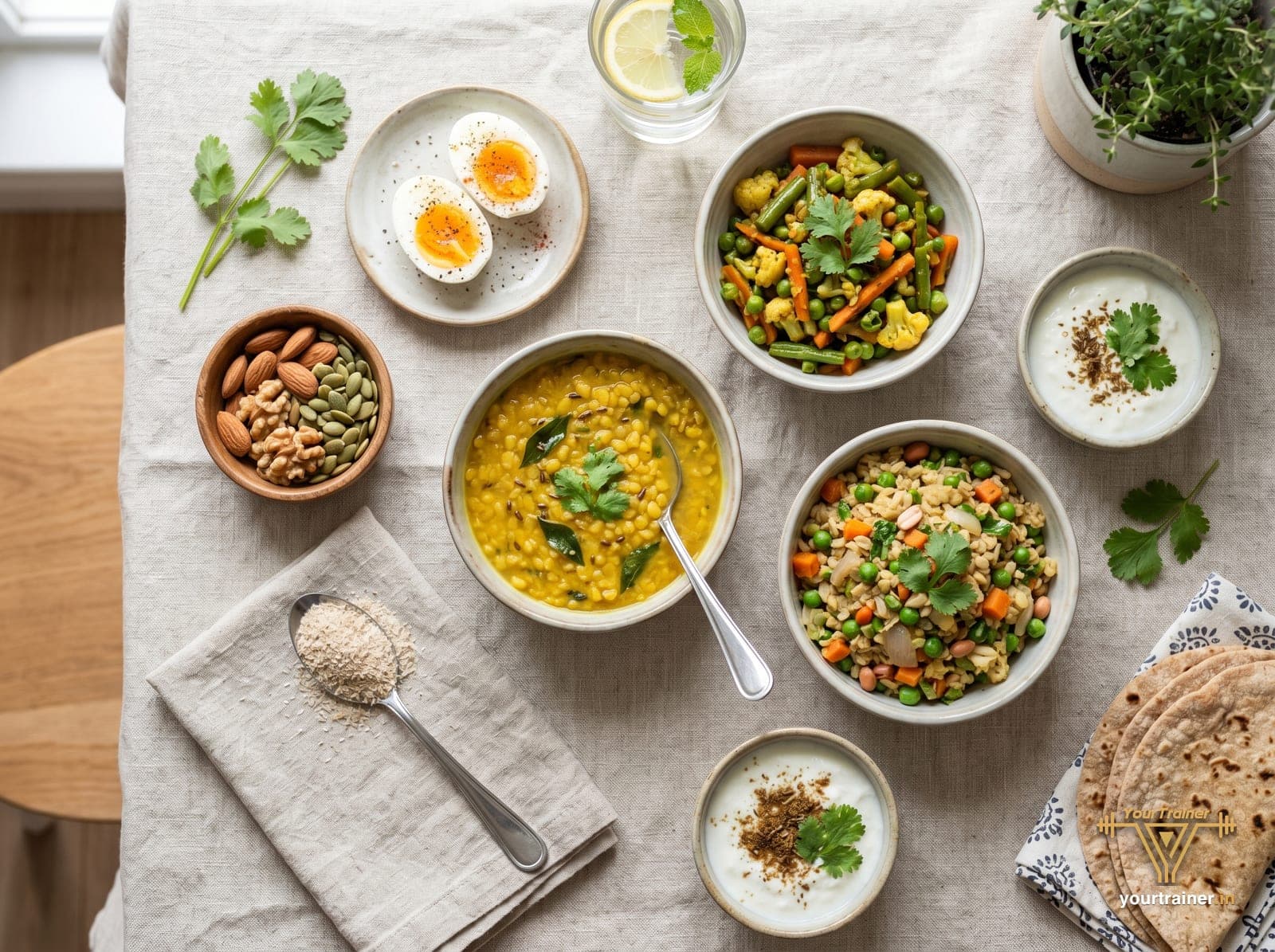
| Breakfast | 200 g Greek yogurt (Fage, Straus Family, or Epigamia India) + 1 scoop whey protein powder + 30 g granola | 44 |
| OR | 2 besan chilla (~120 g) + 150 ml curd + 1 banana | 20 |
| Midday Snack | 1.5 katori (375 ml) moong or masoor dal (~50 g cooked) + 150 g paneer or tofu sabzi + 1 wheat roti | 33 |
| Afternoon Snack | Roasted chana (40 g) OR 1 protein shake (~24 g) OR 1 cup sprouts chaat (moong/alfalfa, 100 g cooked) | 10–25 |
| Dinner | 1.5 katori rajma or chole (~50 g cooked) + 150 g tofu or paneer + mixed veg + 1 roti or 1 cup rice | 28 |
| TOTAL | ~100–130 g |
The powder makes it easy. A single scoop of whey or plant protein (~24 g) bridges the gap. Add it to yogurt, milk, coffee, or smoothies. If you skip powder entirely, you must have tofu, paneer, soya, or legumes at every single meal, doable but rigid.
Complete-Protein Combos: Don't Forget Amino Acids
Vegetarian proteins lack one or more essential amino acids on their own. Dals are low in methionine; grains lack lysine. The fix: combine them.
- Dal + Rice or Roti: Rice/roti adds methionine; dal adds lysine. Eaten together, they form a complete protein. This is ancient Indian wisdom backed by science.
- Soya or Tofu + Any Grain: Soya chunks and tofu are complete proteins on their own (rare for plant sources), so no pairing needed. But combine them with rice or roti for satiety and micronutrients.
- Paneer + Veg: Paneer is complete. Add greens (spinach, fenugreek) for calcium and iron, which paneer processing reduces.
- Curd + Whole Grains: Curd (yogurt, lassi) + cereal, bread, or granola = complete amino acid profile.
Coaching that does this for you
Reading is step one. A coach turns it into a plan built around your body, food & schedule.
100% online · Indian meal plans · weekly progress reviews · daily WhatsApp support.
Start Your Journey →Sourcing High-Protein Options in the US vs India
The availability gap between US and India is real, but smaller than you'd think.
| Source | US Availability | India Availability | Notes |
|---|---|---|---|
| Greek Yogurt | Costco ($10–12/lb), Trader Joe's, regular grocery | Epigamia 400g ₹150–200; Straus Family (Mumbai, Delhi metro) | US prices better; India stock sporadic outside metros |
| Paneer | Indian/Asian grocery, Whole Foods $12–18/lb | Local doodh wala or market ₹300–400/kg | India much cheaper; US version often softer (higher moisture) |
| Tofu | Any Asian market, regular grocery chains | Metro cities (Amar, Nasoya, Pasteurized brands); rural=hard | US way easier; India growing but inconsistent quality |
| Tempeh | Trader Joe's, Whole Foods, Asian markets | Extremely rare; online from specialty stores | US staple; India = specialty import or make at home |
| Soya Chunks | Indian/Asian aisle; less common in regular stores | Everywhere, local kirana, Costplus (online), ₹40–80/100g | India advantage; cheap and ubiquitous |
| Edamame (Frozen) | Costco, Trader Joe's, regular grocery $2–3 per bag | Frozen (Birdseye, etc.) in metros; rare fresh | US much cheaper; portable high-protein snack |
| Lentil/Chickpea Pasta | Whole Foods, Amazon (Barilla, Banza, Explore) $2–3/box | Online (Amazon India, Bigbasket); ₹150–200/box | US cheaper and fresher; India option exists for metros |
| Whey/Plant Protein Powder | Amazon, Costco, Target ($15–40 for 25 servings) | Amazon India, GNC, INOX: ₹1,200–3,000 per kg (expensive) | US 3–5x cheaper; buy while abroad if possible |
| Dals (Moong, Masoor, Rajma, Chole) | Indian grocery, online; $1–2/lb, quality variable | Local market, organic ₹50–100/kg (cheapest) | India advantage; cheap, fresh, superior quality |
| Sattu (Roasted Chickpea/Barley Flour) | Rare in US (specialty online) | Bihar/UP staple; grocers everywhere ₹40–80/kg | India exclusive; 8–10 g protein per 30 g serving |
Simple Wins: How to Reach 100g Without Powder
If you can't or won't use protein powder, here's the formula:
- Breakfast: 200 g Greek yogurt (20 g) or 3 besan chilla (15 g) + 150 ml curd (6 g) = 20–26 g.
- Lunch: 1.5 katori dal (15 g) + 200 g paneer or tofu (22–26 g) + 1 roti (3 g) = 40–44 g.
- Snack: 100 g roasted chana (15 g) OR 100 g boiled edamame (12 g) OR 1 cup sprouts (10 g) = 10–15 g.
- Dinner: 1.5 katori rajma/chole (15 g) + 100 g tofu (8 g) + roti/rice (3 g) = 26 g.
- Total (no powder): ~96–111 g. You hit it by eating tofu or paneer at 2 meals and dals at both lunch and dinner.
Training & Recovery: Why 100g Matters
Protein doesn't build muscle by itself. You need resistance training. If you're lifting 3–4 days per week, 1.6 g/kg is the evidence-based target for maximum muscle gain. If you're doing only cardio or flexibility, 1.2 g/kg is enough. But here's the psychology: when you hit 100 g daily, you're signaling to your body that you're serious about recovery. You'll feel the difference, less soreness, better sleep, stable energy, leaner body composition.
Frequently Asked Questions
Q: Can I hit 100g protein on a purely whole-food vegetarian diet (no powder)?
Yes, but it requires planning. You'll need tofu or paneer at 2 meals, plus dals at lunch and dinner, plus Greek yogurt or soya-based snacks. It's doable for a day or two, but inconsistent over weeks. Most people who skip powder average 75–85 g unless they're very deliberate. A single 25 g protein scoop makes reaching 100 g trivial and leaves room for flexibility.
Q: Is 100g too much protein?
No, if you have healthy kidneys and liver. Studies on athletes show up to 2.2 g/kg is safe. The "50 g limit" myth comes from 1980s nutrition dogma. For a 70 kg person, 100–110 g is moderate. Side effects (bloating, gas) usually come from eating too fast, not from the amount itself. Space protein across the day and drink enough water.
Q: Does plant protein work as well as dairy/whey?
Plant proteins (soya, pea, hemp) work fine if you eat complete proteins or combine dals with grains. Soya protein is actually a complete protein (all 9 essential amino acids), same as whey. The difference: whey absorbs faster and tastes better to most people. Plant powders work; just make sure you're getting lysine and methionine. Tempeh and soya chunks are complete. Dals must be paired with grains.
Q: What about gas and bloating from eating so much protein and dal?
Real. Dals ferment if you eat too much too fast. Fixes: soak and cook dals well (reduces oligosaccharides), start at 60–70 g protein for 2 weeks and increase gradually, chew slowly, and add ajwain or hing (asafetida) when cooking dals. Most bloating subsides as your gut adapts. Stay hydrated.
Q: Is it cheaper to hit 100g in India or the US?
India, mostly. Dals, paneer, and soya chunks are dirt cheap in India. US wins on Greek yogurt (Costco bulk), frozen edamame, and protein powder (3–5x cheaper). If you're abroad, leverage the cheap protein powder + buy dals when home. In India, a month of 100 g daily costs about ₹2,000–3,000 (all food included); in the US, about $200–300 if you use Costco Greek yogurt and bulk powder.
Q: Do I need to eat protein immediately after a workout?
No. The "anabolic window" is a myth. Muscle protein synthesis stays elevated for hours after training. Eat 20–40 g protein within a few hours of training, spread your daily 100 g across meals, and you're fine. The bigger picture matters: total daily protein, consistency, and proper training. A protein shake 2 hours post-workout works just as well as 30 minutes post-workout.
Related articles
- Indian Protein Sources Ranked (Veg + Non-Veg): Grams & Cost. Comprehensive ranking of every protein source by protein-per-100g and price.
- How to Build Muscle on a Vegetarian Indian Diet: Complete Science-Backed Plan. Full training and nutrition framework for vegetarian muscle building.
- Protein Coffee (Proffee): Does It Work? An Indian High-Protein Take. Using protein powder creatively to boost daily intake.
Start building muscle this week
100 g protein isn't magic; it's a floor for muscle building. Add it to 3–4 strength sessions per week, stay consistent for 8–12 weeks, and you'll see real changes, more energy, visible strength, and a leaner shape. In Texas or in Mumbai, the framework is the same. Choose your protein sources from the table above, plan 3 meals a day, and hit your target. Need a coach to put this into practice with your specific body and goals?
Start Your Journey with online coaching designed for Indians abroad and in India.
Sources
- Indian Food Composition Tables (IFCT) 2017 · ICMR, National Institute of Nutrition
- Nutrient Requirements for Indians (RDA and EAR) · ICMR, National Institute of Nutrition
- Healthy diet · World Health Organization
- Dietary profiles and associated metabolic risk factors in India (ICMR-INDIAB survey) · Nature Medicine
Figures for Indian foods follow IFCT 2017 (ICMR-NIN). Coaching guidance on this site is educational and is not a substitute for medical advice. See how we use sources.
Did you find this helpful?

About Anish Agarwal
Founder & Head Coach, YourTrainer · NASM & K11 Certified Personal Trainer · coaching since 2022
Featured in Dietitians.io, Fitness Interview, NRI Pulse. Press and media
Anish Agarwal is a NASM and K11 certified personal trainer coaching fat loss, body transformation, strength, and nutrition for clients across India since 2022. He founded YourTrainer to make expert, science-based coaching accessible online and in Bengaluru. Coach Anish's profile and the YourTrainer story.
Coaching built for this
Want a plan like this done for you? These programs are matched to what you just read:
Online 1-on-1 Coaching
Start Your Journey
Get a personalised training + Indian nutrition plan built around your goal, coached online, anywhere in India or abroad.
Trusted by 1,000+ clients coached across India & abroad
Free 30-min discovery call · No obligation