High Protein Vegetarian Foods: 29 Indian Foods Ranked per Serving (and How Eggs and Chicken Compare)
Soya chunks lead at 26 g a katori; dal gives 8 to 10 g. 29 vegetarian foods ranked per serving and per calorie, real member logs, and 60 to 100 g days.
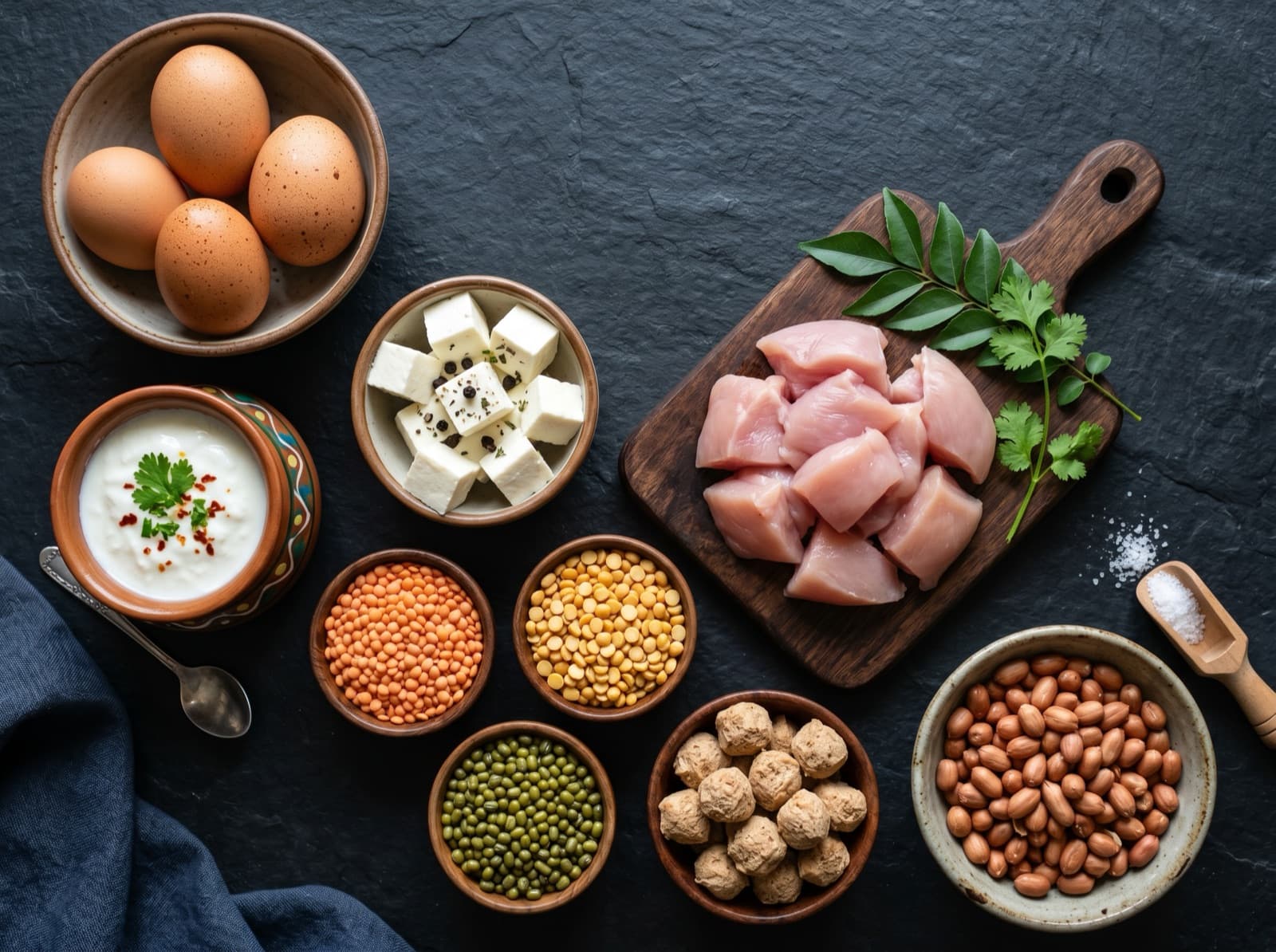
The highest protein vegetarian foods in an Indian kitchen are soya chunks (26 g in a cooked katori), paneer (18 g per 100 g), plain Greek yogurt (15 g a katori) and firm tofu (17.3 g per 100 g). Dal gives 8 to 10 g a katori, which is why a dal-and-roti day stalls around 50 g. Below: 29 foods ranked per serving and per calorie, what our vegetarian members actually ate, and full days at 60, 80 and 100 g.
What our members' logs show
51 g
median protein on a fully logged vegetarian day, against 88 g for members who also eat eggs or meat
39%
of vegetarian days reached 60 g of protein, against 79% of the others
17.6%
of vegetarian protein came from roti, rice and oats, as much as from dal (16.9%)
Source: A small sample of member food logs from the YourTrainer app, 19 April to 2 November 2026, members only. Vegetarian means no egg, meat or fish was logged in that time; a fully logged day has at least three meals
The ranking: 29 vegetarian foods by protein per serving
Per serving, the way you actually eat it: a katori of dal, a 100 g block of paneer, a handful of seeds. Foods marked * come from USDA values, for the ones our Indian database does not hold yet.
| # | Food | Serving | Protein | Calories | Protein per 100 kcal |
|---|---|---|---|---|---|
| 1 | Soya chunks, cooked | 1 katori (100 g) | 26 g | 172 kcal | 15.1 g |
| 2 | Whey protein | 1 scoop | 24 g | 120 kcal | 20 g |
| 3 | Tempeh * | 100 g | 20.3 g | 192 kcal | 10.6 g |
| 4 | Paneer bhurji | 1 katori (150 g) | 19 g | 305 kcal | 6.2 g |
| 5 | Paneer | 100 g | 18 g | 265 kcal | 6.8 g |
| 6 | Firm tofu * | 100 g | 17.3 g | 144 kcal | 12 g |
| 7 | Cottage cheese (US, UK) * | 1 katori (150 g) | 15.7 g | 122 kcal | 12.9 g |
| 8 | Greek yogurt, plain | 1 katori (150 g) | 15 g | 88 kcal | 17 g |
| 9 | Palak paneer | 1 katori (150 g) | 12 g | 240 kcal | 5 g |
| 10 | Edamame * | 100 g | 11.9 g | 121 kcal | 9.8 g |
| 11 | Chana dal | 1 katori (150 g) | 9.5 g | 165 kcal | 5.8 g |
| 12 | Hemp seeds, hulled * | 30 g | 9.5 g | 166 kcal | 5.7 g |
| 13 | Chole | 1 katori (150 g) | 9.2 g | 195 kcal | 4.7 g |
| 14 | Pumpkin seeds * | 30 g | 9.1 g | 168 kcal | 5.4 g |
| 15 | Rajma | 1 katori (150 g) | 9 g | 175 kcal | 5.1 g |
| 16 | Moong dal chilla | 1 chilla (90 g) | 9 g | 165 kcal | 5.5 g |
| 17 | Oats cooked in milk | 1 katori (180 g) | 9 g | 210 kcal | 4.3 g |
| 18 | Roasted peanuts | 1 katori (35 g) | 9 g | 200 kcal | 4.5 g |
| 19 | Masoor dal | 1 katori (150 g) | 8.8 g | 138 kcal | 6.4 g |
| 20 | Moong dal | 1 katori (150 g) | 8.5 g | 132 kcal | 6.4 g |
| 21 | Moong sprouts | 1 katori (100 g) | 8.5 g | 105 kcal | 8.1 g |
| 22 | Toor dal | 1 katori (150 g) | 8 g | 140 kcal | 5.7 g |
| 23 | Milk, toned | 1 glass (250 ml) | 8 g | 145 kcal | 5.5 g |
| 24 | Roasted chana | 1 katori (40 g) | 8 g | 145 kcal | 5.5 g |
| 25 | Besan chilla | 1 chilla (90 g) | 7.5 g | 135 kcal | 5.6 g |
| 26 | Peanut butter * | 2 tbsp (32 g) | 7.1 g | 191 kcal | 3.7 g |
| 27 | Quinoa, cooked * | 1 katori (150 g) | 6.6 g | 180 kcal | 3.7 g |
| 28 | Almonds * | 30 g | 6.3 g | 174 kcal | 3.7 g |
| 29 | Curd, toned | 1 katori (150 g) | 5.4 g | 68 kcal | 7.9 g |
Source: YourTrainer Indian food database: cooked household servings, values reconciled from IFCT 2017 (ICMR-NIN) and USDA FoodData Central; foods marked * from USDA FoodData Central, SR Legacy, per 100 g, scaled to the serving shown. Whey: the median logged scoop in our members' food logs
- Soya chunks, cooked, 1 katori (100 g)26 g
- Whey protein, 1 scoop24 g
- Tempeh, 100 g20.3 g
- Paneer bhurji, 1 katori (150 g)19 g
- Paneer, 100 g18 g
- Firm tofu, 100 g17.3 g
- Cottage cheese (US, UK), 1 katori (150 g)15.7 g
- Greek yogurt, plain, 1 katori (150 g)15 g
- Palak paneer, 1 katori (150 g)12 g
- Edamame, 100 g11.9 g
Source: YourTrainer Indian food database: cooked household servings, values reconciled from IFCT 2017 (ICMR-NIN) and USDA FoodData Central; foods marked * from USDA FoodData Central, SR Legacy, per 100 g, scaled to the serving shown
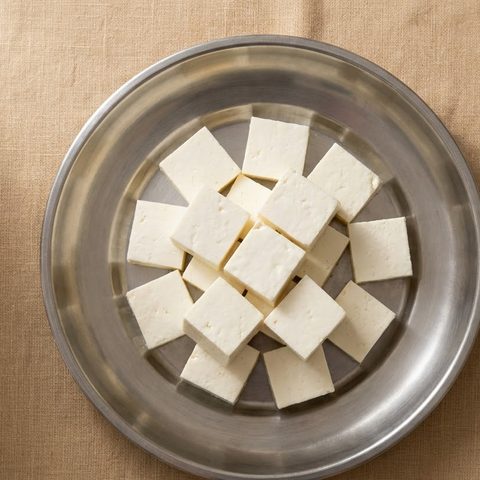
From the YourTrainer kitchen photo library.
Protein per calorie: the list that matters on a fat loss plan
Per serving rewards big, rich foods. Per 100 kcal shows how much protein you get for the calories you spend, which is what decides a fat loss plan. Whey, plain Greek yogurt and soya chunks lead. Paneer drops down the list because about two thirds of its calories come from fat; it is still a good food, just not a lean one.
- Whey protein20 g
- Greek yogurt, plain17 g
- Soya chunks, cooked15.1 g
- Cottage cheese (US, UK)12.9 g
- Firm tofu12 g
- Tempeh10.6 g
- Edamame9.8 g
- Moong sprouts8.1 g
- Curd, toned7.9 g
- Paneer6.8 g
Source: YourTrainer Indian food database: cooked household servings, values reconciled from IFCT 2017 (ICMR-NIN) and USDA FoodData Central; foods marked * from USDA FoodData Central, SR Legacy, per 100 g, scaled to the serving shown
Coach's tip: If paneer is your main protein and the scale has stalled, swap half of it for tofu or Greek yogurt. 100 g of firm tofu has 17.3 g for 144 kcal; the same 100 g of paneer has 18 g for 265 kcal.
Coaching that does this for you
Reading is step one. A coach turns it into a plan built around your body, food & schedule.
100% online · Indian meal plans · weekly progress reviews · daily WhatsApp support.
Start Your Journey →What our vegetarian members actually ate
We looked at a small sample of fully logged days in the YourTrainer app. Members who logged no egg, meat or fish reached a median of 51 g of protein a day (the middle half of days ran from 36 to 67 g). Members who also ate eggs or meat reached 88 g. Only 39% of the vegetarian days reached 60 g and 11% reached 80 g.
- Roti, rice, oats and other grains17.6%
- Dal, beans, chana and besan16.9%
- Whey or protein powder13.8%
- Paneer and tofu10.5%
- Soya chunks and soybean10.3%
- Milk, curd and yogurt8.7%
- Nuts and seeds3.3%
Source: A small sample of member food logs from the YourTrainer app, 19 April to 2 November 2026, members only. Vegetarian means no egg, meat or fish was logged in that time; a fully logged day has at least three meals. The rest (18.9%) came from sabzis, sandwiches, fruit and mixed dishes
Two things stand out. Roti, rice and oats supplied as much protein as dal did, because they are eaten in bigger amounts. And whey did more work than paneer for the members who used it. Neither is a problem; it just shows the gap is closed by adding one dense protein food per meal, not by eating more dal.
How much protein does a vegetarian need?
ICMR-NIN sets the adult requirement at 0.83 g per kg of body weight a day (ICMR-NIN dietary guidelines), about 50 g for a 60 kg adult. That is the floor for health, not the target for building muscle. A meta-analysis of 49 trials found that gains from strength training levelled off at about 1.6 g per kg a day (Morton et al., 2018), about 96 g for 60 kg. Our protein calculator gives your own number in katoris and pieces.

A 60 g, 80 g and 100 g vegetarian day
Three real days built only from the database, no supplements. Each one adds one dense protein food to the day before it.
| Meal | What | Protein | kcal |
|---|---|---|---|
| Breakfast | 2 besan chillas, 1 katori curd | 20.4 g | 338 |
| Lunch | 2 rotis, 1 katori rajma, 1 katori lauki | 17.8 g | 500 |
| Snack | 1 katori roasted chana | 8 g | 145 |
| Dinner | 1 roti, 1 katori moong dal, 1 katori palak | 16.2 g | 347 |
Source: YourTrainer Indian food database: cooked household servings, values reconciled from IFCT 2017 (ICMR-NIN) and USDA FoodData Central
| Meal | What | Protein | kcal |
|---|---|---|---|
| Breakfast | 2 moong dal chillas, 1 katori curd | 23.4 g | 398 |
| Lunch | 2 rotis, 1 katori chole, 1 katori bhindi | 19.2 g | 565 |
| Snack | 1 katori plain Greek yogurt | 15 g | 88 |
| Dinner | 1 roti, 1 katori chana dal, 1 katori palak, 1 glass milk at night | 25.2 g | 525 |
Source: YourTrainer Indian food database: cooked household servings, values reconciled from IFCT 2017 (ICMR-NIN) and USDA FoodData Central
| Meal | What | Protein | kcal |
|---|---|---|---|
| Breakfast | 2 moong dal chillas, 1 katori plain Greek yogurt | 33 g | 418 |
| Lunch | 2 rotis, 1 katori soya chunk curry, 1 katori bhindi | 36 g | 542 |
| Snack | 1 katori roasted chana | 8 g | 145 |
| Dinner | 1 katori paneer bhurji, 1 roti, 1 katori palak | 26.7 g | 520 |
Source: YourTrainer Indian food database: cooked household servings, values reconciled from IFCT 2017 (ICMR-NIN) and USDA FoodData Central
The 100 g day has no whey and comes to 1,625 kcal. The jump from 62.4 g to 103.7 g costs 295 kcal, mostly the paneer bhurji. For more ways to fill each meal, see high protein breakfasts without whey and 100 g of protein a day, vegetarian.
Protein per rupee: the cheapest vegetarian protein
On a budget, the order changes again. Soya chunks are the cheapest protein in an Indian kitchen by a wide margin, and dal is next. Paneer costs about 14 times as much per gram of protein as soya.
- Soya chunksRs 0.25
- Moong dalRs 0.5
- RajmaRs 0.9
- Toned milkRs 2
- EggsRs 2.3
- PaneerRs 3.5
- Chicken breast, bonelessRs 4.2
Source: Blinkit prices checked on 2 October 2026; protein from IFCT 2017 (ICMR-NIN). Local shop prices for eggs and chicken are often lower
Every item, with its price and source, is in the protein cost calculator.
Five mistakes that keep vegetarians low on protein
- Counting dal as the protein. A katori of toor dal has 8 g. Getting 100 g from dal alone would take about twelve katoris.
- Counting a "serving" of paneer as 100 g. The typical paneer entry in our members' logs was 50 g, about a quarter of a 200 g pack and roughly 9 g of protein.
- Fruit-only snacks. A banana has about 1 g of protein. Roasted chana (8 g a katori) or Greek yogurt turns a snack into a protein meal.
- Protein bars as the answer. Many are mostly sugar and fat around 10 g of protein. Read the label: protein should be at least a third of the grams of carbs plus fat.
- No protein at breakfast. A katori of poha has 4.5 g and upma 5.5 g. Two moong dal chillas have 18 g; a katori of plain Greek yogurt has 15 g.
If you also eat eggs, chicken or fish
For comparison, the same household servings for non-vegetarian food. Per calorie, a grilled chicken breast beats every vegetarian food except whey, and Greek yogurt and soya chunks come close. Per serving, soya chunks match it.
| Food | Serving | Protein | Calories | Protein per 100 kcal |
|---|---|---|---|---|
| Chicken breast (grilled) | 100 g | 31 g | 165 kcal | 18.8 g |
| Tandoori chicken | 2 pieces (150 g) | 32 g | 245 kcal | 13.1 g |
| Chicken curry (home) | 1 katori (150 g) | 22 g | 225 kcal | 9.8 g |
| Fish curry | 1 katori (150 g) | 21 g | 185 kcal | 11.4 g |
| Egg bhurji | 2 eggs (140 g) | 14 g | 220 kcal | 6.4 g |
| Egg (boiled) | 1 egg (50 g) | 6.3 g | 78 kcal | 8.1 g |
Source: YourTrainer Indian food database: cooked household servings, values reconciled from IFCT 2017 (ICMR-NIN) and USDA FoodData Central
More in how many eggs a day are safe and the egg protein calculator.
Jain, no onion no garlic, and vegan
- Jain: soya chunks, paneer, Greek yogurt, tofu, dal and chana all fit; nothing in the top ten is a root vegetable. Families who keep stricter rules (same-day curd, no green vegetables on tithi days, no raw curd with pulses) need the plan arranged around them.
- No onion, no garlic: protein does not change when the tadka does. Rajma, chole and paneer cooked with tomato, ginger and hing have the same grams.
- Vegan: soya chunks, tofu, tempeh, edamame, peanuts, hemp and pumpkin seeds. See vegan protein without dairy or whey.
Living abroad: what to buy
In a US, UK or Canadian supermarket, plain Greek yogurt, firm tofu, cottage cheese and frozen edamame are the easiest high protein vegetarian foods. Indian grocers stock soya chunks, paneer and every dal. Check hard cheese for rennet and flavoured yogurt for gelatin. Our protein per dollar tool ranks them by price, and protein per rupee does the same for India.
Quick answers
Which vegetarian food has the most protein?
Per serving, cooked soya chunks: 26 g in one katori for 172 kcal. Paneer has 18 g per 100 g and plain Greek yogurt 15 g a katori.
How can a vegetarian get 100 g of protein a day without whey?
Add one dense protein food to each meal: moong dal chillas with Greek yogurt at breakfast, soya chunks at lunch, roasted chana as a snack and paneer bhurji at dinner. That day comes to about 103.7 g of protein in 1,625 kcal.
Is dal a good source of protein?
It helps, but it cannot carry a day alone: a katori of cooked dal has 8 to 10 g. Pair it with a denser food such as paneer, soya, tofu or Greek yogurt.
Keep reading
- How much protein should an Indian eat? A vegetarian chart
- Soya keema: a high protein vegetarian dinner
- Paneer bhurji for breakfast
- Which dal has the most protein?
- Whey vs plant protein
- Is plant protein harder to digest?
- Building muscle as a vegetarian: a 12-week plan
- Vitamin B12 for Indian vegetarians
- Protein for Indians hub
Want a plan built around the vegetarian food you already cook? Start Your Journey.
How we counted
- Food values: YourTrainer Indian food database: cooked household servings, values reconciled from IFCT 2017 (ICMR-NIN) and USDA FoodData Central. Foods marked * use USDA FoodData Central SR Legacy values (firm tofu 172475, tempeh 174272, edamame 168411, cottage cheese 172182, hemp seeds 170148, pumpkin seeds 170556, peanut butter 172470, almonds 170567, cooked quinoa 168917).
- Member numbers: A small sample of member food logs from the YourTrainer app, 19 April to 2 November 2026, members only. Vegetarian means no egg, meat or fish was logged in that time; a fully logged day has at least three meals. Shares and medians only; the sample is small, so read them as a pattern, not a national figure.
- Protein per 100 kcal is protein divided by calories for the same serving.
Did you find this helpful?

About Anish Agarwal
Founder & Head Coach, YourTrainer · NASM & K11 Certified Personal Trainer · coaching since 2022
Featured in Dietitians.io, Fitness Interview, NRI Pulse, The MASALA Study. Press and media
Anish Agarwal is a NASM and K11 certified personal trainer coaching fat loss, body transformation, strength, and nutrition for clients across India since 2022. He founded YourTrainer to make expert, science-based coaching accessible online and in Bengaluru. Coach Anish's profile and the YourTrainer story.
Online 1-on-1 Coaching
Start Your Journey
Get a personalised training + Indian nutrition plan built around your goal, coached online, anywhere in India or abroad.
Trusted by 1,000+ clients coached across India & abroad
Free 30-min discovery call · No obligation