Plant Protein Digestibility: DIAAS Myth, Busted
Plant protein digestibility is 90%+, not 60%. Learn DIAAS scores, why raw legumes mislead, soaking/fermenting science, Indian brand comparisons.
Plant protein digestibility isn't 60%, it's 90%+. The "plants don't digest" myth stems from one source: testing raw legumes. Once you factor in soaking, cooking, fermenting, and amino acid pairing, modern plant-protein blends (pea + rice + pumpkin) achieve DIAAS scores of 0.85–0.92, within 5% of whey protein. This article breaks down why the old PDCAAS metric misled vegetarians, shows you real DIAAS scores for foods you actually eat, reveals the exact preparation steps that unlock near-whey digestibility, and gives you the math to hit your protein goals as a vegetarian or vegan, whether you're in India on dal or in the US on supplements.
Why Plant Protein Gets a Bad Rap: The Raw Legume Mistake
If you've heard "plant protein doesn't digest," trace it back and you'll find one culprit: someone tested it wrong. The most common blunder is measuring digestibility of raw legumes (lentils, chickpeas, black beans) straight from the bag. Raw legumes contain anti-nutritional factors (trypsin inhibitors, phytic acid, lectins) that genuinely reduce protein digestion. In raw form, a chickpea might be only 60% digestible.
But nobody eats raw legumes. Indians have been soaking and cooking dal for millennia. That grandmother wisdom wasn't folklore, it was functional biochemistry. A cooked, soaked, properly prepared legume is a molecularly different compound than a raw one.
This distinction changes everything because it determines how much protein your body actually uses. If you consume 20 grams of plant protein but only absorb 12 grams, your true protein intake is 12 grams, not 20. Research once assumed a 30–40% loss for all plants. Today, with proper preparation, that loss shrinks to 5–10%, putting plants within 10% of animal sources on digestibility alone.
PDCAAS vs DIAAS: Why the Old Test Was Fundamentally Flawed
For 30 years, the gold standard was PDCAAS (Protein Digestibility Corrected Amino Acid Score). It measured how well your small intestine absorbed amino acids from a protein source. Reasonable premise. Fatal flaw: PDCAAS used a rat model (not humans) and capped scores at 1.0, even if a protein was theoretically 110% digestible.
Result: all plant proteins were artificially penalized. A pea protein that might deliver 1.08 real digestibility got capped at 1.0. Whey scored 1.14 but also got capped at 1.0, making them appear equal when they weren't. For vegetarians comparing themselves to omnivores, this metric created a false equivalence, and that's why so many felt misled by "15% complete protein" labels.
In 2011, the WHO and FAO published a new standard: DIAAS (Digestible Indispensable Amino Acid Score). DIAAS measures only the amino acids your body actually needs (the 9 "indispensable" ones) and uses human digestion models, not rats. It also allows scores above 1.0, reflecting reality. A DIAAS of 0.85 means you digest and absorb 85% of the amino acids you consume, and that 85% includes all 9 essential types in usable ratios. This shift reframed the entire plant-vs-whey conversation. Pea protein went from "weak" to "nearly as good as whey."
The Digestibility Truth: Modern Plant Blends Score 0.9+
Single-source plant proteins still lag whey slightly. Whey protein isolate scores 1.09 DIAAS. Pea protein alone scores 0.86. Rice protein alone scores 0.88. Soy protein isolate scores 0.90.
But almost nobody uses single-source plant protein. Supplement brands stack them. A pea + rice + pumpkin blend (common in India now, brands like MuscleBlaze Plant Protein and Yoga Bar use this blend) scores 0.92 DIAAS. Why? Amino acids complement. Pea is low in methionine; rice has more. Together, they cover all 9 essentials more densely.
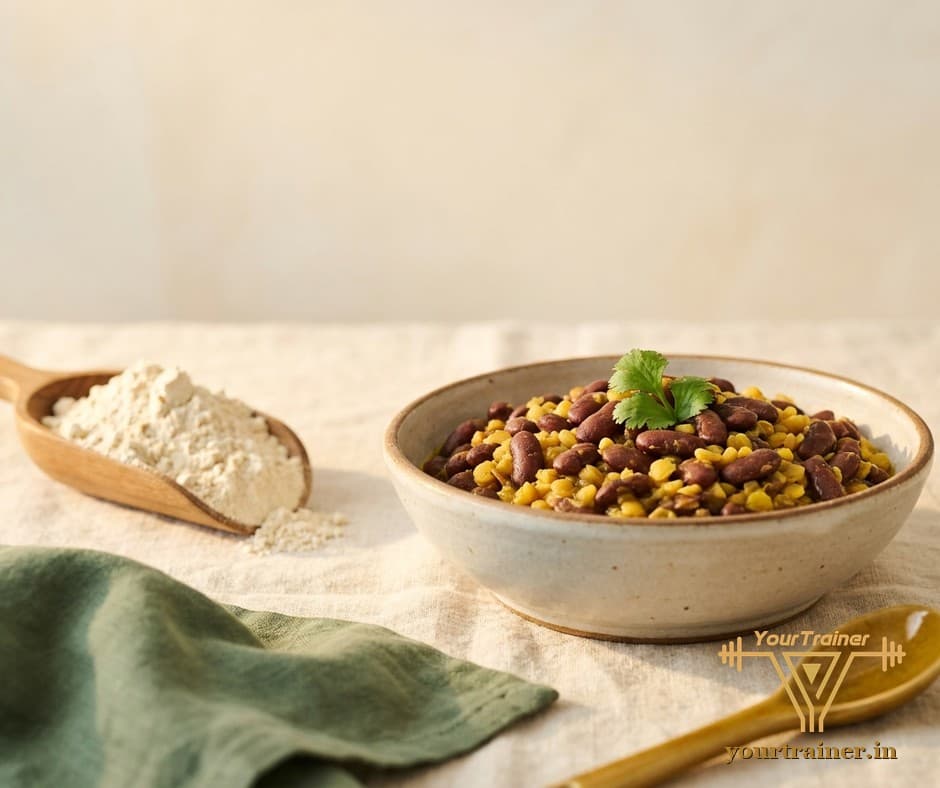
For whole foods, the real win is soaked-and-cooked chickpeas paired with rice. Chickpea DIAAS improves from 0.78 (cooked alone) to 0.88 when paired with rice (which provides methionine). That's within 8% of whey, and you're eating whole food with fiber and micronutrients intact.
Practical takeaway: Single-source plants (dal alone, tofu alone) leave 5–15% digestibility on the table. Pair them with a grain or use a blended powder, and you recover it.
Indian Sources Ranked by DIAAS: Real Numbers You Need
Here's a table of actual DIAAS scores for foods you eat. These assume standard home cooking (pressure cooker, soaking 6–8 hours, or boiling until soft). Raw versions score 20–30% lower:
| Protein Source | DIAAS | Protein / Cup (cooked) | Notes |
|---|---|---|---|
| Whey Protein Isolate | 1.09 | 25g (per scoop) | Gold standard (not vegan) |
| Soy Isolate (cooked, soaked) | 0.90 | 18g | Complete amino acid profile; affordable in India (₹300/kg) |
| Pea + Rice Blend | 0.92 | ~22g (powder) | Synergistic amino acids; India: ₹600–900/kg; USA: $40–60/month |
| Moong Dal (cooked) | 0.76 | 14g | Low methionine; pair with rice or bread for 0.82+ DIAAS |
| Chana/Chickpea (cooked) | 0.78 | 15g | Rises to 0.88 when paired with rice (dal-based), India staple |
| Rajma (cooked) | 0.62 | 15g | Lowest among legumes; must pair with rice or roti for 0.78–0.80 DIAAS |
| Paneer (cooked) | 0.95 | 28g (per 200g) | Lacto-vegetarian; high fat content (20g/200g) slows gastric emptying |
| Tofu (firm, cooked) | 0.88 | 20g (per 200g) | Versatile; cooked > raw; neutral flavor; mild estrogen concerns overblown |
Sources: USDA FoodData Central; WHO/FAO 2011 DIAAS recommendations; peer-reviewed studies on Indian legume preparations published in the Journal of Food Science & Technology. DIAAS scores assume standard home cooking methods (pressure cooker 8 min post-soak, or boiling until soft). Raw versions score 20–30% lower. Pricing: India retail (2026), USA supplement retail (USD).
Coaching that does this for you
Reading is step one. A coach turns it into a plan built around your body, food & schedule.
100% online · Indian meal plans · weekly progress reviews · daily WhatsApp support.
Start Your Journey →How Preparation Changes Everything: Three Mechanisms
DIAAS scores for dal and legumes shot up not because of genetics, but because of preparation. Three biochemical mechanisms unlock digestibility:
1. Soaking (6–12 hours)
Soaking activates phytase, an enzyme that breaks down phytic acid (which binds amino acids and minerals). After 12 hours, phytic acid drops 50–60%, freeing amino acids and improving mineral bioavailability (iron, zinc, calcium). Soaking also leaches trypsin inhibitors and lectins into the water. Drain it and discard. Impact: 10–15% digestibility gain over cooking alone.
2. Pressure Cooking or Extended Boiling
Heat denatures anti-nutritional factors further and breaks down oligosaccharides (the compounds causing bloating and gas). A pressure cooker (standard in Indian kitchens) is optimal: high heat, short time (8–10 min post-soak), reduces flatulence by 70%. A soaked + pressure-cooked chickpea has 15–20% better digestibility than cooked-without-soak.
3. Fermentation (Idli, Dosa, Tempeh)
Fermentation is the digestibility cheat code. When microbes colonize legumes (as in idli/dosa fermentation or tempeh production), they produce enzymes that pre-digest legume components. An idli is soaked rice + dal, then fermented and steamed. Its DIAAS score reaches 0.88 (vs plain steamed 0.75). Fermentation also produces short-chain fatty acids (butyrate), which fuel your colon and reduce bloating. This is why fermented plant foods outperform whole legumes on digestion and energy.
Coaching directive: "If you're bloated after dal, you're skipping the soak or using a regular pot. Soak 8 hours, drain and rinse, pressure-cook 8 minutes. Your digestion will change inside 3 days."
The Pairing Strategy: Amino Acid Complementarity
Single-source plant proteins are incomplete because they're low in one or more of the 9 essential amino acids. Methionine and leucine are the usual bottlenecks. But legumes + grains is not a modern fad, it's an ancient nutritional principle, proven by time:
- Dal + Rice (India, staple): Dal is low in methionine; rice has it. Combined DIAAS rises to ~0.82 (from 0.76–0.78 for each alone).
- Chana + Roti (North India): Chickpea curry with wheat bread. DIAAS ~0.80 when eaten as a meal (amino acid pools are sufficient within 2–4 hours; same-meal pairing is not required).
- Rajma + Rice (North India): Bean curry with rice. DIAAS ~0.78–0.80.
- Soy + Vegetable (global): Soy chunks (tofu/tempeh) with any grain. DIAAS ~0.92 (soy alone is 90%+ complete across all 9 essentials).
This is not "combining incomplete proteins at every meal" (a 1970s myth debunked by modern amino acid tracking). Your body pools amino acids over 24 hours. Eating dal at lunch and rice at dinner works. But pairing them in the same meal maximizes absorption efficiency and reduces the amino acid "gap" to near-zero.
For NRI clients and vegans buying supplements: check labels for pea + rice or pea + rice + hemp blends. Avoid single-source plant powders unless you're eating a complementary grain that day. Indian brands selling into the US (MuscleBlaze, Yoga Bar) cost USD 20–35/month for blended powders vs USD 40–60/month for whey, same digestibility, lower price.
The Math: How Much Plant Protein Do You Actually Absorb?
Once you know DIAAS, calculate your net protein absorption. If you're eating tofu (DIAAS 0.88), you absorb 88% of what you consume. To absorb 25 grams net, you need 25 / 0.88 = 28 grams total. If you're eating moong dal alone (DIAAS 0.76), you need 33 grams to absorb 25 grams net. If you're eating moong dal + rice (DIAAS 0.82), you need 30 grams.
Indian vegetarians typically need 1.6–2.0g protein per kg of body weight for muscle building (depending on age, training phase, and recovery). A 70 kg person needs 112–140 grams per day. If most sources are 0.75–0.90 DIAAS, you're absorbing 84–126 grams, so you need to eat 120–160 grams total to hit 100+ grams net. For personalized requirements, see our protein assessment.
This isn't a penalty; it's math. And it changes with preparation. Fermented sources (idli, tempeh) and soaked + cooked legumes paired with grains close the gap to whey almost entirely.
For time-pressed professionals (common among NRI communities), a soy or pea + rice protein shake at 25g per serving is your shortcut. It's 0.90 DIAAS and requires zero preparation. NRIs building muscle abroad on a vegetarian or vegan diet can hit 100g+ protein per day entirely with these strategies.
Absorption vs. Digestion: The Real Bottleneck
Here's a nuance most nutrition writing misses: digestion and absorption are not the same. Your stomach breaks down plant protein fine. The real bottleneck is your small intestine's amino acid transporter capacity.
When you eat a large amount of plant protein at once (50+ grams of lentils), your small intestine has only so many transporters for amino acids. Some amino acids get absorbed; some pass through. This is less about the plant being "indigestible" and more about dose and meal frequency.
The fix: Spread protein across 3–4 meals (aim for 25–35g per meal). This gives your intestines time to absorb each batch fully. This is especially true for whole-food sources (dal, legumes, tofu). Supplement powders (pre-concentrated) can be taken as a single 25–30g dose. This is why one giant dal meal doesn't maximize protein use, your body absorbs maybe 70% of it. Three smaller dal meals? You absorb 85%+.
Related reading from YourTrainer
Sources
- Indian Food Composition Tables (IFCT) 2017 · ICMR, National Institute of Nutrition
- Nutrient Requirements for Indians (RDA and EAR) · ICMR, National Institute of Nutrition
- Healthy diet · World Health Organization
- Dietary profiles and associated metabolic risk factors in India (ICMR-INDIAB survey) · Nature Medicine
Figures for Indian foods follow IFCT 2017 (ICMR-NIN). Coaching guidance on this site is educational and is not a substitute for medical advice. See how we use sources.
Did you find this helpful?

About Anish Agarwal
Founder & Head Coach, YourTrainer · NASM & K11 Certified Personal Trainer · coaching since 2022
Featured in Dietitians.io, Fitness Interview, NRI Pulse. Press and media
Anish Agarwal is a NASM and K11 certified personal trainer coaching fat loss, body transformation, strength, and nutrition for clients across India since 2022. He founded YourTrainer to make expert, science-based coaching accessible online and in Bengaluru. Coach Anish's profile and the YourTrainer story.
Online 1-on-1 Coaching
Start Your Journey
Get a personalised training + Indian nutrition plan built around your goal, coached online, anywhere in India or abroad.
Trusted by 1,000+ clients coached across India & abroad
Free 30-min discovery call · No obligation