Creatine for Indians: Benefits, Dosage, Veg Sources & Myths Debunked
Creatine monohydrate for Indians: how it works, why vegetarians see bigger gains, 3 to 5 g a day without loading, safety, and affordable Indian brands.
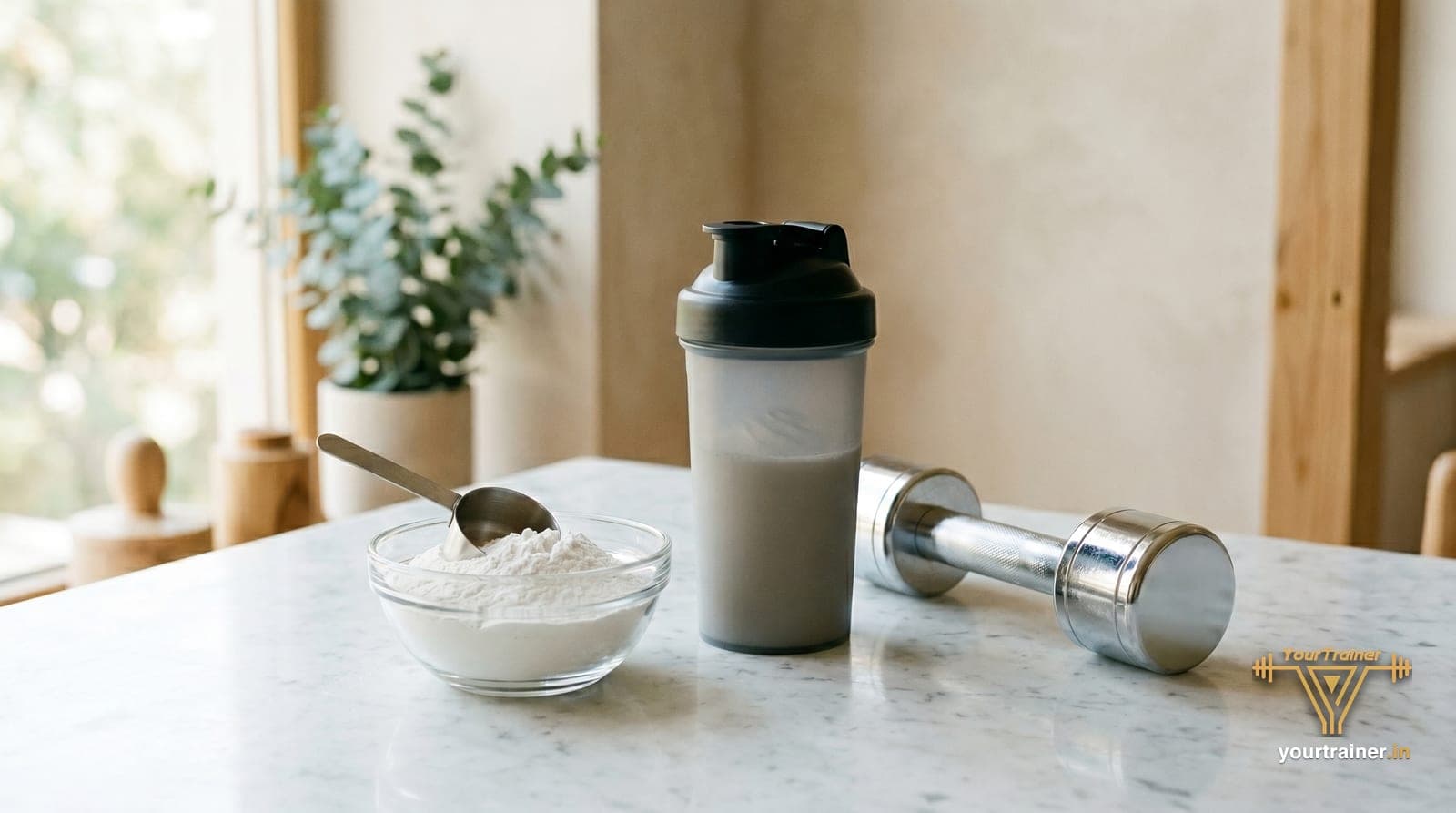
Quick answer: Creatine monohydrate is one of the most researched supplements in fitness, safe, affordable, and effective for building strength and muscle. Take 3 to 5 grams daily every day (no loading needed). Vegetarians see the biggest gain because meat and fish are the main dietary sources of creatine; supplementing gives your muscles the raw material they're missing. You'll notice stronger lifts within 2 to 3 weeks and modest water-weight gain (0.5 to 1.5 kg) as creatine pulls water into muscle cells. It's not a steroid, won't damage your kidneys if you're healthy, and works equally well for men and women. Cost: roughly ₹300 to 600 per month in India.
Creatine at a Glance
What is Creatine and How Does It Work?
Creatine is a compound your body makes naturally from amino acids (mainly in your liver and kidneys). It's stored in muscle and used during high-intensity effort, lifting weights, sprinting, intense cardio. When you perform a 1-rep max or a heavy set, your muscles burn through energy (ATP) rapidly. Creatine phosphate donates a phosphate group to regenerate ATP, extending the time your muscles can fire at maximum power.
The limit: your muscles can only hold so much creatine. If you're a meat-eater, dietary creatine from chicken, beef, and fish tops off your stores naturally. If you're vegetarian, your muscle creatine levels run 20 to 30% lower from birth, which is why supplementation creates such a noticeable difference for veg athletes.
Supplemental creatine monohydrate is synthesised in a lab (not extracted from animal tissue), so it's suitable for vegetarians and vegans. It's the most tested form, thousands of peer-reviewed studies, zero credible evidence of harm in healthy people.
Why Vegetarians See the Biggest Gain
Meat and fish are the primary dietary sources of creatine. A chicken breast has roughly 350 mg per 100g; a salmon fillet, 270 mg. Vegetarian staples, lentils, chickpeas, tofu, paneer, contain almost no creatine.
Result: vegetarian and vegan athletes start with lower muscle creatine saturation. When they supplement with 3 to 5 g daily, their muscles rapidly fill up to the same level as meat-eaters. The difference is measurable:
- Strength gains: 5 to 15% improvement in max lifts within 2 to 3 weeks (vegetarians often see the high end of this range)
- Endurance in high reps: More reps before fatigue in sets of 6 to 15 reps
- Recovery between sets: Faster ATP regeneration means tighter rest periods feel easier
- Muscle pump: Water shifts into muscle cells, so muscles look fuller and feel "harder"
Non-vegetarians see the same benefits but slightly smaller in magnitude (since they're starting from a higher baseline). Everyone wins with creatine, it's just that vegetarians see the most dramatic response.
Dosing and Timing: The Simple Truth
Forget "loading protocols." Research shows they don't matter:
| Protocol | Timeline to Effect | Why It Works |
|---|---|---|
| Loading (20g/day, 5 to 7 days) | 3 to 5 days (muscle saturation rapid) | Floods muscles quickly; comes with bloating and GI upset |
| Standard (3 to 5g/day, every day) | 12 to 16 days (steady rise to saturation) | Steady muscle accumulation; zero side effects; achieves same end result |
| No loading, skip doses | 21+ days (much slower) | Inconsistent intake delays saturation; not worth it |
Recommendation: Just take 3 to 5 g daily, every day, no loading. Add it to your post-workout shake or morning tea. Timing doesn't matter; consistency does. After 2 to 3 weeks, you'll feel stronger. Stick with it for 8 to 12 weeks to see full benefit.
Cost in India: Creatine monohydrate powder in India costs ₹300 to 600/month from brands like Optimum Nutrition, Muscletech, or local alternatives (Healthkart, MuscleBlaze). Buy a 1 kg tub and a cheap milligram scale; 1 tsp is roughly 5g. Avoid expensive "advanced" forms, creatine ethyl ester, buffered creatine, they don't work better and cost 2 to 3x more.
Building Strength and Muscle With Creatine
Creatine doesn't build muscle on its own. It enables your muscles to work harder and recover faster. Here's how to maximise it:
- Strength training 3 to 5 days/week: Focus on compound lifts (squats, deadlifts, bench press, rows). Creatine helps you add reps or weight each week, this progressive overload is what drives muscle growth.
- Protein intake: 1.6 to 2.2 g per kg body weight daily. Creatine only works if your muscles have the amino acids to build with. For a 70 kg person, that's 112 to 154g protein daily. Vegetarian options: paneer, tofu, lentils, chickpeas, Greek yoghurt, protein powder.
- Calories: Eat in a small surplus (200 to 300 cal/day above maintenance) if building muscle. If cutting fat, eat at maintenance or slight deficit, paired with high protein, creatine still helps preserve muscle.
- Water intake: Creatine draws water into muscles, so drink 3 to 4 L daily. Don't under-hydrate or you risk cramps.
Combined, creatine + progressive training + high protein = measurable muscle gain. Expect a quick 1 to 2 kg from water drawn into the muscle in the first weeks, and then slow lean-mass gains that depend on training and protein, not on creatine alone.
Coaching that does this for you
Reading is step one. A coach turns it into a plan built around your body, food & schedule.
100% online · Indian meal plans · weekly progress reviews · daily WhatsApp support.
Start Your Journey →Safety: Myths vs Reality
Creatine is one of the most studied supplements in sports nutrition. Here's what research actually shows:
Myths vs Facts
❌ Myth: Creatine is a steroid
Fact: Steroids are synthetic hormones that alter your endocrine system. Creatine is a naturally occurring metabolite with zero hormonal effect. It's in your body right now.
❌ Myth: Creatine damages kidneys
Fact: Creatine is filtered by kidneys and excreted. In people with normal kidney function, years of supplementation shows no kidney damage. If you have kidney disease, avoid it, but healthy people are safe.
❌ Myth: You must cycle on and off
Fact: Your muscles adapt to steady creatine; cycling doesn't change this. Take it continuously without breaks. When you stop, levels drop back to baseline over 4 to 6 weeks.
❌ Myth: Creatine is only for men
Fact: Women get the same strength and muscle gains as men. Creatine doesn't raise testosterone or cause virilisation. Female athletes use it routinely.
❌ Myth: It's only for bodybuilders
Fact: Creatine helps anyone doing high-intensity effort, strength athletes, runners, field sports, even endurance cyclists. One meta-analysis found it improves repeated-sprint performance by 5 to 15%.
Indian Protein Sources to Pair With Creatine
Creatine only builds muscle if you eat enough protein. Here's a vegetarian-friendly reference for India:
| Source (per 100g / serving) | Protein (g) | Cost (₹) | Best For |
|---|---|---|---|
| Paneer (100g) | 18 to 22 | 40 to 60 | Versatile, daily staple |
| Tofu (100g) | 15 to 17 | 30 to 50 | Lean, mild flavour |
| Chickpeas (cooked, 1 cup) | 12 to 15 | 15 to 25 | Fibre + protein, budget option |
| Greek Yoghurt (100g) | 10 to 12 | 35 to 50 | Post-workout, quick snack |
| Lentils (cooked, 1 cup) | 9 | 10 to 15 | Carbs + protein, filling |
| Whey Protein Powder (1 scoop) | 20 to 25 | 2 to 4 per serving | Convenient, fast absorption |
Aim for 1.8 to 2.2 g protein per kg body weight. A 70 kg person needs 126 to 154 g daily. Spread it across 3 to 4 meals to maximise muscle-protein synthesis.
Creatine for Indians: Practical Considerations
A few India-specific notes:
- Water quality: Creatine is hydrophilic (loves water). If your tap water is heavily chlorinated or mineral-heavy, use filtered water. This won't affect creatine's efficacy but may reduce any GI upset.
- Summer heat: Creatine powder is stable at room temperature but store it in a cool, dry place. In coastal cities (Mumbai, Goa) or during peak summer (Delhi, Bangalore May to June), keep it in an airtight container or small fridge compartment to prevent moisture absorption.
- NRIs and overseas shipping: If you're an NRI, creatine monohydrate is legal to import into most countries. Cost is usually cheaper online from Indian sites (Healthkart, MuscleBlaze) than Western brands like Optimum Nutrition. Shipping typically takes 7 to 10 days.
- Budget alternative: Some gyms in India stock "unbranded" creatine monohydrate at ₹200 to 400 per kg. Quality can vary, so buy from a reputable gym or retailer with good reviews.
✓ The bottom line: Creatine monohydrate is safe, cheap, and backed by decades of research. For vegetarians in India especially, it's a no-brainer if you're serious about building strength. Take 3 to 5 g daily, eat enough protein, train hard, and you'll see measurable results in 2 to 3 weeks.
Ready to Build Real Strength?
Creatine works best as part of a complete plan, progressive training, solid nutrition, and recovery. If you're ready to dial in your entire approach to fitness, talk to an online strength coach who can build a personalised program and nutrition plan tailored to your goals and budget.
If you want to explore more nutrition strategies for muscle-building, check out our guide on Indian protein sources ranked and see what other fitness athletes in India are doing.
Have questions about creatine, supplementation, or your training plan? Start your free discovery call with Coach Anish, we'll assess your goals and build a roadmap that actually works.
Sources
- Indian Food Composition Tables (IFCT) 2017 · ICMR, National Institute of Nutrition
- Nutrient Requirements for Indians (RDA and EAR) · ICMR, National Institute of Nutrition
- Healthy diet · World Health Organization
- Dietary profiles and associated metabolic risk factors in India (ICMR-INDIAB survey) · Nature Medicine
Figures for Indian foods follow IFCT 2017 (ICMR-NIN). Coaching guidance on this site is educational and is not a substitute for medical advice. See how we use sources.
⚠ Lifestyle coaching information only. Not medical advice. Creatine monohydrate is safe for healthy people but not recommended for anyone with existing kidney disease, liver disease, or unmanaged diabetes. Always confirm dosage and timing with your doctor or sports nutritionist, especially if you have underlying health conditions.
Did you find this helpful?

About Anish Agarwal
Founder & Head Coach, YourTrainer · NASM & K11 Certified Personal Trainer · coaching since 2022
Featured in Dietitians.io, Fitness Interview, NRI Pulse, The MASALA Study. Press and media
Anish Agarwal is a NASM and K11 certified personal trainer coaching fat loss, body transformation, strength, and nutrition for clients across India since 2022. He founded YourTrainer to make expert, science-based coaching accessible online and in Bengaluru. Coach Anish's profile and the YourTrainer story.
Online 1-on-1 Coaching
Start Your Journey
Get a personalised training + Indian nutrition plan built around your goal, coached online, anywhere in India or abroad.
Trusted by 1,000+ clients coached across India & abroad
Free 30-min discovery call · No obligation