
Guide, Indian food after delivery
Postpartum Diet Plan Indian
Sample days for vegetarian and non veg meals, one set while breastfeeding and one set without. Every number comes from ICMR-NIN or from our Indian food table, and the honest notes are at the end.
- Extra energy a day, first 6 months of lactation
- +600 kcal
- Extra protein a day, first 6 months of lactation
- +13.6 g
- Lactating reference, first 6 months
- about 2,245 kcal, 77 g
- Rest at home after delivery, one South India study
- 40 days
Your targets
Energy and protein, by reference
These are reference figures for adult women from the ICMR-NIN guidelines, not a personal plan. Your doctor or dietitian sets your numbers.[1]
| Who | Energy | Protein |
|---|---|---|
| Breastfeeding, months 0 to 6 (extra) | +600 kcal a day | +13.6 g a day |
| Breastfeeding, months 7 to 12 (extra) | +520 kcal a day | +10.6 g a day |
| Lactating woman, food group example, months 0 to 6 | about 2,245 kcal | about 77 g |
| Woman, sedentary, food group example | about 1,600 kcal | about 55 g |
Sample days
Four days, with the numbers in each meal
Totals come from the portions in our Indian food table, so they are estimates. Use them to see the shape of a day.[2]
Vegetarian, breastfeeding
about 2,220 kcal, 91 g protein
- Breakfast (310 kcal, 17 g): 1 moong dal chilla, 1 glass toned milk
- Mid-morning (145 kcal, 8 g): 1 katori roasted chana
- Lunch (675 kcal, 23 g): 2 rotis with ghee, 1 katori dal toor, 1 katori mixed veg, 1 katori curd
- Evening (88 kcal, 2 g): 1 katori roasted makhana
- Dinner (857 kcal, 33 g): 3 rotis (1 with ghee), 1 katori palak paneer, 1 katori moong dal, 1 katori lauki sabzi
- Bedtime (145 kcal, 8 g): 1 glass toned milk
Non veg, breastfeeding
about 2,190 kcal, 113 g protein
- Breakfast (485 kcal, 26 g): 2 eggs as bhurji, 1 roti, 1 glass toned milk
- Mid-morning (88 kcal, 2 g): 1 katori roasted makhana
- Lunch (695 kcal, 42 g): 2 rotis, 1 katori home chicken curry, 1 katori dal toor, 1 katori curd
- Dinner (922 kcal, 43 g): 3 rotis with ghee, 1 katori fish curry, 1 katori mixed veg, 1 katori moong dal
Vegetarian, not breastfeeding
about 1,570 kcal, 74 g protein
- Breakfast (338 kcal, 20 g): 2 besan chillas, 1 katori toned curd
- Mid-morning (105 kcal, 9 g): 1 katori boiled sprouts
- Lunch (560 kcal, 21 g): 2 rotis, 1 katori dal toor, 1 katori mixed veg, 1 cup chai without sugar
- Dinner (565 kcal, 25 g): 1 bajra roti, 1 roti, 1 katori moong dal, 1 katori gobi sabzi, 1 katori toned curd
Non veg, not breastfeeding
about 1,460 kcal, 79 g protein
- Breakfast (331 kcal, 19 g): 2 boiled eggs, 1 roti, 1 cup chai without sugar
- Lunch (618 kcal, 37 g): 2 rotis, 1 katori fish curry, 1 katori mixed veg, 1 katori toned curd
- Dinner (507 kcal, 23 g): 1 roti, 1 katori dal toor, 1 katori gobi sabzi, 1 katori moong dal
The breastfeeding days sit near the lactation reference, so they are not a calorie cut. The non breastfeeding days sit near the sedentary reference of about 1,600 kcal.
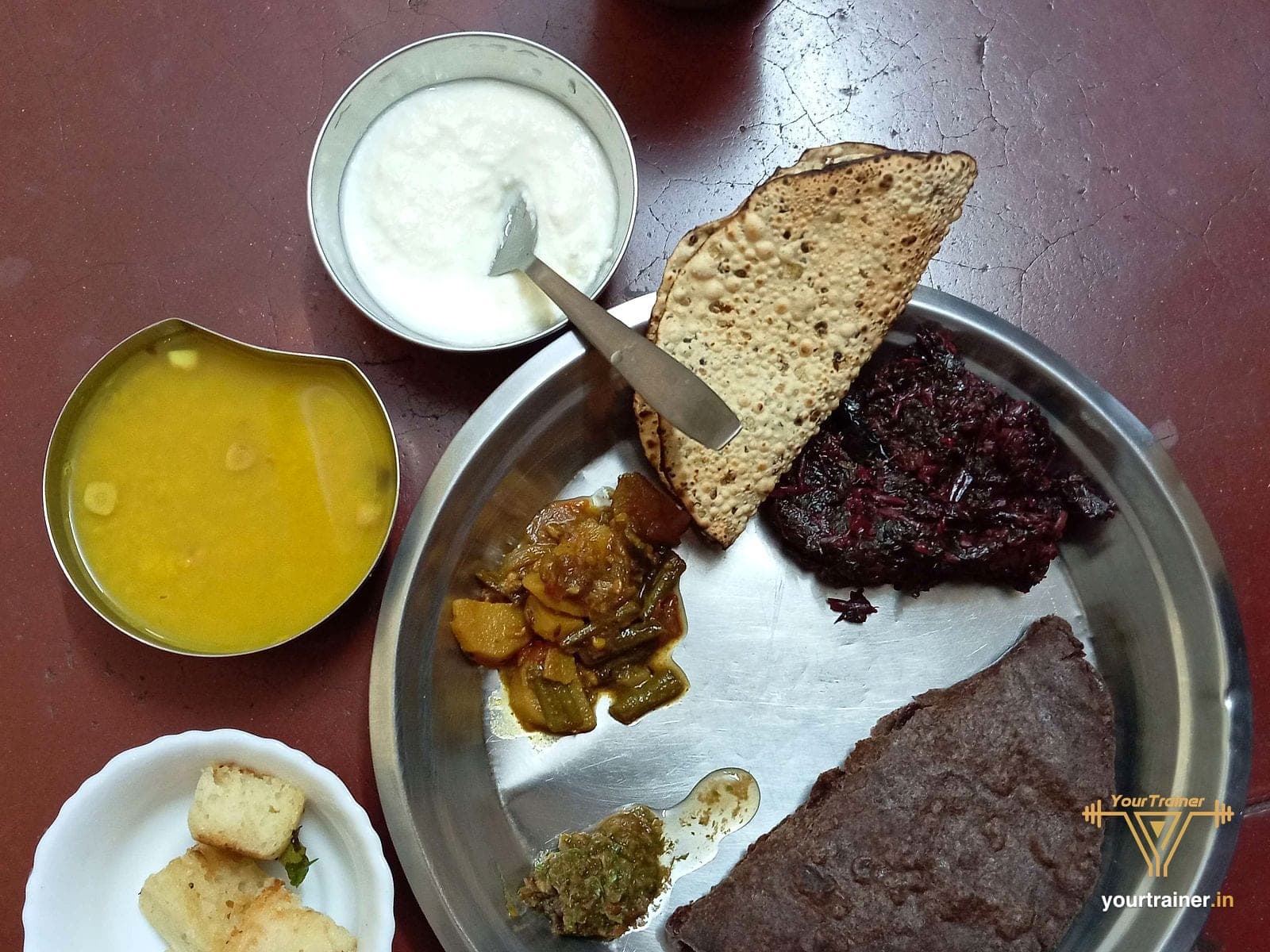
Traditional foods
Real numbers from our food table
Ghee, dal, laddoos and dry fruit all appear in the same table. Where a food is not in it yet, we say so rather than guess.
| Food | Serving | kcal | Protein (g) | Note |
|---|---|---|---|---|
| Ghee | 1 tsp (5 g) | 45 | 0 | The main calorie driver in laddoos and panjiri |
| Moong dal | 1 katori (150 g) | 132 | 8.5 | Protein for the calories |
| Toor dal, home style | 1 katori (150 g) | 140 | 8.0 | Standard home dal with a light tadka |
| Roasted chana | 1 katori (40 g) | 145 | 8.0 | Crunchy and filling |
| Roasted makhana | 1 katori (25 g) | 88 | 2.4 | Light snack, low in protein |
| Roasted peanuts | 1 katori (35 g) | 200 | 9.0 | Calorie heavy: a handful adds up |
| Besan laddu | 1 piece (45 g) | 200 | 3.5 | Calorie heavy for the protein it gives |
| Soya chunks, cooked | 100 g | 172 | 26 | The highest protein per calorie in our table |
| Full fat curd | 1 katori (150 g) | 90 | 5.0 | Toned curd is 68 kcal |
| Toned milk | 1 glass (250 ml) | 145 | 8.0 | Full cream is 185 kcal |
| Wheat roti, plain | 1 roti (40 g) | 120 | 3.5 | With ghee it is 160 kcal |
| Bajra roti | 1 roti (45 g) | 130 | 3.8 | More fibre than wheat |
| Dal makhani | 1 katori (150 g) | 285 | 9.0 | Cream and butter make it the heaviest dal |
| Butter chicken | 1 katori (150 g) | 340 | 20 | Calorie heavy on restaurant menus |
Not in our table yet, so no number
Ragi (finger millet), methi (fenugreek seeds), ajwain (carom seeds), gond laddoo, panjiri and dry fruit laddoo. Recipes vary a lot, so one number would mislead. Ask for the ghee, sugar or jaggery in the recipe and count those first.
Honest notes
What to know before you start
Laddoos and panjiri are calorie heavy
Mostly ghee, nuts, seeds and sugar or jaggery. A small piece with a meal fits. A handful after every feed adds up fast.Methi and ajwain for milk
The evidence is weak. A 2020 Cochrane review found only low certainty evidence that oral galactagogues raise milk volume.[4] Ask your doctor before any supplement.Family food pressure
Many families push ghee, laddoos and rich soups in the first weeks. Build your plate first: one protein, one dal or curd, vegetables and a roti. Let others add to it, not replace it.Rest comes with the food
In a South India study, mothers were kept home for 40 days after delivery, and 86.3 percent did not go out for walks. Only 19 percent did any exercise.[3] Walking, breath and sleep are part of the plan too.
Call the same day for a high temperature over 38C or heavier bleeding.[5] Food is never a reason to wait.
Keep going
Keep going
FAQ
Frequently asked questions
Which Indian foods give the most protein for the calories?
In our table, grilled chicken breast gives 31 g protein for 165 kcal per 100 g, and cooked soya chunks give 26 g for 172 kcal per 100 g. Moong dal gives 8.5 g for 132 kcal per katori. Paneer is protein rich but also fatty, at 265 kcal per 100 g raw.
Are gond laddoo and panjiri good after delivery?
They are mostly ghee, nuts, seeds and sugar or jaggery, so they are calorie heavy. Our table has one teaspoon of ghee at 45 kcal. Take one small piece with a meal, not a handful after every feed. Their exact numbers depend on the recipe, so we do not publish one.
Can methi or ajwain increase breast milk?
The evidence is weak. A Cochrane review (2020) found only low certainty evidence that oral galactagogues increase milk volume, and fenugreek safety still needs study. Eating methi in a sabzi is one thing, but ask your doctor before taking it as a supplement.
How much protein do I need while breastfeeding?
ICMR-NIN adds 13.6 g of protein a day in the first 6 months of lactation, on top of your normal need, and 10.6 g in months 7 to 12. The food group example for a lactating woman gives about 77 g a day in the first 6 months.
Can I eat less to lose weight while breastfeeding?
Not much. The extra 600 kcal a day in the first 6 months is part of the plan, so a small cut should come from that extra and keep protein high. Set the pace with the calculator and check the plan with your doctor or dietitian.
Is ragi a good food after delivery?
Ragi is a whole grain and works well as one roti in place of wheat, if you like it. It is not in our food table yet, so this guide shows no number for it. Check the flour label for calories per 100 g.
Sources
- ICMR-NIN. Dietary Guidelines for Indians 2024. Extra 600 kcal and 13.6 g protein a day in the first 6 months of lactation, 520 kcal and 10.6 g in months 7 to 12 (p. 32). Food group examples for lactating and sedentary women (p. 146). nin.res.in/dietaryguidelines/pdfjs/locale/DGI_2024.pdf
- YourTrainer Indian food table (apps/web/lib/indian-food-data.ts), built from IFCT 2017 (ICMR-NIN) and USDA values for shared ingredients. Per household portion, cooked. www.yourtrainer.in/indian-food-calorie-calculator
- Rao CR, Dhanya SM, Ashok K, Niroop SB. Assessment of cultural beliefs and practices during the postnatal period in a coastal town of South India: a mixed method study. Global Journal of Medicine and Public Health 2014;3(5). nicpd.ac.in/ojs-/index.php/gjmedph/article/download/4040/3143/7088
- Cochrane Database of Systematic Reviews. Galactagogues for breastfeeding women (CD011505, 2020): low certainty evidence that oral galactagogues raise milk volume; safety of fenugreek needs study. cochranelibrary.com/cdsr/doi/10.1002/14651858.CD011505.pub2/information/es
- NHS. Early days after the birth: call your GP, midwife or health visitor for a high temperature over 38C, worsening tummy pain or heavier bleeding. www.nhs.uk/pregnancy/labour-and-birth/after-the-birth/early-days
Reviewed by Vishnu Priya, Clinical Dietitian (MSc Nutrition and Dietetics), on · Updated
A plan works when it fits your kitchen, your family's meals and your check-up. A free 15-minute call with a coach can start that plan.
Start Your Journey