Rice or Chapati for Diabetes? What Real Member Plates Show
On coached members' plates a rice meal and a roti meal carried the same 57 g of carbs. Why chapati's edge is small, the plate our coaches build for diabetes, and how to test it on your own glucometer.
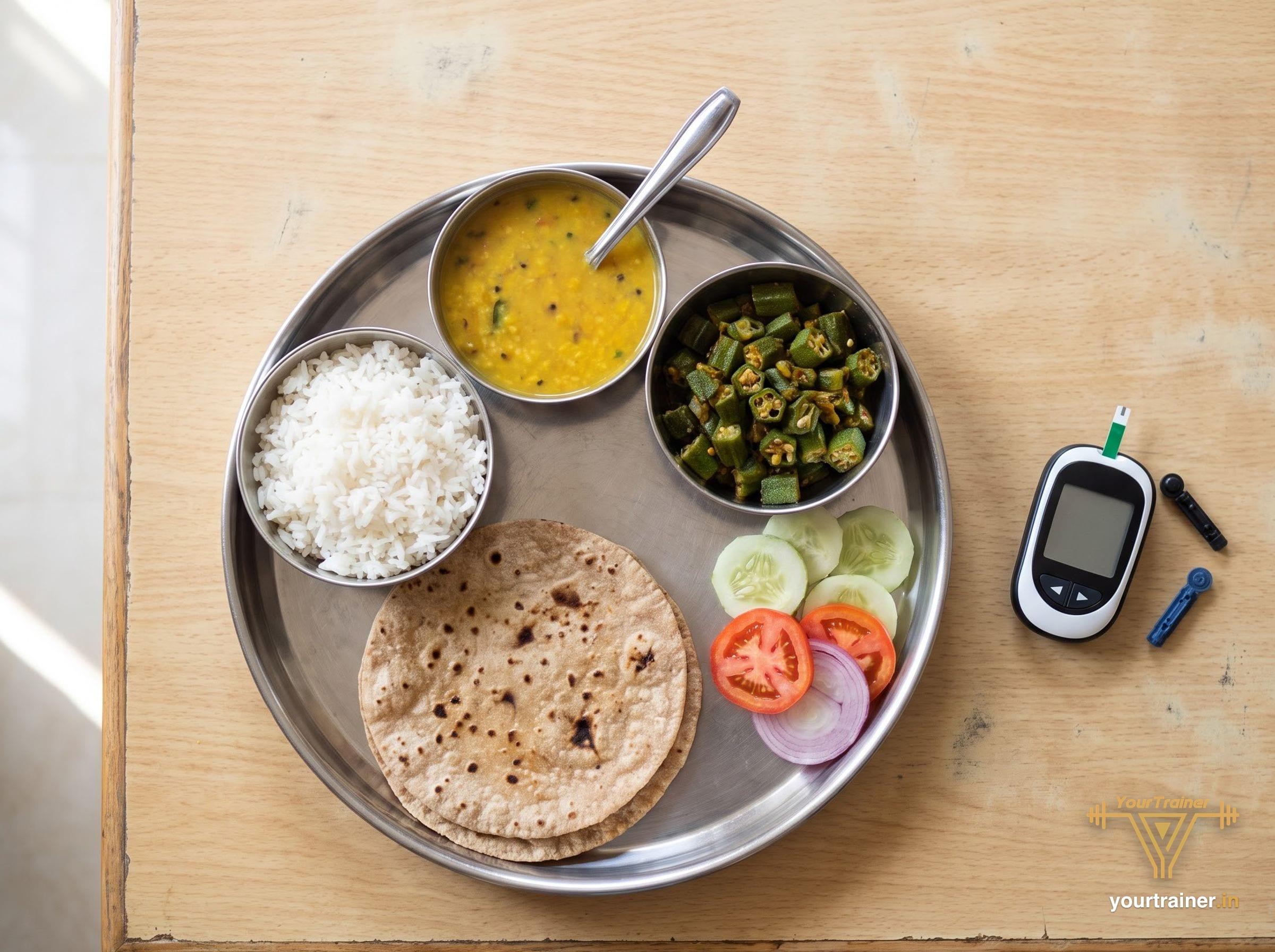
"Rice or chapati?" is the first food question almost every diabetic member asks, often with a family member already sure of the answer. Most Indian advice says chapati wins. We looked at real lunch and dinner plates logged by coached members to see what actually differs between a rice meal and a roti meal, and the answer was more useful than a winner.
Method: a sample of lunches and dinners logged in the YourTrainer app by coached members, 19 Apr to 12 Oct 2026, with carbohydrate and protein from the app's food database. Medians, not averages, so one big meal does not skew them. Members anonymised. Research is from the ICMR-INDIAB study.
The short answer
Both raise blood sugar, and on our members' plates a rice meal and a roti meal carried the same median carbohydrate, 57 g. Whole wheat or millet rotis have more fibre than white rice, which helps, but the portion and what sits next to it matter more than the choice. Keep the grain to about a quarter of the plate, add dal, paneer, egg or chicken, fill half with vegetables, and check your own glucometer two hours after the meal.
Our data
57 g
median carbs in a rice meal, and the same in a roti meal
25.0%
of member meals had rice only; 15.7% roti only
82.7%
of rice meals included a protein
45.3%
of rice meals included vegetables
From our members' own food logs
Source: YourTrainer food logs, a sample of member lunches and dinners, Apr to Oct 2026
What the plates showed
| Rice meals | Roti meals | |
|---|---|---|
| Share of all meals | 25.0% (plus 3.9% with both) | 15.7% |
| Median carbohydrate | 57 g | 57 g |
| Median protein | 20.3 g | 20.75 g |
Once a coach has set the portion, the grain stops being the big variable. A katori of cooked rice and two medium rotis carry a similar amount of carbohydrate, and that is roughly the size of a coached portion. And more than half the meals, 55.4%, had neither rice nor roti: dal and sabzi, eggs, salads, millets, or a protein with vegetables.
The gap that did show up was vegetables. 82.7% of rice meals had a protein on the plate, which is good, but only 45.3% had vegetables. That is the easiest fix on the plate, and it matters for blood sugar more than swapping rice for roti.
Why chapati still has an edge, and why it is small
A whole wheat or millet roti carries more fibre than a katori of polished white rice, and fibre slows how fast sugar enters the blood. So like for like, carb for carb, a whole-grain roti is a slightly gentler choice. But four rotis are not gentler than one katori of rice, and maida rotis or a ghee-heavy paratha lose most of the advantage. Brown rice, red rice, hand-pounded rice and millets close the gap from the other side.
The bigger picture is total carbohydrate. The ICMR-INDIAB study, which analysed the diets of more than 18,000 Indian adults, worked out that remission in newly diagnosed diabetes was most likely with carbohydrate at about 49 to 54% of daily energy and protein at 19 to 20%. Its conclusion was to reduce the share of carbohydrate and increase protein, not to ban a particular grain.
Blood sugar, coached
Knowing what spikes your sugar is step one. A week of meals, walks and strength sessions that keep it steady is the hard part.
A YourTrainer coach and nutritionist plan your Indian meals, add strength training three days a week and check your logs every week, alongside your doctor, who stays in charge of medication.
Start Your JourneyStart from here:Diabetes and pre-diabetes coaching·For Indians in the USA
How our coaches build a diabetic plate
Grain to a quarter of the plate. One katori of cooked rice, or two medium rotis. A sensible starting point that your glucometer then fine-tunes.
Protein to a quarter. A katori of dal, rajma or chole, paneer, two eggs, curd, or a piece of chicken or fish. Protein slows the rise and keeps you full.
Vegetables to half. Sabzi, salad or both. This is the gap our member plates showed, so coaches check for it in food logs.
Eat in order if it helps. Some members eat the vegetables and protein first and the rice or roti last. It is a simple habit worth testing on your own meter.
Walk after the meal. A 10 to 15 minute walk after lunch and dinner. We showed one diabetic member's real readings in post-meal walking and blood sugar.
Coach's tip: Test, do not guess. Eat your usual rice meal one day and your usual roti meal another day, same time, same activity, and check your glucometer two hours after each. Your own numbers beat any list. Your doctor sets your target range.
Rice is not off the menu
For many South Indian, Bengali and Odia families, telling someone with diabetes to give up rice often means they give up the plan instead. So our coaches keep rice for the members who love it and change the portion, the plate around it and the walk after it. If weight is your worry too, our post on whether rice makes you gain weight looks at the same food logs from that angle.
Medicine is your doctor's call. If you take insulin or a sulphonylurea, changing your carbohydrate suddenly can cause low sugar, so tell your doctor before you change your meals. The diabetes reversal coaching page explains how our coaches and nutritionist work alongside your doctor.
Want a coach to build your plates around rice, roti and your glucometer?
Start Your JourneySources
- Anjana RM et al. Macronutrient recommendations for remission and prevention of diabetes in Asian Indians based on a data-driven optimization model: the ICMR-INDIAB national study. Diabetes Care 2022. PubMed 36350789
- Anjana RM et al. Metabolic non-communicable disease health report of India: the ICMR-INDIAB national cross-sectional study. Lancet Diabetes Endocrinol 2023. PubMed 37301218
Related reading
- Diabetes Plate Builder: build your plate and test rice against roti on your meter
- Diabetes reversal coaching: how we work
- Does rice make you gain weight? Real food logs
- Post-meal walking: a diabetic member's real readings
- Type 2 diabetes reversal: an Indian meal plan
- Indian portion sizes: katori, roti and rice in grams
Did you find this helpful?

About Anish Agarwal
Founder & Head Coach, YourTrainer · NASM & K11 Certified Personal Trainer · 5+ years coaching
Featured in Fitness Interview, Dietitians.io, NRI Pulse, The MASALA Study. Press and media
Anish Agarwal is a NASM and K11 certified personal trainer coaching fat loss, body transformation, strength, and nutrition for clients across India, with 5+ years coaching. He founded YourTrainer to make expert, science-based coaching accessible online and in Bengaluru. Coach Anish's profile and the YourTrainer story.
Online 1-on-1 Coaching
Start Your Journey
Get a personalised training + Indian nutrition plan built around your goal, coached online, anywhere in India or abroad.
Trusted by 1,000+ clients coached across India & abroad
Free 30-min discovery call · No obligation