
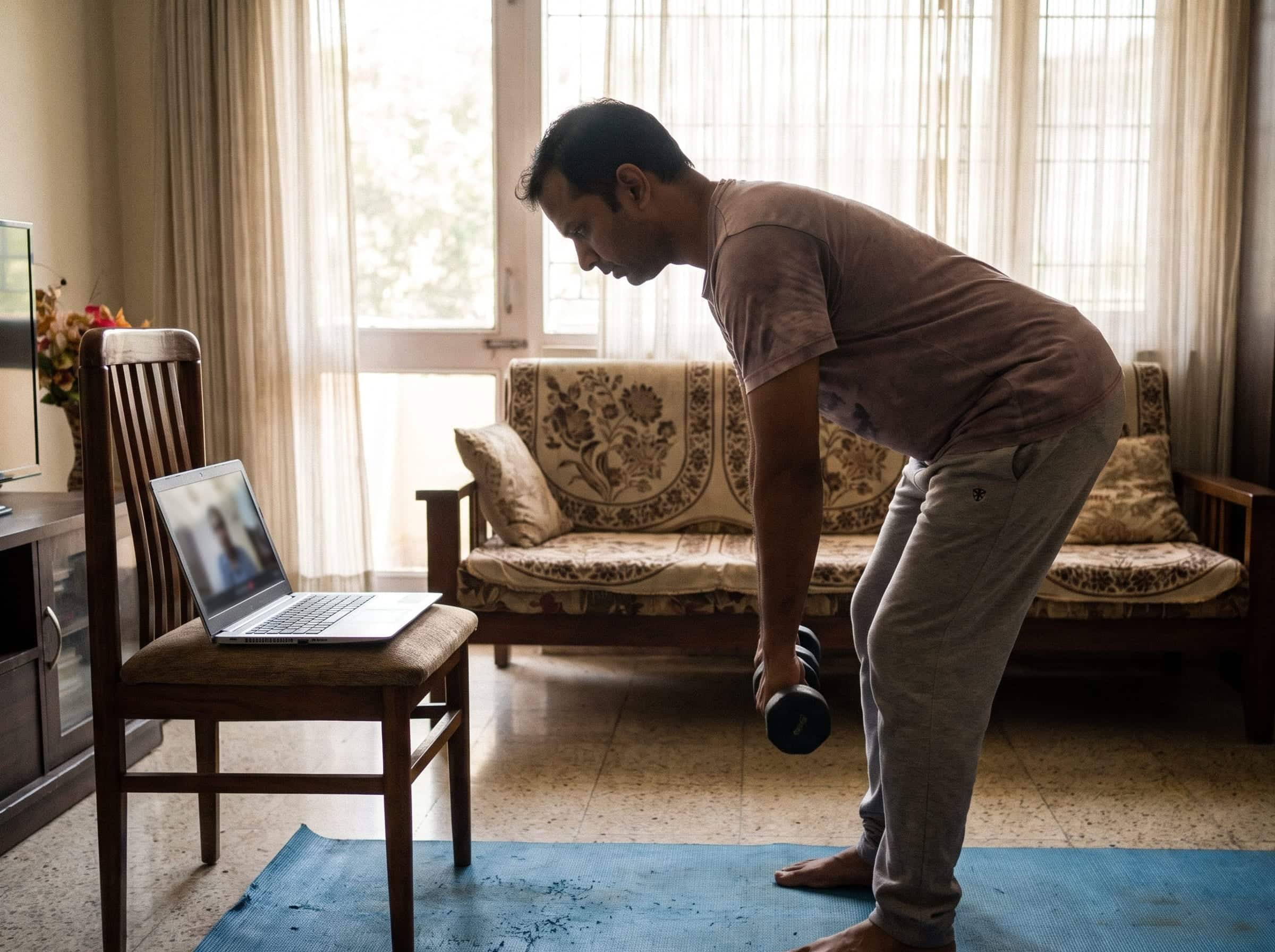
Lower back pain coaching, online
Lift again, without fearing your back.
1-on-1 strength coaching that checks your back every set, puts form before load and builds the core and hip strength that takes pressure off it.
Online, 1-on-1, from home or your gym. We work alongside your doctor or physio.
Who this is for
- Desk workers whose lower back stiffens by evening
- People who stopped lifting after a back strain
- Anyone told by a doctor or physio to strengthen their core and hips
- New parents and carers whose back aches from lifting and bending
What a coached week looks like
- 1Check in every setThe coach asks about your back after each set and adjusts before anything flares.
- 2Form before loadIf a dumbbell triggers pain, it goes down and the movement gets cleaned up first.
- 3Build the trunk and hipsCore holds, glute and hamstring strength grow steadily so daily lifting feels easier.
How we coach
How your coach runs every session
- Form corrected as you moveYour coach watches every rep on video and fixes your position in real time.About 10 corrections in a typical session
- Shown first, then you tryThe coach demonstrates the movement on camera, then watches you do it.67% of sessions
- Every rep counted with youYour coach counts the reps aloud and pushes you through the last ones.Every session we reviewed
- Mobility to startJoints and spine warmed up before any load goes on.At least 82% of sessions
- Stretching to finishSessions close with stretches for the muscles you trained.At least 84% of sessions
- Knowledge you keepThe coach explains why each exercise and cue matters, so you can train well on your own.About 2 in 3 sessions
- Habits for the days betweenSteps, water, sleep and protein tasks, checked at your next session.Water and steps come up in about 6 in 10 sessions
Corrections, explaining why, water and steps: a sample of recorded coached sessions, 17 Aug to 21 Oct 2026. The rest: 1-on-1 sessions recorded 1 to 21 October 2026, each reviewed in full. Some recordings start after the warm-up, so the mobility and stretching shares are a floor.
“Less than 3, I would say manageable, but if the pain is 5, we shouldn't push it.”
Where the training goes
- A 2021 Cochrane review of 249 trials found moderate-certainty evidence that exercise helps chronic low back pain more than no treatment, usual care or placebo.
- The 2017 American College of Physicians guideline puts non-drug treatment, including exercise, first for chronic low back pain.
- NICE NG59 suggests a group exercise programme for a flare-up, and encourages people to keep up normal activity.
Sample week
A week that trains the trunk and hips without flaring the back
Two strength sessions, one low-impact interval session, and walking or easy movement on the days between. The coach changes load before movement. Anything numb, weak or getting worse goes to your doctor first.
Your days, your times. You pick the days and the hours, in your own time zone, and a session can move when your week changes.
See the week day by day
- MonStrength and conditioningGoblet squat to box, dead bug, glute bridge, bird dog. Your coach asks about the back after every set.
- TueActive recoveryWalk 30 min, plus hip and hamstring mobility. A desk break every 45 min: stand and walk 2 minutes.
- WedStrength and conditioningHip hinge with a light dumbbell, side plank, seated row, step-up. Any load that pulls the back comes down.
- ThuActive recoveryEasy walk, swim or cycle. Gentle cat-cow and child's pose. Note how the back feels when you wake.
- FriLow-impact intervalsInstead of HIIT: bike or incline-walk intervals, then Pallof press and a light farmer carry. No jumping.
- SatNutrition callWeekly call with your nutritionist about what you ate and what changes next week.
- SunRestFull rest, or an easy 20 min walk.
Friday is low-impact on purpose: no jumping and no heavy lifting while the back settles. Each week we review pain out of 10 per session, lifting load, steps and sleep.
From our coaching data
Lower back pain: how we train around it
Lower back pain is the condition our members list most often in the app. For most people without red flags, guidelines recommend staying active and exercising rather than resting. And pain does not get skipped: in a sample of our recorded classes (17 Aug to 21 Oct 2026), coaches asked about pain in over half of them.
1 in 4
people filling our assessment report back pain
#1
condition members list in the YourTrainer app
1 in 4
recorded classes include a lower back check-in or adjustment
First
ACP lists exercise among the first treatments for chronic low back pain
Source: YourTrainer assessment answers (a sample, Sep to Oct 2026), app profiles and recorded classes (Aug to Oct 2026); ACP (2017); NICE NG59. See the method and cite this data
How our coaches handle it in sessions
From recorded YourTrainer sessions and chats, members anonymised.
Ask after the set, not only before
"Any discomfort, lower back pain or something?" is one of the most repeated lines in our recordings.
Drop the load before the movement
"Just don't use a dumbbell for now if it's giving you back pain. Make your posture right." Form first, weight later.
Brace and test
Core holds are timed, and the coach checks the back stays quiet before adding difficulty.
Strong hips, strong back
Glute, hamstring and core strength are built steadily, because a stronger trunk and hips take load off the lower back.
What the published evidence says
American College of Physicians · 2017
For chronic low back pain, start with non-drug treatment, including exercise.
Noninvasive treatments for acute, subacute and chronic low back painNICE · 2016, updated 2020
Consider a group exercise programme, and encourage people to keep up normal activities.
Low back pain and sciatica in over 16s: assessment and management (NG59)
Talk to your doctor first if
- Get urgent medical help for numbness around the groin or buttocks, new bladder or bowel problems, or weakness in a leg.
- See a doctor first for back pain with fever, unexplained weight loss, a recent fall, or pain that is worse at night at rest.
- Diagnosed slip disc or sciatica? Share your doctor's or physio's advice so the plan follows it.
Your doctor stays in charge of your medication, and we coach alongside their care.
Read next
- Strength training with lower back pain: what coaches change
- Pilates vs gym for weight loss and back pain
- Online strength training with a coach
- How online personal training works
Get a plan built around your back
Answer a few questions, then talk it through with a coach on a free call.
Start Your JourneyFAQ
Common questions
Is it safe to lift weights with lower back pain?
For most lower back pain without red flags, staying active is better than rest, and guidelines from the American College of Physicians and NICE recommend exercise. Lifting is safe when the load is right and the form is checked, which is why our coaches drop the weight before they change the movement.
What exercises are good for lower back pain?
Core holds such as dead bugs and planks, glute bridges, hip hinges with light load, and rows. Which ones and how heavy depend on what triggers your back, which the coach works out with you on the first sessions.
Should I stop exercising if my back hurts?
Stop the exercise that hurts, not all exercise. Tell your coach: usually the load drops, the range shortens or the movement is swapped for one that keeps your back quiet.
When should I see a doctor first?
Get urgent help for numbness around the groin or buttocks, new bladder or bowel problems, or leg weakness. See a doctor first for back pain with fever, unexplained weight loss, a recent fall, or pain that is worse at night at rest.
Can I train online with a slip disc?
Often yes, once your doctor or physio has cleared exercise. Share their advice with us and the plan follows it, with the coach watching every rep over video.