Knee Pain Climbing Stairs: Why It Happens and What Our Coaches Do About It
Why stairs hurt the knee more than walking, how to climb them today with less pain, and the 4-week hip and knee plan our coaches use, from recorded sessions and the patellofemoral consensus.

"Any difficulty during the stairs or jumping movement?" Our coaches ask this when they first assess a member, before a single squat. Stairs are the most honest knee test there is: everyone climbs them, and they load the front of the knee more than flat walking does. This post covers why stairs hurt, how to climb them today with less pain, and the exercises our coaches use to make them easy again.
Method: from recorded YourTrainer one-to-one classes, Aug to Oct 2026, and the assessment answers behind our knee coaching page; members anonymised, coach lines verbatim. Research is from the patellofemoral pain consensus statements and NICE NG226.
The short answer
Knee pain on stairs usually comes from the joint behind the kneecap, which takes more load when the knee bends under body weight. For most people it is a reason to strengthen the hips and thighs, not to avoid stairs. Today: lead with the good leg going up and the sore leg going down, use the rail, and take one step at a time. Over 4 weeks: glute bridges, side-lying leg raises, sit-to-stands, low step-ups and calf raises.
Our data
1 in 5
people filling our assessment report knee problems
2 of 3
recorded classes include knee coaching
2 to 3
out of 10: the pain our coaches treat as manageable
Hip + knee
the exercise mix the consensus recommends
From our own coaching data
Source: YourTrainer assessment answers and recorded classes, Aug to Oct 2026; Collins NJ et al. 2018
Why stairs hurt more than walking
When you climb a step, one leg lifts your whole body with the knee bent. Coming down, the same leg controls your body weight as the knee bends further. Both put more pressure through the joint between the kneecap and the thigh bone than walking on flat ground.
Pain around or behind the kneecap that gets worse with stairs, squatting and getting up after sitting is the classic pattern of patellofemoral pain. The 2016 international consensus statement lists stair climbing among the activities that aggravate it. Many adults over 45 also have some knee osteoarthritis, and stairs bother that knee too. Either way, the guidance points the same direction: exercise, not rest.
Going down often hurts more than going up. That is because coming down asks the thigh muscles to work while lengthening, braking your body weight. Weak quads and glutes make that braking job harder and the knee takes the slack.
How to climb stairs today with less pain
Up with the good, down with the sore. Going up, step first with the pain-free leg. Coming down, lead with the sore leg so the strong leg does the bending.
Use the rail. Holding the rail takes load off the knee. There is no prize for climbing without it while the knee is sore.
One step at a time. Both feet on each step for now. You will go back to alternating as the knee gets stronger.
Whole foot on the step. Put your full foot on the step, not just the toes, and push through the heel. Keep the knee in line with the second toe, not falling inwards.
Lean slightly forward going up. A small forward lean from the hips gets the glutes to share the work with the thigh.
Train around it, with a coach
Sore knees rarely mean stop training. They mean train differently, with every set rated for pain.
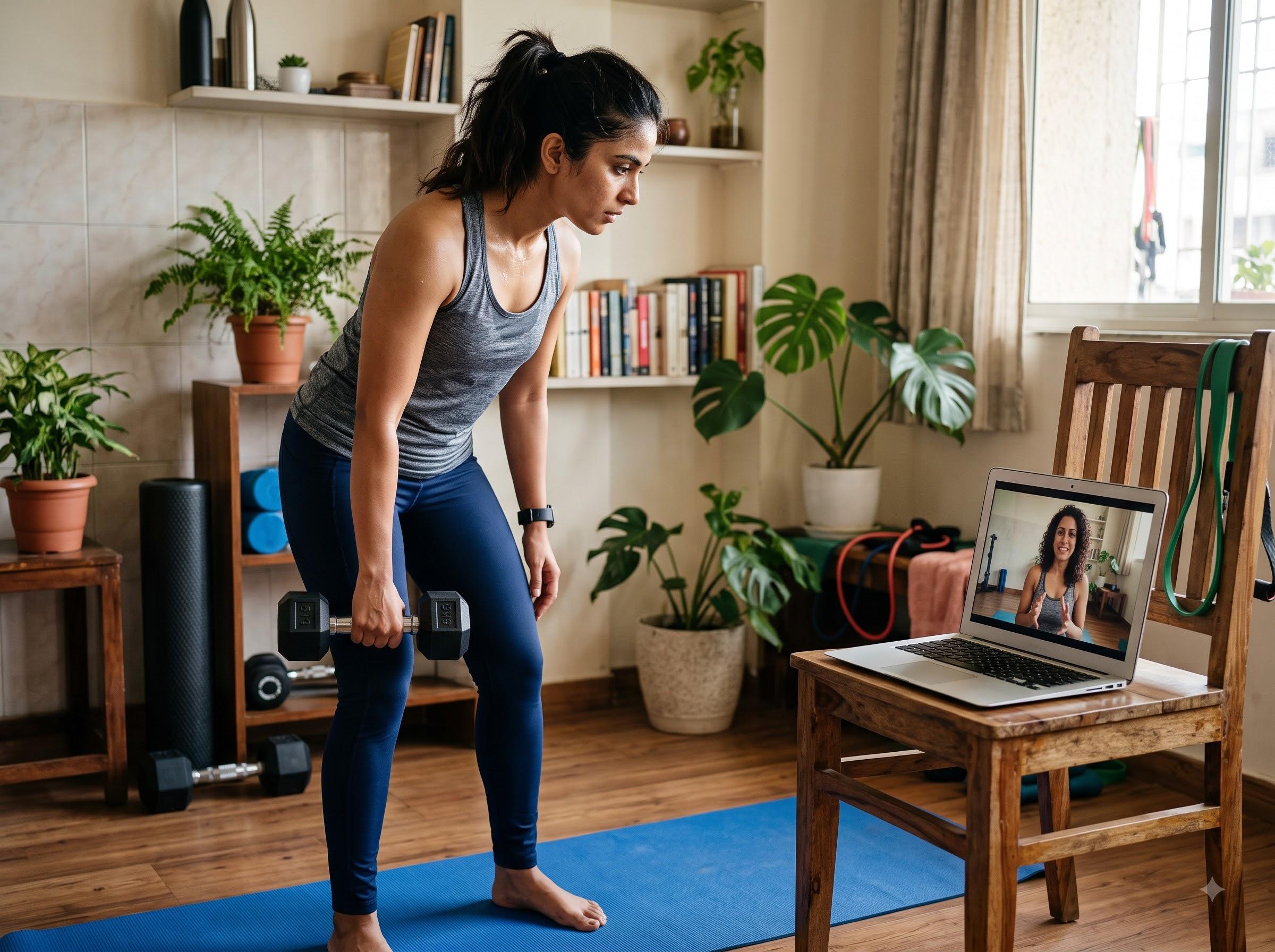
A coach watches each rep over video, swaps what hurts and builds strength around your hip and knee, week by week, alongside your doctor or physio.
Start Your JourneyStart from here:Knee pain strength coaching
What our coaches do in a session
Stairs are not only a symptom for us; they are equipment. In a home session, coaches regularly ask, "Is there a staircase or step nearby for light step ups?" For many members the bottom stair is the most useful piece of home gym they own. Here is how they use it.
- Rate it every set. "Any pain like 2 or 3 is manageable." Above that, the exercise changes on the spot.
- Swap, do not skip. If step-ups hurt today, glute bridges and side-lying leg raises keep the legs training while the knee settles.
- Calf raises on the step. Heels lowered off the edge, slow up and down, holding the rail. Strong calves help the whole leg absorb load.
- Low step first. Step-ups start on the lowest step, slowly, with the knee tracking over the toes. Height goes up only when 3 sets of 8 feel easy.
- The next morning counts. Pain that is worse the next morning means the dose was too high, and the next session gets lighter.
The 4-week plan that gets stairs back
The 2018 international consensus on patellofemoral pain recommends exercise therapy, especially combining hip-focused and knee-focused exercises. NICE puts therapeutic exercise at the core of osteoarthritis care too. Our free plan follows that mix and ends on the stairs.
| Week | Focus | Key exercises |
|---|---|---|
| 1 | Wake the muscles up | Quad sets, straight leg raise, glute bridge, heel slides |
| 2 | Stand and load | Sit-to-stand from a chair, side-lying leg raise, glute bridge hold, calf raise |
| 3 | Single leg control | Step-up to a low step, shallow wall sit, single-leg bridge, standing hamstring curl |
| 4 | Build back the squat | Box squat to a chair, higher step-up, short reverse lunge, calf raise on a step |
The full plan with sets and reps is free on our knee pain coaching page. Move to the next week only when the current one feels easy. If you also get pain in squats, our coaches' fixes are in knee pain during squats.
Coach's tip: Count your stairs. If the building has 20 steps to your floor, note how many you climb before the knee complains. When that number goes up week by week, the plan is working, whatever the scale says.
When to see a doctor first
- The knee is swollen, hot or red, or it locks or gives way.
- The pain started with a fall, a twist or a pop.
- You cannot put weight on the leg, or pain wakes you at night.
- Pain is getting worse week on week despite resting from what triggers it.
A doctor or physiotherapist should see these before any training. For everything else, the evidence and our own sessions agree: a stronger leg makes stairs easier.
Want a coach to watch your knee on camera and build the plan around it?
Start Your JourneySources
- Crossley KM et al. 2016 Patellofemoral pain consensus statement, Manchester. Part 1. Br J Sports Med 2016. PubMed 27343241
- Collins NJ et al. 2018 Consensus statement on exercise therapy and physical interventions to treat patellofemoral pain. Br J Sports Med 2018. PubMed 29925502
- NICE NG226. Osteoarthritis in over 16s: diagnosis and management. nice.org.uk
Related reading
Did you find this helpful?

About Anish Agarwal
Founder & Head Coach, YourTrainer · NASM & K11 Certified Personal Trainer · 5+ years coaching
Featured in NRI Pulse, Dietitians.io, Fitness Interview, The MASALA Study. Press and media
Anish Agarwal is a NASM and K11 certified personal trainer coaching fat loss, body transformation, strength, and nutrition for clients across India, with 5+ years coaching. He founded YourTrainer to make expert, science-based coaching accessible online and in Bengaluru. Coach Anish's profile and the YourTrainer story.
Online 1-on-1 Coaching
Start Your Journey
Get a personalised training + Indian nutrition plan built around your goal, coached online, anywhere in India or abroad.
Trusted by 1,000+ clients coached across India & abroad
Free 30-min discovery call · No obligation