
FAQ
Questions people ask
Every question we answer on the site, grouped by topic. Pick a topic on the left, or scroll to read them all.
Getting started with YourTrainer
How much does a personal trainer cost at YourTrainer?
It depends on the format you choose. Guided app-based coaching is the most affordable way to start, and premium 1-on-1 live coaching (a dedicated coach, custom Indian meal plan and daily accountability) is the premium option. The easiest way to decide: take the ₹499 trial session, experience the coaching first-hand, and get an exact quote for your goal on the free consultation call. And if you're an Indian abroad: prices are the same as in India: you just pay in your local currency (USD, GBP, AED or EUR).
Is online personal training as effective as in-person training?
For most goals (fat loss, strength, body recomposition) yes, provided it's genuine live 1-on-1 video coaching where the coach watches you train and corrects form in real time. YourTrainer sessions are live on video with a dedicated coach, not app templates. In-person still wins if you need a physical spotter for maximal lifts or hands-on rehab work.
Do you have female trainers and PCOS or thyroid specialist coaches?
Yes. YourTrainer has certified female coaches, and the Elite plan matches you with a specialist for PCOS, thyroid or prenatal/postpartum coaching. Plans are built around hormonal conditions: insulin-aware Indian meal plans, strength-first training and cycle-aware adjustments: not generic weight-loss templates.
Can you coach Indians living in the US, UK or Gulf?
Yes: YourTrainer coaches NRIs across the US, UK, UAE, Canada, Australia and Singapore. India's timezone overlaps naturally with US mornings and UK/Gulf evenings, so sessions are live at hours that suit you. Meal plans work with Indian home cooking plus your local supermarket: and pricing is the same as our India plans, simply billed in USD, GBP or AED.
What makes YourTrainer different from fitness apps?
Fitness apps give you a plan; YourTrainer gives you a coach who watches you train. Every client gets live 1-on-1 video sessions, real-time form correction, daily WhatsApp accountability and a coach who handles both training and Indian-food nutrition: with a capped client load, so you're never a number in a queue.
Do I need prior fitness experience to join?
Not at all. We specialize in training beginners and busy professionals. Programs are fully customized to your current fitness level and goals, and your first sessions focus on learning movements safely with your coach watching live.
Where do training sessions happen?
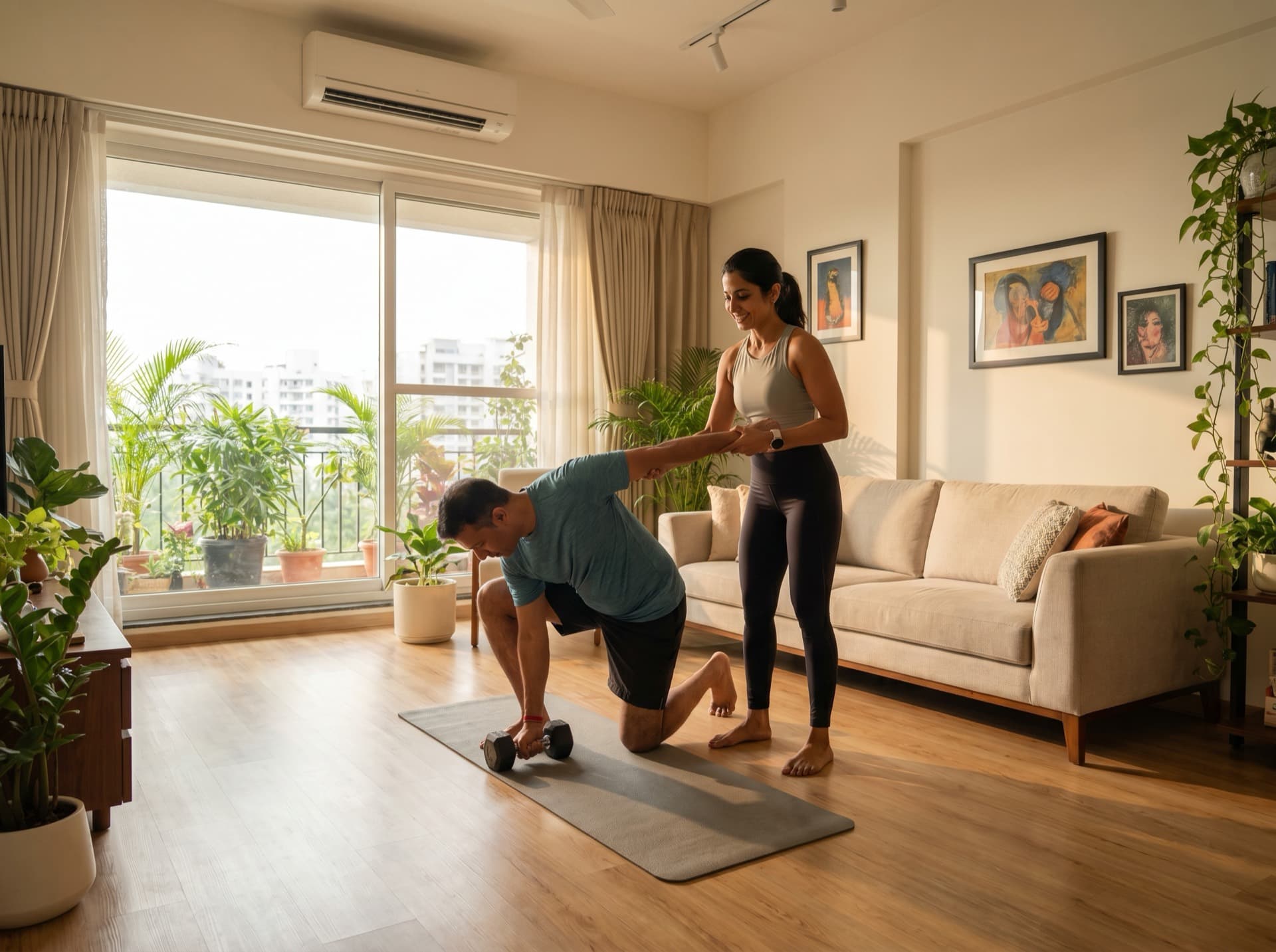
You choose: at your home, your apartment or commercial gym, or fully online over live video. Outside Bengaluru, training is online; in Bengaluru you can also get at-home personal training.
How long until I see results with YourTrainer coaching?
Many people notice better energy and strength within 2 to 3 weeks. Visible body composition change usually takes 6 to 8 weeks with consistent training and nutrition adherence.
What's included in the nutrition support?
A personalized Indian meal plan built around how your household actually cooks (roti, rice, dal, regional and vegetarian preferences included) with portion guidance in katori and roti terms, WhatsApp photo feedback on meals, and festival-aware adjustments. No crash diets.
How is the free consultation done?
Book a call or WhatsApp us. We'll discuss your goals, assess your current fitness, and recommend the best program for you: no pressure, no obligation.
Coaching programs
Which coaching program should I choose?
If you want a coach running every session live, choose Ultimate Personal Training (1-on-1 or partner coaching). If food is your main gap, choose Nutrition Guidance: personalised, practical and Indian-friendly, without extreme dieting. If you would rather train at your own pace, YourTrainer GO gives you app-based training with structured guidance and recorded programs.
What is the difference between personal training and YourTrainer GO?
Personal training is live: your coach runs each session with you, 1-on-1 or with a partner, and corrects your form in real time. YourTrainer GO is app-based: structured weekly workouts and recorded sessions you follow on your own schedule, with check-ins from your coach.
Can I sign up for nutrition coaching on its own?
Yes. Nutrition Guidance is its own program, built around the Indian food you already eat. If you also want training, the personal training and GO programs include nutrition support too.
Can I join a coaching program from outside India?
Yes. Live 1-on-1 online coaching runs over video on your time zone, with fat loss, strength and Indian-food nutrition. It is popular with IT professionals and the Indian diaspora across the USA, UK, Australia and Europe.
What happens on the free strategy call?
It is a free 30-minute call with no sales pitch: an honest look at your goals, a recommendation for the program that fits your lifestyle, and zero commitment.
Is there a lock-in or a long contract?
No. Plans run month to month, or as 3-month and 6-month packages. You can stop after the plan you bought, and you are not charged for the next period.
How much does coaching cost?
It depends on the program, how many sessions you take each week and whether you train online or in person, so your coach gives you the exact plan on the free call. If you would like to try a session first, the trial is a single session for ₹499.
How many sessions a week will I need?
Usually 3 to 5 days a week. Your coach recommends the right number for your goal, your recovery and the time you actually have.
Do I need a gym or equipment at home?
No. Programs are written around what you have: bodyweight only, resistance bands, dumbbells or a full gym.
Can I train in person, or is it only online?
Both. Sessions can run at your home, your apartment gym or a gym near you in Bengaluru, or live on video from anywhere in the world.
Will the food plan work if I am vegetarian or eat Indian food every day?
Yes. Plans are built around the Indian food you already eat, and vegetarian, vegan, gluten-free and diabetic-friendly needs are all planned for.
How soon will I see results?
Most people feel stronger and more energetic within the first 2 to 3 weeks, as your coach corrects form and raises the load. Changes you can see in the mirror usually take 6 to 8 weeks of steady training and eating.
Personal training
Do I need prior gym experience for personal training?
Not at all. We work with complete beginners to advanced athletes. Your trainer will assess your current fitness level and design a program that matches exactly where you are right now.
Where do personal training sessions take place?
Sessions can happen at your home, apartment gym, a commercial gym near you, or online via video call: whichever works best for your schedule and comfort.
How many sessions per week do I need?
Training is usually 3-5 days a week. Your trainer will recommend the ideal frequency based on your goals, recovery capacity, and availability.
What equipment do I need at home?
None is required to get started. We design programs based on what you have access to: bodyweight only, resistance bands, dumbbells, or a full gym setup.
How soon will 1-on-1 personal training show results?
Expect to feel stronger and more energetic within the first 2-3 weeks, because your trainer corrects your form and raises the load session by session. Changes you can see in the mirror usually take 6-8 weeks of steady training and eating.
Is nutrition coaching included?
Yes. All personal training plans include nutrition guidance. Our Core and Elite plans include detailed monthly meal plans and weekly refinements from our nutritionist.
Nutrition coaching
Do I need to follow a strict diet?
No crash diets here. We build sustainable, Indian-friendly meal plans around your food preferences, schedule, and lifestyle: so you actually stick to it.
Will I get a personalized meal plan?
Yes. Your nutritionist creates a plan tailored to your goals, health conditions, food preferences, and budget.
What if I have dietary restrictions?
We accommodate all needs: vegetarian, vegan, gluten-free, diabetic-friendly, and more. Just let us know and we'll plan around it.
Do I need to track calories?
Not necessarily. We simplify nutrition so it works for your lifestyle, calorie tracking is optional and only used when it helps you progress faster.
How often does my nutrition plan get updated?
Your plan is reviewed and adjusted every 2-4 weeks based on your progress, feedback, and any changes in your routine.
YourTrainer Go
What is YourTrainer GO?
YourTrainer GO is our app-based coaching program that lets you train from anywhere (at home, in a hotel, or at your local gym) with structured guidance and recorded workouts.
Do I need gym equipment?
No. We design programs for home, gym, or travel: whatever you have access to. Bodyweight-only options are fully available.
How do I communicate with my coach?
Via the app, WhatsApp, or scheduled video calls: whichever works best for you. Your coach is always reachable.
Is YourTrainer GO suitable for beginners?
Yes. Programs are scaled to your current fitness level and progress at your pace, whether you're just starting out or getting back on track.
What's included in the GO program?
Structured weekly workouts, nutrition guidance, progress tracking, check-ins with your coach, and access to recorded sessions you can replay anytime.
Health programs
Which health conditions do your programs cover?
PCOS and PCOD, type 2 diabetes and prediabetes, hypothyroidism, fatty liver, menopause, lower back pain, knee pain and arthritis, high cholesterol, and Restore & Perform for injury recovery. Each has its own structured program.
Why does a health condition need its own program?
Because each condition changes what training and food should do. The PCOS program combines targeted strength training, insulin-sensitive nutrition and stress regulation; the diabetes program is built to improve insulin sensitivity and metabolic markers; thyroid support is designed around hypothyroid and hyperthyroid challenges.
Is this a replacement for my doctor?
No. This is lifestyle coaching, not medical treatment. Your doctor stays in charge of diagnosis and medication; we build the training, nutrition and habit system around their plan.
Can I join from outside Bangalore or outside India?
Yes. Coaching runs over live video, so you can join from anywhere in the world.
Can I keep taking my medication?
Yes. We never change or stop medication. Any change to your medicine is your doctor's decision; we coach training, food and habits around it.
Should I share my medical reports?
It helps. Recent blood reports and your doctor's notes let your coach and nutritionist plan around them. If you have none yet, we start from what you know and what your doctor has advised.
Is strength training safe with knee or lower back pain?
For most people it is part of the answer, as long as movements and loads are chosen around the pain. Your coach starts with movements that do not provoke it, checks in every session and adds load only when the movement feels steady. If you have a recent injury or severe pain, get it assessed by a doctor or physiotherapist first.
Will the food plan work with Indian and vegetarian food?
Yes. Meals are planned around the Indian food you already eat, vegetarian included, and adjusted for your condition, for example keeping carbs in proportion for diabetes.
How do you track progress for a health condition?
Every week your coach reviews your weight, measurements, energy and how your sessions went, and you can share new reports whenever your doctor orders them. The plan changes with what that record shows.
Is there a lock-in?
No. Plans run month to month, or as 3-month and 6-month packages. You can stop after the plan you bought, and you are not charged for the next period.
What happens on the free consultation?
It is a short call with no sales pitch. We look at your condition, goals and routine, and recommend the program that fits.
PCOD and PCOS
How is this program different from a regular fitness program?
Our PCOD/PCOS program is specifically designed considering hormonal fluctuations, insulin resistance, and inflammation. We use cycle-synced training, anti-inflammatory nutrition, and low-impact exercises that support hormonal balance rather than disrupt it.
Will exercise help with my PCOD/PCOS symptoms?
Yes. Regular exercise, especially strength training and low-impact cardio, can improve insulin sensitivity, help with weight management, reduce stress hormones, and support hormonal balance: all of which help manage PCOD/PCOS symptoms.
Do I need a strict diet to manage PCOS?
No crash diets here. We focus on sustainable, anti-inflammatory nutrition that supports hormonal health. You'll still enjoy your favorite foods while learning to make better choices that support your health goals.
How long until I see results with PCOS?
Many people notice better energy and mood within 2 to 3 weeks, and visible change usually follows at 6 to 8 weeks. Results vary, and your doctor tracks the medical markers.
What is the best exercise for PCOS?
Strength training on two non-consecutive days a week plus regular activity such as brisk walking, as the 2023 international PCOS guideline recommends. Muscle helps the body handle insulin, which is central to PCOS. The best plan is the one you can keep up around your cycle and your energy.
What is the difference between PCOD and PCOS?
In India the two names are often used for the same thing. Medically the condition is PCOS, now also called PMOS, and doctors diagnose it when at least two of three signs are present: irregular periods, signs of high androgens, and polycystic ovaries on ultrasound. Your gynaecologist decides which applies to you; the lifestyle plan is much the same.
Is there a 7-day Indian diet plan for PCOS?
Yes, our free 7-day Indian vegetarian PCOS diet plan is on the blog. It puts protein at every meal, keeps rice and rotis in sensible portions and leans on dal, paneer, curd and sprouts. A coached plan then adjusts it to your cycle, cravings and routine.
Can I do this program from home?
Yes. We offer home training, gym training, and online coaching options. Your trainer will design a program that works with whatever equipment and space you have available.
Thyroid
Can I exercise with a thyroid condition?
Yes. A 2023 review of 10 studies found exercise safe for people with hypothyroidism, with better physical and mental health outcomes. We set the intensity to how your energy is that week, and your doctor's advice comes first.
Why is it so hard to lose weight with thyroid issues?
Restoring normal thyroid levels tends to bring a modest weight change, not a large one. Across 23 studies the average was 1.39 kg lower, with a wide interval. Our plan tracks the waist and the strength log, which move even when the scale does not.
What if I have low energy days?
That is common, and the plan has rules for it. On low-energy days we cut the load first, keep the walk short, and do not skip the whole week. In a 12 week trial of women on levothyroxine, all three exercise types improved fitness and physical quality of life against control.
Should I avoid certain exercises?
The 2023 review found exercise safe. The coach picks the type and load for you, and any new symptom goes back to your doctor. If you have chest pain, fainting, or a fast heartbeat with exercise, stop and see your doctor.
How does nutrition affect thyroid?
Food supports the plan, but no food replaces your medicine. We build an Indian plate with protein, vegetables and whole grains. Ask your doctor or pharmacist when to take your tablet against meals and supplements, and tell us so the food plan matches.
How common is hypothyroidism in India?
In an eight-city study of 5,360 adults, 10.95% had hypothyroidism. 7.48% knew it already, and 3.47% were found by the study. The rate was 15.86% in women and 5.02% in men. Our own website questionnaire, from 2 Jun to 14 Oct 2026, had 13.1% of forms ticking thyroid, counted once per person.
Does levothyroxine cause weight gain or loss?
Neither in a large way. The 2026 reviews found body weight fell by about 1.4 kg on average when levels were restored, and by 2.15 kg in clinical hypothyroidism, mostly in the first 3 months.
Do you change my thyroid medication?
No. Your doctor diagnoses, sets and changes medication, and orders and reads the tests. Keep taking the tablet as prescribed, and tell your coach when the dose changes so the plan can follow.
Restore and perform
I'm in pain. Can I still exercise?
Often, yes. The guidance for low back pain encourages people to keep up normal activities, and our trainers work inside your pain-free range, widening it gradually. Complete rest is rarely the plan. Your doctor or physio makes any medical call first.
How is this different from physiotherapy?
We complement physiotherapy, not replace it. A physio leads the clinical side of an injury. We build the fitness training that comes after, and we can coordinate with your physiotherapist so the two plans match.
What if my injury flares up during training?
We stop the load, not the person. The session drops to the last pain-free step, the flare is logged with what caused it, and the next week's plan is adjusted. If the pain is new, severe or follows a fall or a sudden twist, see your doctor first.
How long does rehabilitation take?
The injury and your doctor or physio set the timeline for the injury itself. We set the training steps and the review points, and we move up a rung only when the log supports it.
Can you help prevent future injuries?
Yes, and strength is the part with the strongest evidence. In a meta-analysis of 25 trials, strength training was linked to a risk ratio of 0.315 for sports injuries, while stretching alone was not. Our prevention work is built on that, with balance and movement drills where they fit.
When do I take a deload week?
A deload is a planned lighter week, not a break from training. In one trial of trained adults, a one-week deload in the middle of a nine-week programme gave smaller lower-body strength gains, with no difference in muscle size. In untrained men, deload weeks did not stop muscle or strength gains. We plan a deload when the log asks for one, and keep it short.
What does the return to sport look like?
The 2023 international consensus on hamstring injuries covers rehabilitation, running and return to sport. We follow the same principle: each rung needs the one below it to be steady, and the return to full training is a decision made with the log and your doctor.
Diabetes
Can type 2 diabetes go into remission?
In the DiRECT trial, 46% of people in a supervised weight-loss programme were in remission after a year, against 4% on usual care. Remission depends on your starting point, how much weight you lose and your doctor's guidance. We coach the lifestyle side and cannot promise it.
Is this medical treatment?
No. We are lifestyle coaches, not doctors. We do not prescribe, change or stop medication. Your doctor makes every medication decision.
Can I start if I take insulin?
Ask your doctor first. Exercise can cause low blood sugar with insulin and some tablets, and your doctor guides any dose change.
What will I eat?
Your own Indian meals, rebalanced: smarter carbs such as jowar, bajra and ragi, and more protein from dal, paneer, curd, sprouts and eggs if you eat them.
Can I do this from outside India?
Yes. Sessions run over video in your time zone, with the meal plan adapted to the groceries you can buy.
I have pre-diabetes. Is this for me?
Yes. Pre-diabetes (HbA1c 5.7 to 6.4%) is the stage where lifestyle change matters most, and the ICMR-INDIAB study found 15.3% of Indian adults are in it. The same plan applies: Indian meals rebalanced, strength training three days a week and walks after meals, with your doctor re-checking your labs.
Is rice or chapati better for diabetes?
Both raise blood sugar, so the portion and what you eat with it matter more than the choice. Whole wheat or millet rotis carry more fibre than white rice, which slows the rise. Many of our members keep rice: one katori, half the plate vegetables, dal or paneer for protein, and a short walk after the meal.
How much rice can a diabetic eat?
There is no single number. A katori of cooked rice with vegetables and protein is a common starting point. The honest test is your own glucometer reading two hours after the meal, which tells you how your body handles that portion. Your doctor sets the target range.
What does it cost?
Fees depend on the plan and are shared on the free 30-minute discovery call.
Diabetes coaching in Bangalore
Do you coach in person in Bangalore?
Yes, optionally, across HSR, Bellandur, Whitefield, Indiranagar, Koramangala and Jayanagar. The default format is online by video.
What result can I expect?
It depends on your starting HbA1c, how long you have had diabetes and how closely you follow the plan. We track your numbers through the programme and share them with your doctor.
How do I start?
Book the free 30-minute discovery call. Share your latest HbA1c and your daily routine, and we will recommend the plan that fits.
Knee pain
Should I exercise with knee pain?
For most knee pain without swelling, locking or a recent injury, yes. NICE guidance for knee osteoarthritis puts tailored exercise at the core of treatment. The key is the dose: our coaches keep pain during a set at about 2 or 3 out of 10 and change the exercise if it goes higher.
Can I do squats if my knees hurt?
Often yes, in a modified form: a higher box, a shorter range, or a different stance. While the knee settles, coaches swap squats for deadlifts, glute bridges and hip work, then build the squat back as strength grows.
What exercises help knee pain?
Strength around the knee and hip: glute bridges, hip abduction, step-ups to a comfortable height, hamstring work and controlled partial squats. Which ones and how heavy depends on what hurts and when, which is what the first call is for.
When should I see a doctor instead?
See a doctor first for a swollen, hot or locked knee, a knee that gives way, pain after a fall or twist, or pain at night that does not ease with rest.
What are the best knee strengthening exercises at home?
Start with quad sets, straight leg raises, glute bridges and sit-to-stands from a chair, then add step-ups, side-lying leg raises, calf raises and partial squats as they get easy. The free 4-week plan on this page lays them out week by week. Keep any pain at 2 or 3 out of 10.
How long does it take to strengthen the knees?
Most people feel steadier on stairs and squats within 4 to 6 weeks of training two or three times a week. Real strength gains keep building for months, which is why the plan progresses rather than repeating the same exercises.
Should I do knee exercises every day?
Two or three strength sessions a week with a rest day between is enough for most people. Gentle range-of-motion work and walking can be daily. If the knee is sorer the next morning, the dose was too high.
Does this work online?
Yes. Sessions run over video. The coach watches each rep, adjusts stance and range live, and plans around the equipment you have at home or in your gym.
Lower back pain
Is it safe to lift weights with lower back pain?
For most lower back pain without red flags, staying active is better than rest, and guidelines from the American College of Physicians and NICE recommend exercise. Lifting is safe when the load is right and the form is checked, which is why our coaches drop the weight before they change the movement.
What exercises are good for lower back pain?
Core holds such as dead bugs and planks, glute bridges, hip hinges with light load, and rows. Which ones and how heavy depend on what triggers your back, which the coach works out with you on the first sessions.
Should I stop exercising if my back hurts?
Stop the exercise that hurts, not all exercise. Tell your coach: usually the load drops, the range shortens or the movement is swapped for one that keeps your back quiet.
When should I see a doctor first?
Get urgent help for numbness around the groin or buttocks, new bladder or bowel problems, or leg weakness. See a doctor first for back pain with fever, unexplained weight loss, a recent fall, or pain that is worse at night at rest.
Can I train online with a slip disc?
Often yes, once your doctor or physio has cleared exercise. Share their advice with us and the plan follows it, with the coach watching every rep over video.
High cholesterol
How can I reduce cholesterol naturally?
Lose weight if you carry extra, cut trans fats and deep-fried and bakery food first, eat more fibre from dal, oats, vegetables and fruit, walk daily and strength train two or three times a week. These help, but how far they go depends on your starting numbers and genes, so check with your doctor whether you also need medicine.
Does exercise lower cholesterol?
It lowers triglycerides reliably: a 2024 review of 28 trials found interval training cut them by about 20 mg/dL. The same review found no significant change in total cholesterol from exercise alone. That is why we pair training with food changes and weight loss, not training on its own.
What is a good Indian breakfast for high cholesterol?
Something with protein and fibre and little fried or bakery food: besan or moong dal chilla, vegetable poha with peanuts in moderation, idli with sambar, oats upma, or curd with fruit. Puri, bakery biscuits and packaged snacks with vanaspati are the ones to cut first.
How many eggs can I eat if my cholesterol is high?
Our nutritionist usually keeps members with high cholesterol to about two whole eggs a day and uses egg whites for any extra protein. Your doctor may advise differently based on your report, and their advice comes first.
Can I stop my statin if I diet and exercise?
No, not on your own. Only your doctor can change or stop a statin. Many people need both medicine and lifestyle change, and we coach the lifestyle side alongside whatever your doctor prescribes.
Is this for people in India only?
No. Coaching is online, so members in India, the US, the UK and the Gulf join. Plans are written around Indian food and your local groceries.
Fatty liver
Is fatty liver reversible?
Fat in the liver can fall with weight loss, and in a 52-week lifestyle study of 293 people with steatohepatitis, the highest rates of improvement came at weight losses of 10% or more (Vilar-Gomez et al., Gastroenterology, 2015). No one can promise a cure or a fixed result. Your doctor checks whether it has improved with repeat blood tests or a scan.
What is the best Indian diet for fatty liver?
Cut sugary drinks, sweets, white flour, deep-fried food and alcohol first. Build plates around dal, sprouts, vegetables, curd, eggs or paneer, and measured whole grains such as oats, brown rice or millets. The EASL-EASD-EASO 2024 guideline makes dietary change and weight loss part of the first step for adults with MASLD. Total calories matter more than any single food.
Which exercise helps fatty liver?
Both regular movement and strength training. In a 2023 meta-analysis of 14 trials with 551 people, exercise improved liver fat on MRI even though weight loss in the exercise groups was small, about 2.8% on average (Stine et al., Am J Gastroenterol, 2023). A daily walk plus two or three strength sessions a week is the usual starting point, built up gradually.
How fast does fatty liver improve with diet and exercise?
There is no fixed timeline, and it differs from person to person. We review food, weight and activity every week. Your doctor decides when to repeat the liver blood tests or the ultrasound, so progress is measured rather than guessed.
What does grade 1 vs grade 2 fatty liver mean?
On an ultrasound, grade 1 usually means mild fat in the liver and grade 2 means moderate fat, with grade 3 the most severe. The grade describes how much fat the scan sees. It does not on its own tell your doctor how the liver is functioning, so blood tests and sometimes a fibrosis check are needed alongside it.
Can thin or normal-weight people get fatty liver?
Yes. In a 2024 hospital study in India, 4.3% of 1,243 people screened at a COVID-19 vaccination centre had lean MASLD, meaning fatty liver with a normal body weight (Euroasian Journal of Hepato-Gastroenterology, 2024). Normal weight does not rule it out, so blood tests and a scan are the way to check.
Is alcohol safe with fatty liver?
Alcohol is one of the most important things to cut. The EASL-EASD-EASO 2024 guideline recommends discouraging alcohol consumption for people with MASLD. Ask your doctor what, if anything, is safe for your liver, and we will plan around that answer.
When should I see a doctor about fatty liver?
See a doctor soon for yellow eyes or skin, swelling of the belly or legs, confusion, vomiting blood, black stools, weight loss you did not try for, or ongoing belly pain. A raised liver enzyme or a scan that reports fibrosis also needs your doctor's review before you change the plan.
Menopause
Why do Indian women hit menopause earlier than women in the West?
Indian women reach menopause at a median age of roughly 46-47, against about 51 in Western populations, several years earlier. Nutrition through earlier life, body composition, parity and socioeconomic factors are all implicated. The practical consequence matters more than the cause: perimenopause can begin in the late thirties, so the weight gain, sleep disruption and mood changes that start around 38-42 are frequently dismissed as stress when they are hormonal. Earlier menopause also means a longer post-menopausal life spent at raised risk of bone and heart problems, which is exactly why strength training matters sooner here than the Western literature implies.
Why has my weight moved to my stomach when my diet has not changed?
Falling estrogen changes where the body stores fat, moving it from hips and thighs to the abdomen: including visceral fat around the organs. At the same time, muscle mass declines with age unless it is actively trained, and less muscle means a lower resting metabolic rate. So the same food and the same walking now produce a different result. This is not a willpower failure and it does not respond well to eating less. It responds to rebuilding muscle, which raises the metabolic floor and directly targets the central fat pattern.
Should I be doing cardio or weights?
Weights first, cardio second. This is the single most common thing we change. Most Indian women arrive doing walking plus some cardio and eating less, which loses weight from muscle as well as fat and leaves the metabolism lower than when they started. Resistance training is what protects muscle, supports bone density and improves insulin sensitivity through midlife. We typically run strength two to three times a week, with walking and some cardio around it, rather than the other way round.
How much protein do I actually need, and can I get it as a vegetarian?
Protein requirements rise in midlife because the body becomes less efficient at using it to build and hold muscle. A typical target is 1.4-1.8g per kg of bodyweight, adjusted by the coach. It is achievable on an Indian vegetarian diet but it does not happen by accident, a typical dal-rice-sabzi day often lands well under half of it. We build it from curd and paneer, dals and rajma and chana, soya, milk, eggs where eaten, and a supplement only if the food plan genuinely cannot close the gap.
I have hypothyroidism as well. Does that change things?
It is very common to have both, and the symptoms overlap heavily (fatigue, weight gain, low mood, hair thinning) which is why one is often blamed for the other. Get your thyroid function checked and properly medicated first, because training and nutrition cannot compensate for untreated hypothyroidism. Once it is managed, the training approach is largely the same, with more attention to fatigue management and a slower rate of progression. Your coach will work around your medication and your doctor's guidance, not against them.
What about my bones? Everyone tells me to take calcium.
Calcium matters, but on its own it is not enough. Bone loss accelerates sharply around and after menopause, and Indian women carry additional risk from widespread vitamin D deficiency and diets that are often low in both calcium and protein. Bone responds to mechanical load, which means resistance training and weight-bearing movement are as important as what you swallow. We build progressive loading into the programme from the start, alongside calcium, vitamin D and protein in the food plan. Get your vitamin D tested, it is the most commonly missed piece.
Will strength training make me look bulky?
No. Building visible bulk requires high training volume, a calorie surplus and hormonal conditions that midlife women do not have: and declining estrogen makes it harder still. What resistance training actually produces at this stage is retained muscle, better shape, a stronger back and hips, and easier fat loss. Nearly every woman we coach through menopause ends up smaller, not bigger, while lifting more than she ever has.
Do you provide female coaches?
Yes. If you would prefer a woman coach, say so when you book and you will be matched with one. All sessions are live one-to-one over video, so you train at home with your own coach watching your form.
What does menopause weight-loss coaching cost?
Programmes run on 30-day cycles and sit in the ₹8,000 to ₹18,000 a month band; most people choose Core, which adds nutrition and daily WhatsApp support. A specialist coach for menopause, thyroid or PCOS is available on every tier, and all plans include a starting assessment and weekly progress reviews.
Menopause coaching in the USA
Why is menopause weight gain so hard to reverse?
Estrogen drop during menopause lowers resting metabolism and shifts fat storage to your belly (central adiposity). Muscle loss accelerates without hormone support. Plus, sleep disruption, hot flashes, and mood swings kill motivation. It's not laziness, it's biochemistry. Strength training + protein-forward nutrition + hormone-aware rest patterns flip this back on.
Can strength training help during menopause?
Yes. Progressive resistance training preserves and builds muscle (which burns calories at rest), improves insulin sensitivity, increases bone density (critical for osteoporosis risk post-menopause), and reduces hot flashes and mood swings. Studies show women 45-55 who train consistently see their best body composition results AFTER starting strength work, not before.
Will I lose muscle if I don't strength train during menopause?
Yes. Women lose 3-8% muscle per decade after 30, and this accelerates post-menopause without estrogen. The result: slower metabolism, weight creep even on the same calories, and weak bones. Strength training 3x/week reverses this. You literally rebuild your metabolism and body.
What nutrition works for menopause belly fat?
Protein-forward (1.2g per lb bodyweight) to preserve muscle, anti-inflammatory fats (olive oil, fish), whole grains over refined carbs (to manage insulin), and Indian staples like dal + paneer (complete proteins). Skip the crash diets, they tank muscle. Your coach designs real food you actually buy and cook.
I'm on HRT / bioidentical hormones. Will that affect my training?
HRT/bioidentical hormone therapy can help some women, and yes: it affects recovery and strength gains positively. Your coach coordinates with your doctor and adjusts intensity based on your cycle phases (if applicable) and energy patterns. Better hormone stability = better training performance.
I'm in perimenopause. Is it different from full menopause?
Perimenopause (typically 8-10 years before your last period) is when the chaos begins: hot flashes, irregular periods, weight gain, mood swings. Training strategy is the same: strength-focused, hormone-aware, and responsive to your energy. Perimenopause is a good window to build muscle, because you still respond to training faster than after menopause.
Can I train if I'm having hot flashes / sleep issues?
Yes, with adjustments. Morning or evening slots vary per person, your coach finds what works. Light yoga or walking on brutal sleep days. Strength training on good days. Rest and recovery matter more at this stage, so we build flexibility into your plan. You don't push through hot flashes; you work WITH them.
Will menopause weight loss look different than normal fat loss?
Yes. Menopause fat loss is slower than in your 30s and belly-fat-first (frustrating, but reversible). However, with strength training, you build visible muscle while losing fat: so you look leaner even if the scale moves slowly. Progress is measured by how your clothes fit, energy, and bone density, not just weight.
How does your coach handle menopause-specific challenges like mood and hot flashes?
We track energy, sleep, and mood patterns over 2-4 weeks to identify what makes training better/worse. Some clients train before hot flash peaks; others use cool showers post-workout. Nutrition adjustments (magnesium-rich foods, hydration, anti-inflammatory choices) help mood. This is a holistic, responsive program, not rigid.
Is online coaching right if I have menopause brain fog?
Actually, yes. Your coach gives you a written plan for every session. Video sessions are short (45-60 min, not 90-min group classes). WhatsApp check-ins mean no need to remember complex rules. The structure and clarity often helps menopause clients more than younger women. Plus, you train from home: zero decision fatigue on gym days.
Client results
Are these real client transformations?
Yes. Every story on this page is from a real YourTrainer client who chose to share their journey.
How long does it take to see results like these?
It depends on your starting point, your consistency and your goal. Your coach tracks your numbers every week, so you see progress instead of guessing at it.
Can a complete beginner get results like these?
Yes. Your plan starts from where you are today, whether you have trained for years or have never set foot in a gym.
Do these results come from crash diets or extreme workouts?
No. Coaching is built around Indian food you already eat and training you can keep up, not elimination diets or extreme programs.
Can I share my own transformation story?
Yes, if you would like to. Sharing is always voluntary and some clients prefer to stay private, which we respect. Tell your coach if you are open to it.
Are these results typical?
Every body responds differently, depending on starting point, consistency and health conditions. These are real results, not promises; your coach sets realistic targets after looking at your starting point.
Still have a question? Start with the free consultation and ask your coach directly.
Start Your Journey