
Free tool, the honest version
Weight Loss Timeline
Most plans sell you a month. Fat loss works in quarters. This shows the real number of weeks, the deficit it needs, and what happens if you try to rush it.
- Safe loss a week, of bodyweight
- 0.5 to 1%
- A week for a 70 kg person
- 0.35 to 0.7 kg
- Realistic time to lose 10 kg
- 4 to 6 months
- Energy in 1 kg of body fat, rule of thumb
- 7,700 kcal
Your timeline
How long to lose your kilos
Set your current and target weight, then pick a pace. The weeks and daily deficit update at once.
Pace
Realistic timeline
That is about 4.7 months to lose 13 kg.
What one month actually looks like
At this pace you would lose about 2.8 kg in the first month. If you have seen "5 kg in 30 days" plans, that is roughly double a safe rate for most people, and a large share of it is water and muscle rather than fat.
This assumes consistent adherence. Real timelines run 20 to 30 percent longer because of travel, festivals, weddings and plateaus. Build that in rather than treating it as failure.
Get the plan that hits this timelineHow the timeline is worked out
Weeks, then a daily deficit
weeks = kg to lose / (current kg x pace)
daily deficit (kcal) = kg a week x 7,700 / 7
- Pick a pace: 0.5, 0.75 or 1 percent of current bodyweight a week.
- Divide the kilos to lose by that weekly loss. The result is the number of weeks.
- Spread the weekly fat loss over seven days at about 7,700 kcal per kg of fat, a rule of thumb.
Worked example: 85 kg to 75 kg at the standard pace. 85 x 0.75% = 0.64 kg a week, 10 / 0.64 = 16 weeks, and 0.64 x 7,700 / 7 = about 700 kcal a day below maintenance.
The same 10 kg, three paces (from 85 kg)
| Pace | Loss a week | Weeks | Daily deficit |
|---|---|---|---|
| Steady, 0.5% | about 0.4 kg | 24 | about 470 kcal |
| Standard, 0.75% | about 0.64 kg | 16 | about 700 kcal |
| Fast, 1% | 0.85 kg | 12 | about 935 kcal, above the 750 kcal line |
The straight line is the earliest finish
Body weight answers a change in intake slowly, with half times of about one year, and heavier people lose more for the same change.[1] The calculator holds a steady percentage, so treat its week count as the fastest realistic finish. Build in 20 to 30 percent more time, as we do with members.
Why the scale drops fast at first
Stored glycogen carries water with it. The first kilos on the scale include that water, not only fat, which is why the first two to three weeks look faster than the rest.
Sources
- Hall KD et al. Quantification of the effect of energy imbalance on bodyweight. Lancet 2011;378(9793):826-37. doi.org/10.1016/S0140-6736(11)60812-X
- Fernandez-Elias VE et al. Relationship between muscle water and glycogen recovery after prolonged exercise in the heat. Eur J Appl Physiol 2015;115(9):1919-26. doi.org/10.1007/s00421-015-3175-z
- Morton RW et al. Systematic review, meta-analysis and meta-regression of protein supplementation on resistance training gains. Br J Sports Med 2018;52(6):376-384. doi.org/10.1136/bjsports-2017-097608
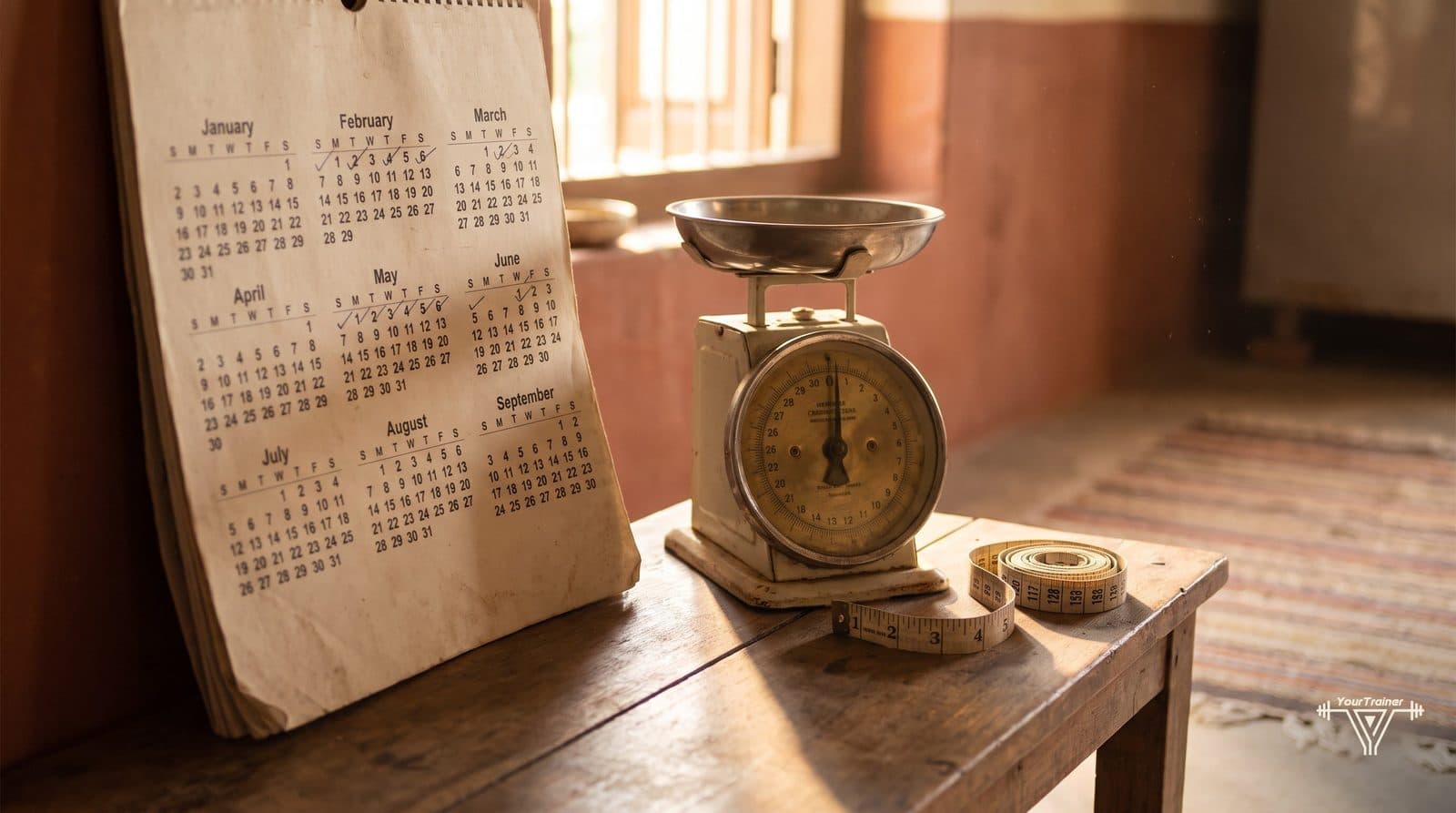
Why the First Month Lies
Almost everyone loses 2 to 4 kg quickly when they start. It feels like proof the plan is working, and it sets an expectation that the next month will do the same. It will not.
That early drop is mostly glycogen and the water bound to it, plus reduced gut content from eating less volume. Each gram of glycogen stored in muscle holds roughly three grams of water,[2] so cutting carbohydrate empties a few kilos that were never fat. Once that reservoir is gone, the scale slows to the actual rate of fat loss, which is far less dramatic.
This is the single biggest reason people quit in month two. They are not failing, they are seeing the truth for the first time.
The Cost of Going Faster
Weight loss is not the same as fat loss. Push the deficit hard enough and the body meets the gap partly by breaking down muscle, especially without adequate protein and resistance training. The consequences compound:
- Lower resting metabolism. Less muscle means fewer calories burned at rest, permanently.
- Worse body composition at the same weight. You hit the target number looking softer than you expected.
- Easier regain. Fat returns faster than muscle does, so each cycle leaves you worse off.
- Adherence collapse. Very large deficits are simply not survivable alongside Indian family meals, travel and festivals.

Build the Rest of the Plan
A timeline is only useful with the numbers behind it. Find your maintenance calories with the TDEE calculator, set the protein floor that protects muscle with the protein calculator, and track composition rather than weight alone with the body fat calculator. To see what your current meals actually deliver, use the Indian food calorie calculator.
Further reading: the honest take on losing 5 kg in a month, why you are not losing weight in a deficit, and finding your real maintenance calories.
Free Consultation
A timeline you can actually finish.
We plan around festivals, travel and family meals instead of pretending they do not exist. Start with a free call and a ₹499 trial session.
What the first weeks look like in real coaching
A timeline assumes you follow the plan every day. Step counts and first-call notes from our members show where real weeks differ.
Movement, the part of the week plans assume
About 5,400
steps on the median day
19%
of days reach 10,000 steps
46%
of days stay under 5,000
About 4 in 10
days reach 7,000 steps
Source: Daily step counts synced from members' own phones and watches, 1 Jun to 29 Sep 2026, days with steps recorded, aggregated
- Monday5,100
- Tuesday5,700
- Wednesday5,700
- Thursday5,700
- Friday5,600
- Saturday6,000
- Sunday4,900
Source: Daily step counts synced from members' own phones and watches, 1 Jun to 29 Sep 2026, days with steps recorded, aggregated
Sunday is the lowest day: its median is about 4,900 steps, and half of Sundays stay under 5,000. If your timeline slips, check the weekend first.
When the scale stalls but you are still working
About 1 in 5 people in our first nutrition consultations had a scale stuck for months despite real effort. Our team's advice was to measure waist, hips and arms every week, because inches can drop while weight does not. Weigh on the same morning each week, and skip the weigh-in during your period, when water retention raises the number for a few days.
Real members, their own words
Real timelines from our members
How long it took three members, in their own words. Individual results vary.
“I started off at somewhere close to 95 kilos, right now close to 89. So lost 6 kilos in 24 sessions.”
“I lost almost 8 kgs in the last three months. I've been trying to lose 1 kg, 2 kg in 6 months, but I never achieved these things.”
“Initially when I started three months back, I was 93. Now it's 86. It's not just about the weights. I feel overall energetic and very confident.”
Quotes are from members' own video testimonials. Individual results; every starting point is different, and these are not promises. Watch the member videos
Related pages
Related pages
FAQ
Frequently asked questions
Can you lose 5 kg in 1 month?
Physically possible for someone heavy, but for most people it is roughly double a safe rate and much of it is not fat. A safe pace is 0.5 to 1 percent of bodyweight per week, so a 70 kg person loses about 1.5 to 3 kg in a month. Rapid first-month drops are mostly water and glycogen, plus lean tissue if protein and strength training are missing. The weight that comes off that fast usually returns.
How long does it take to lose 10 kg?
For an 85 kg person at a standard pace of 0.75 percent of bodyweight per week, roughly 16 weeks, or about four months. At a steadier 0.5 percent pace it is closer to 24 weeks. Real-world timelines typically run 20 to 30 percent longer than the arithmetic because of travel, festivals, weddings and plateaus.
What calorie deficit do I need to lose weight?
One kilogram of body fat holds roughly 7,700 calories, so losing 0.5 kg a week needs about a 550 calorie daily deficit. Most people do best between 400 and 600 calories below maintenance. Deficits above 750 calories a day are hard to sustain on Indian meals and usually cost muscle, which lowers metabolic rate and makes maintenance harder later.
Why did my weight loss stop after the first month?
The first two to three weeks include a large water and glycogen drop that does not repeat. After that you are seeing actual fat loss, which is slower and looks disappointing by comparison. Plateaus also come from unlogged oil, weekend eating, and reduced daily movement as calories drop. Waist measurements often keep improving during a scale plateau, which is why tracking both matters.
Does losing weight slowly protect muscle?
Yes. At faster rates the share of the loss that comes from lean tissue rises. Slower loss combined with at least 1.6 g of protein per kg of bodyweight and two to three strength sessions a week is what keeps the weight you lose overwhelmingly fat. In a meta-analysis of resistance training, lean mass gains levelled off above about 1.6 g per kg a day (Morton et al., 2018). That matters because losing muscle lowers resting metabolic rate and makes regain easier.
Keep going
The timeline is the easy part. A coach builds the week by week plan around your kitchen.
Start Your Journey