
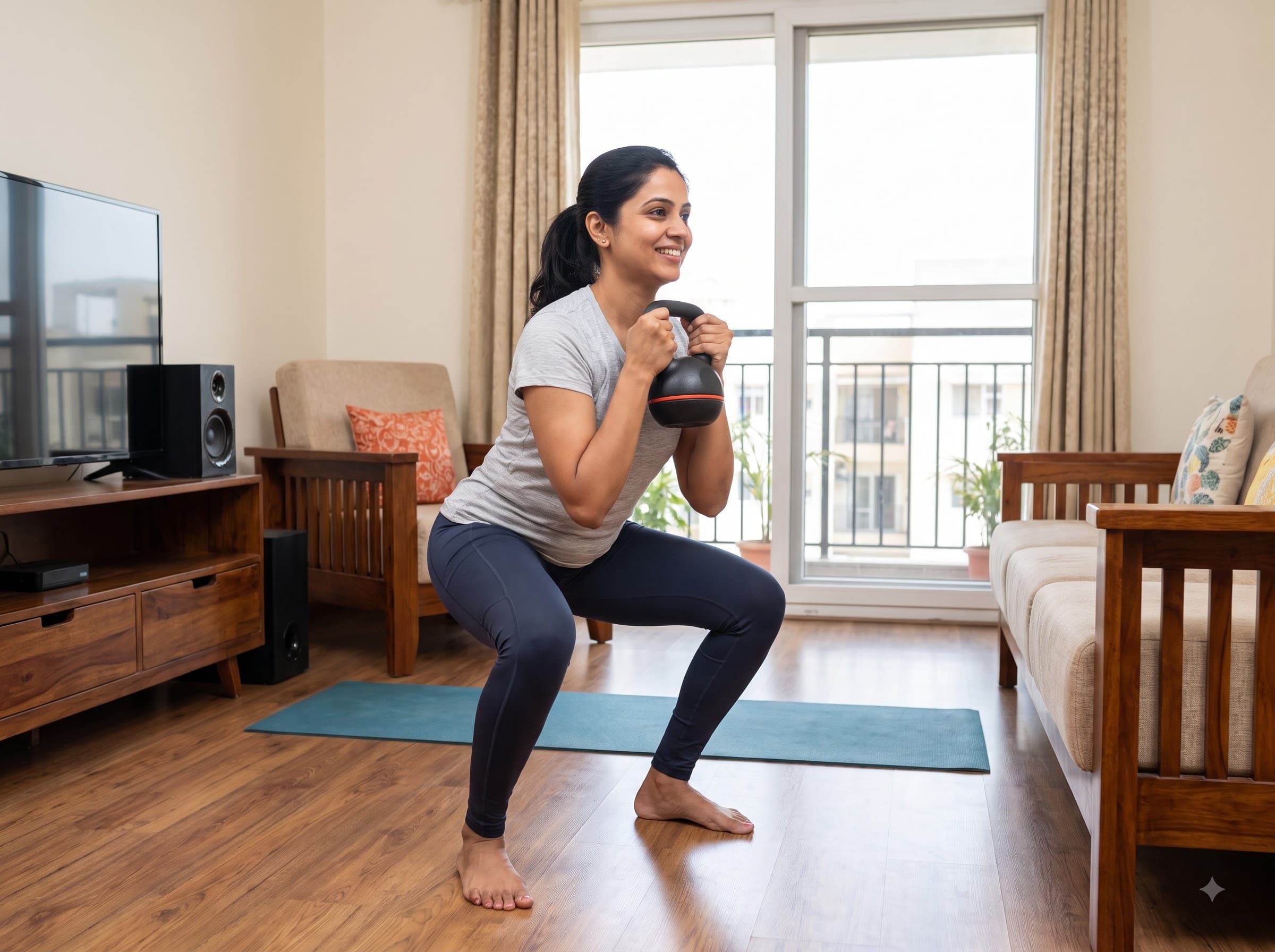
Knee pain coaching, online
Strong legs, without flaring your knees.
1-on-1 strength coaching that rates every set for pain, swaps what hurts and builds strength around the knee and hip, week by week.
Online, 1-on-1, from home or your gym. We work alongside your doctor or physio.
Who this is for
- Knees that ache on stairs, squats or after long sitting
- Early knee osteoarthritis where your doctor has advised exercise
- An old knee injury that keeps you away from leg day
- Runners and walkers whose knees complain as the distance goes up
What a coached week looks like
- 1Rate it, then trainEvery set gets a pain score. 2 to 3 out of 10 is fine; higher means the exercise changes, not the session ending.
- 2Swap, do not skipDeadlifts, glute bridges and hip work keep your legs training while the knee settles.
- 3Build back the movementSquats and lunges return with range and load that grow as the knee tolerates them.
How we coach
How your coach runs every session
- Form corrected as you moveYour coach watches every rep on video and fixes your position in real time.About 10 corrections in a typical session
- Shown first, then you tryThe coach demonstrates the movement on camera, then watches you do it.67% of sessions
- Every rep counted with youYour coach counts the reps aloud and pushes you through the last ones.Every session we reviewed
- Mobility to startJoints and spine warmed up before any load goes on.At least 82% of sessions
- Stretching to finishSessions close with stretches for the muscles you trained.At least 84% of sessions
- Knowledge you keepThe coach explains why each exercise and cue matters, so you can train well on your own.About 2 in 3 sessions
- Habits for the days betweenSteps, water, sleep and protein tasks, checked at your next session.Water and steps come up in about 6 in 10 sessions
Corrections, explaining why, water and steps: a sample of recorded coached sessions, 17 Aug to 21 Oct 2026. The rest: 1-on-1 sessions recorded 1 to 21 October 2026, each reviewed in full. Some recordings start after the warm-up, so the mobility and stretching shares are a floor.
“So we don't have to pressurize our joints. We have to train the muscles.”
Free plan
Free 4-week knee strengthening plan
The progression our coaches start most sore knees on, for home with a chair, a step and a wall. Do it two or three times a week with a rest day between. Keep pain at 2 or 3 out of 10, and move to the next week only when this one feels easy.
Week 1
Wake the muscles up
- Quad sets: 3 x 10, hold 5 s
- Straight leg raise: 3 x 8 each leg
- Glute bridge: 3 x 10
- Heel slides: 2 x 10
Week 2
Stand and load
- Sit-to-stand from a chair: 3 x 8
- Side-lying leg raise: 3 x 10 each
- Glute bridge, 3 s hold at top: 3 x 10
- Standing calf raise: 3 x 12
Week 3
Single leg control
- Step-up to a low step: 3 x 8 each
- Wall sit, shallow: 3 x 20 s
- Single-leg bridge: 3 x 6 each
- Standing hamstring curl: 3 x 10 each
Week 4
Build back the squat
- Box squat to a chair: 3 x 8
- Step-up, slightly higher: 3 x 8 each
- Reverse lunge, short step: 2 x 6 each
- Calf raise on a step: 3 x 12
General guidance, not a diagnosis. Stop and see a doctor or physio for swelling, locking, giving way or sharp pain. A coach adjusts each exercise to your knee, which a written plan cannot do.
Where the training goes
- OARSI's 2019 guideline for knee osteoarthritis lists structured land-based exercise, with or without weight management, as a core treatment for knee osteoarthritis.
- NICE NG226 names therapeutic exercise and weight management as the core treatments for osteoarthritis.
- Our coaches use pain out of 10 for every set. Up to 2 or 3 out of 10 is manageable; sharp pain means the exercise changes.
Sample week
A week for knee pain: legs keep training, the knee gets a lighter dose
Two strength sessions with knee-friendly leg work, a low-impact interval session instead of jumping, and active recovery in between.
Your days, your times. You pick the days and the hours, in your own time zone, and a session can move when your week changes.
See the week day by day
- MonStrength and conditioningLeg day: glute bridge, leg press with a short range, seated hamstring curl, calf raise. Pain rated after each set.
- TueActive recoveryFlat walk, 30 min. Morning knee check: swelling, stiffness, first steps.
- WedStrength and conditioningStep-up to a low step, hip hinge with dumbbells, wall sit to a comfortable depth, hip abduction, then row, press and core.
- ThuActive recoverySwim, cycle or walk at an easy pace. Pool or bike instead of stairs when the knee is grumbling.
- FriLow-impact intervalsInstead of HIIT: bike or pool intervals, 30 sec harder and 60 sec easy. No jumping.
- SatNutrition callWeekly call with your nutritionist. Tell your coach if a flare-up lasted more than 2 days.
- SunRestFull rest. A walk to the shops if you feel like it.
Friday is low-impact on purpose: bike or pool intervals, no jumping or stairs running, so the knee stays calm. A knee that swells the next morning means the next session gets lighter.
From our coaching data
Knee pain: how we train around it
Most knee pain we see is not a reason to stop training. It is a reason to train differently. Guidelines for knee osteoarthritis put exercise at the centre of care, and our coaches adjust every leg day to the knee in front of them.
1 in 5
people filling our assessment report knee problems
2 of 3
recorded classes include knee coaching, from form cues to swaps
2 to 3
out of 10: the pain our coaches treat as manageable in a set
Core
NICE puts therapeutic exercise at the core of osteoarthritis care
Source: YourTrainer assessment answers (a sample, Sep to Oct 2026) and recorded classes (Aug to Oct 2026); NICE NG226. See the method and cite this data
How our coaches handle it in sessions
From recorded YourTrainer sessions and chats, members anonymised.
Rate it, every set
Coaches ask for pain out of 10. "Any pain like 2 or 3 is manageable." Above that, the exercise changes on the spot.
Swap, do not skip
"Since you have a knee pain, we will not do squats today." Deadlifts, glute bridges and hip work keep the legs training while the knee settles.
Adjust the machine and the stance
On the leg press: feet a little higher on the plate, knees in line, and "if your knee hurts, stop."
Strength around the knee fixes the squat
A member who could not squat because of an old injury trained deadlifts and glutes first: "that improved my knee pain in the squat."
“Earlier I used to have knee pain very often. After regular training, my knee issue has not come back yet.”
What the published evidence says
NICE · 2022
Offer therapeutic exercise tailored to the person, and support weight loss where it applies, as core treatments.
Osteoarthritis in over 16s: diagnosis and management (NG226)
Talk to your doctor first if
- See a doctor first for a swollen, hot or locked knee, a knee that gives way, or pain after a fall or twist.
- Sharp pain during a movement means stop and tell your coach. Dull effort in the muscles is fine.
- Pain that is worse the next morning means the dose was too high, and the next session gets lighter.
Your doctor stays in charge of your medication, and we coach alongside their care.
Read next
- Knee pain climbing stairs: what our coaches do
- Knee pain during squats: the fixes our coaches use
- Online strength training with a coach
- How online personal training works
Get a plan built around your knees
Answer a few questions, then talk it through with a coach on a free call.
Start Your JourneyFAQ
Common questions
Should I exercise with knee pain?
For most knee pain without swelling, locking or a recent injury, yes. NICE guidance for knee osteoarthritis puts tailored exercise at the core of treatment. The key is the dose: our coaches keep pain during a set at about 2 or 3 out of 10 and change the exercise if it goes higher.
Can I do squats if my knees hurt?
Often yes, in a modified form: a higher box, a shorter range, or a different stance. While the knee settles, coaches swap squats for deadlifts, glute bridges and hip work, then build the squat back as strength grows.
What exercises help knee pain?
Strength around the knee and hip: glute bridges, hip abduction, step-ups to a comfortable height, hamstring work and controlled partial squats. Which ones and how heavy depends on what hurts and when, which is what the first call is for.
When should I see a doctor instead?
See a doctor first for a swollen, hot or locked knee, a knee that gives way, pain after a fall or twist, or pain at night that does not ease with rest.
What are the best knee strengthening exercises at home?
Start with quad sets, straight leg raises, glute bridges and sit-to-stands from a chair, then add step-ups, side-lying leg raises, calf raises and partial squats as they get easy. The free 4-week plan on this page lays them out week by week. Keep any pain at 2 or 3 out of 10.
How long does it take to strengthen the knees?
Most people feel steadier on stairs and squats within 4 to 6 weeks of training two or three times a week. Real strength gains keep building for months, which is why the plan progresses rather than repeating the same exercises.
Should I do knee exercises every day?
Two or three strength sessions a week with a rest day between is enough for most people. Gentle range-of-motion work and walking can be daily. If the knee is sorer the next morning, the dose was too high.
Does this work online?
Yes. Sessions run over video. The coach watches each rep, adjusts stance and range live, and plans around the equipment you have at home or in your gym.