Knee Pain During Squats: 3 Fixes Our Coaches Used in Real Sessions (You Don't Have to Stop)
In a sample of our online coaching case studies, some pain or discomfort came up in 67%. Here are the three knee fixes our coaches used live, with the real sessions they came from.
In the YourTrainer coaching sessions we sampled, some pain or discomfort came up in 67%, and the knee was mentioned in 64%. Not one of those sessions was stopped because of it. Here are the three fixes our coaches used live, on camera, without ever touching the client.
Method Note
This case study draws on a sample of YourTrainer coaching sessions held between 17 August and 7 September 2026, reviewed in detail as case studies. Percentages below are from those sessions. Client names are changed.
Pain in a real class, and what happened next
If your knee complains in a squat and your first instinct is to quit squats, this is for you. Our coaches deal with this several times a week, online, without touching the client. Here is what they actually do.
Fix 1: Change the stance, not the exercise
Case study: R., 40s, works in the US, trains at 6 AM his time
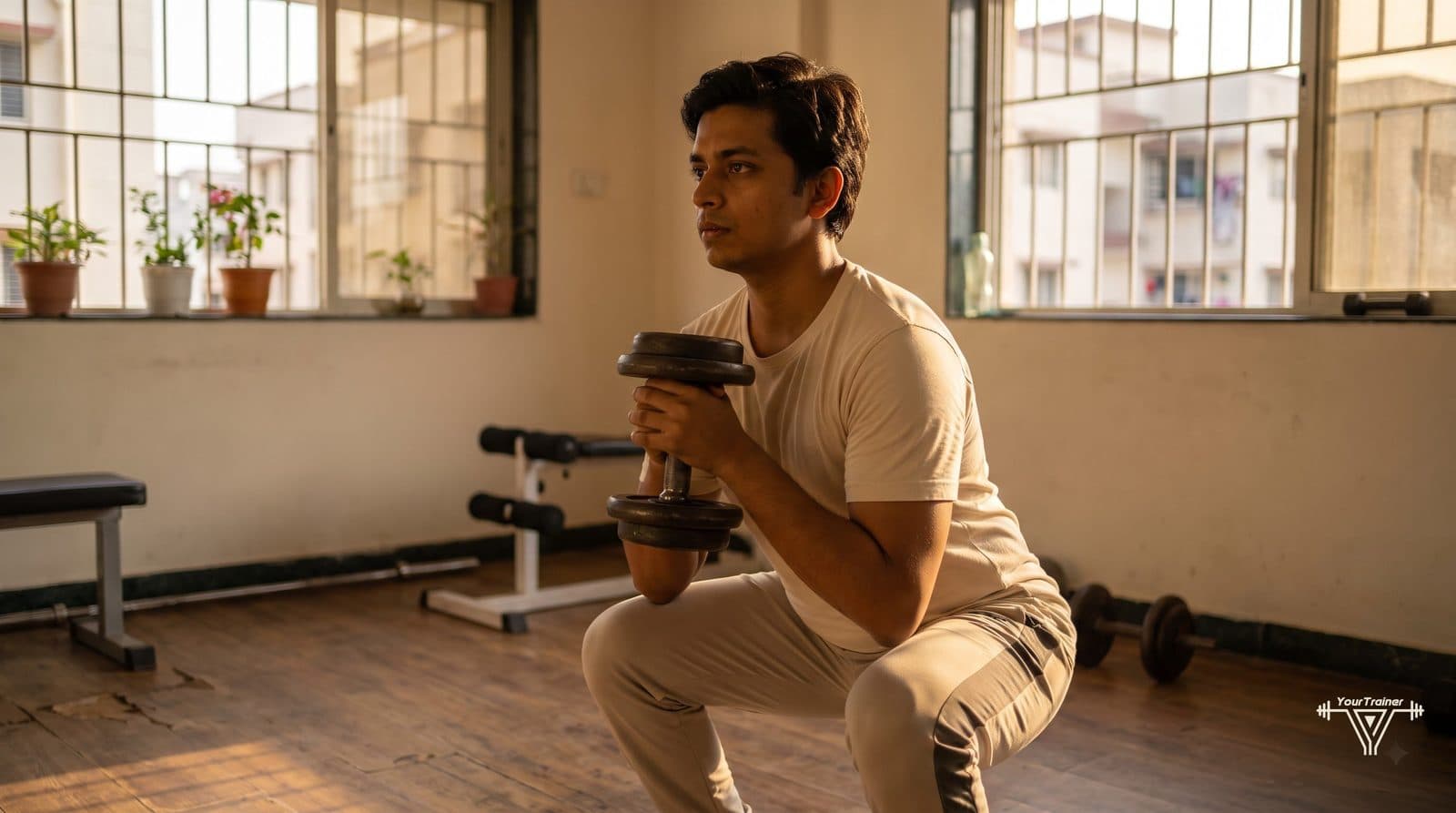
Third set of squats, left knee starts to hurt. R. has a history that would make most people stop: "I haven't done squats, it's been a couple of years." His coach, Vivek, watched the camera and asked for two changes: bring the feet slightly closer together, point the toes forward instead of out. R. did the next set. By the end of it, the pain was gone.
The coach's session note reads: "form reassessment, coach confirmed back was straight, pain disappeared in third set."
The 30-second stance check: Feet under hips, not wide. Toes forward or barely out. Knees travel over the toes, not inward. Chest up. Go only as deep as your knee stays quiet. Long-legged clients may never squat to the floor, and that's fine, our coaches told two long-femured clients exactly that.
Fix 2: Load the legs without loading the knee or the back
With the stance fixed, Vivek still did not chase heavy squats with R. He moved him to the leg press: "Leg press is a great machine to train your legs without loading your back." R. went from 65 lb to 165 lb in a single session, pain-free, and kept squats as a lighter technique exercise.
Case study: T., 30s, beginner with a pinched nerve and a sore knee
Lunges bothered both. Her coach swapped lunges for Romanian deadlifts (a hip hinge) and kept the dumbbells at 5-8 lb while she learned the pattern. Her first-class summary: multiple pain points, no incident, full session completed.
| If this hurts | Our coaches swap in |
|---|---|
| Lunge | Romanian deadlift, glute bridge, or a backward lunge holding a chair |
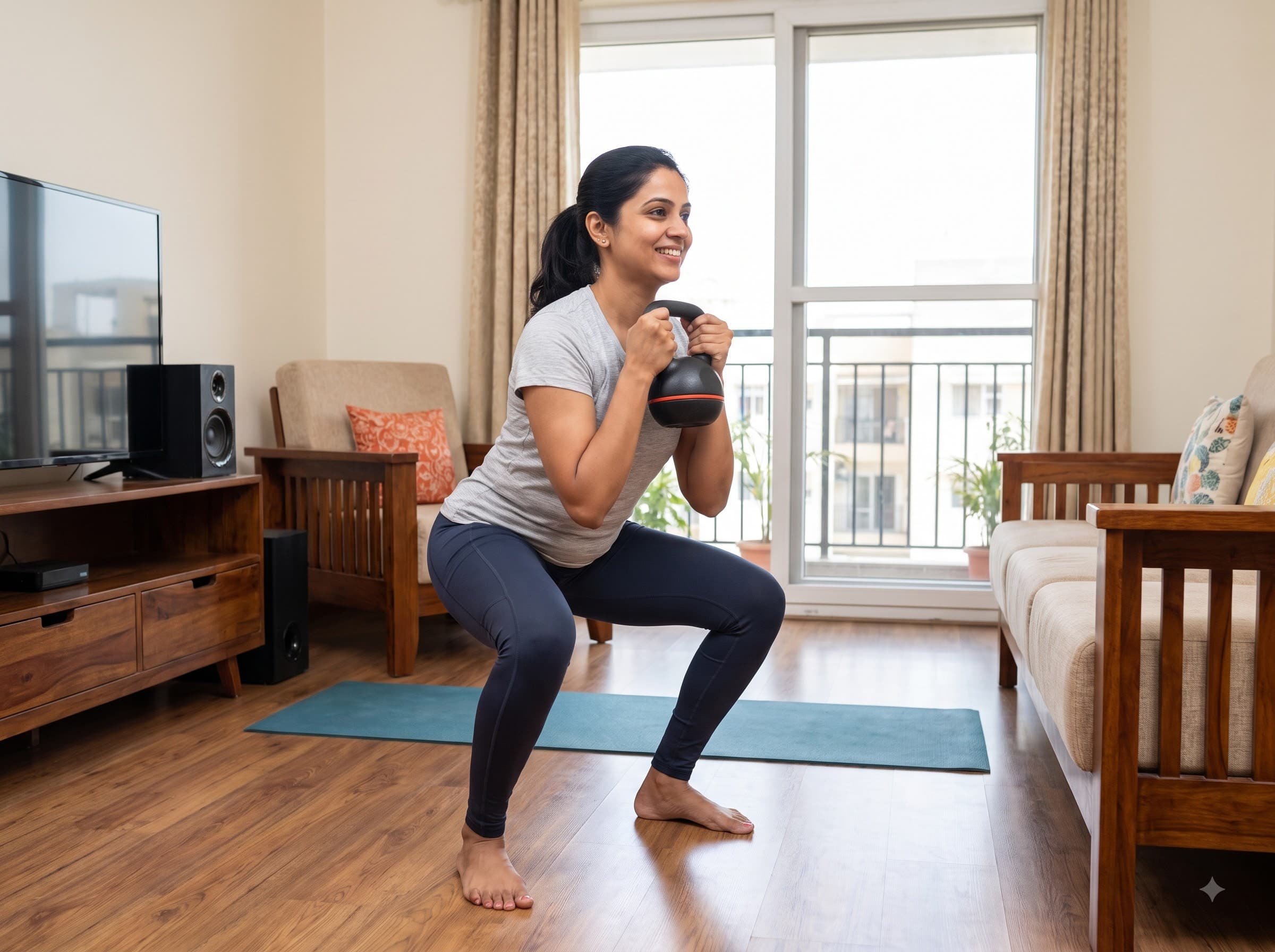
| Squat at depth | Box or wall squat to a shorter range, then goblet squat |
| Need leg strength, knee unhappy | Leg press, step-ups to a low step, hip thrust |
Train around it, with a coach
Sore knees rarely mean stop training. They mean train differently, with every set rated for pain.
A coach watches each rep over video, swaps what hurts and builds strength around your hip and knee, week by week, alongside your doctor or physio.
Start Your JourneyStart from here:Knee pain strength coaching
Fix 3: Start with bodyweight if there is a surgery in your history
Case study: M., desk job, knee surgery ten years ago, first class ever
Her coach, Gokul, did not hand her a dumbbell. Day one was joint rotations, bodyweight squats, wall push-ups, side-lying leg raises and hip mobility, because sitting 8 hours a day had tightened her hip flexors more than the old surgery had weakened her knee. Her homework was not exercise: get a measuring tape, and take daily steps from about 3,500 to 6,700. Measurements come after 12 classes, when there is something to compare.
Case study: A., 40s, ligament rupture from badminton in 2009
Fully recovered, now training with weights. Her coach's summary after checking her: "Your bone density is good, your strength is good, you can do your daily work." A serious knee injury fifteen years ago is history, not a limit, the same principle behind our Restore & Perform recovery-focused program.
How to tell knee pain from muscle pain
Our coaches teach this distinction in almost every beginner block, because it decides whether you continue:
| Type | Feels like | What to do |
|---|---|---|
| Joint pain | Sharp, localised, short, often at one point of the movement | Stop that rep, change stance or exercise, tell your coach |
| Muscle soreness | Dull, spreading, lingers a day or two, worse the next day | Normal, fades as the movement becomes familiar |
Vivek to a first-month client: "These movements are completely fresh to your body, so it doesn't know how to move, which is why it is getting so sore." And Gokul's recovery rule: "If you are not recovering within 24 to 48 hours, your body is not getting proper recovery, and we change the plan."
Why it matters that these were online classes
Every fix above was done through a phone camera. No hands-on adjustment, no gym floor. The tools were a stance cue, an exercise swap, a lighter dumbbell and a question at the start of the class ("any pain today?"). In our data, coaches asked about sleep, energy or pain at the start of 75% of the sampled sessions. If yours doesn't, ask them to. It's the same check-in-first approach we use with desk-job clients and busy professionals who start deconditioned.
Related articles
- Why Your Weight Goes Up Before Your Period: What Our Sessions Showed Us
- Restore & Perform: Recovery-Focused Fitness Program
- How Long Does It Take to See Results From a Personal Trainer?
Want a coach who tracks more than your reps? YourTrainer coaches Indians, worldwide, with live 1-on-1 video sessions, Indian-food meal plans and WhatsApp accountability. Start Your Journey.
Coaching guidance on this site is educational and is not a substitute for medical advice. See how we use sources.
Did you find this helpful?

About Anish Agarwal
Founder & Head Coach, YourTrainer · NASM & K11 Certified Personal Trainer · coaching since 2022
Featured in Dietitians.io, Fitness Interview, NRI Pulse, The MASALA Study. Press and media
Anish Agarwal is a NASM and K11 certified personal trainer coaching fat loss, body transformation, strength, and nutrition for clients across India since 2022. He founded YourTrainer to make expert, science-based coaching accessible online and in Bengaluru. Coach Anish's profile and the YourTrainer story.
Online 1-on-1 Coaching
Start Your Journey
Get a personalised training + Indian nutrition plan built around your goal, coached online, anywhere in India or abroad.
Trusted by 1,000+ clients coached across India & abroad
Free 30-min discovery call · No obligation