Live Video Coaching vs App-Based Plans: What Actually Changes Your Form
Some coaching watches you train in real time. Some reviews your logs afterwards. The difference matters most for beginners and heavy lifts, and here are the questions to ask before you pay anyone.

Quick answer: Coaching services broadly split into two models. In live coaching a coach watches you train in real time and can correct a lift while it is happening. In asynchronous coaching you train alone and receive feedback on your logs or uploaded clips afterwards. Both are legitimate, but they differ in when the feedback lands, which matters most for beginners and for heavy compound lifts. The most useful thing you can do before paying anyone is ask exactly which model you are buying.
Questions worth asking any coaching service
- Will anyone actually watch me train, and how often? This is the core question. Live sessions, live form reviews, or logs reviewed afterwards are three different products.
- Who is my specific coach and what are they qualified in? On larger platforms the answer varies by who you are assigned. Ask before you pay, not after.
- What happens between sessions? Daily messaging, weekly check-ins and a monthly plan update are very different levels of contact.
- Can sessions be scheduled around my timezone? Particularly worth pinning down if you are abroad and the coach is not.
- Is the plan adjusted based on what I report, or fixed for the block? Both exist. Only one responds to a bad week.
- What are the cancellation and refund terms? A service confident in its coaching will answer this plainly.
The two models, described honestly
It is worth being precise here, because the marketing language across the industry tends to blur the distinction. Plenty of services offer both, and a service being app-based does not automatically mean it has no live element. What you are trying to establish is what your particular plan includes.
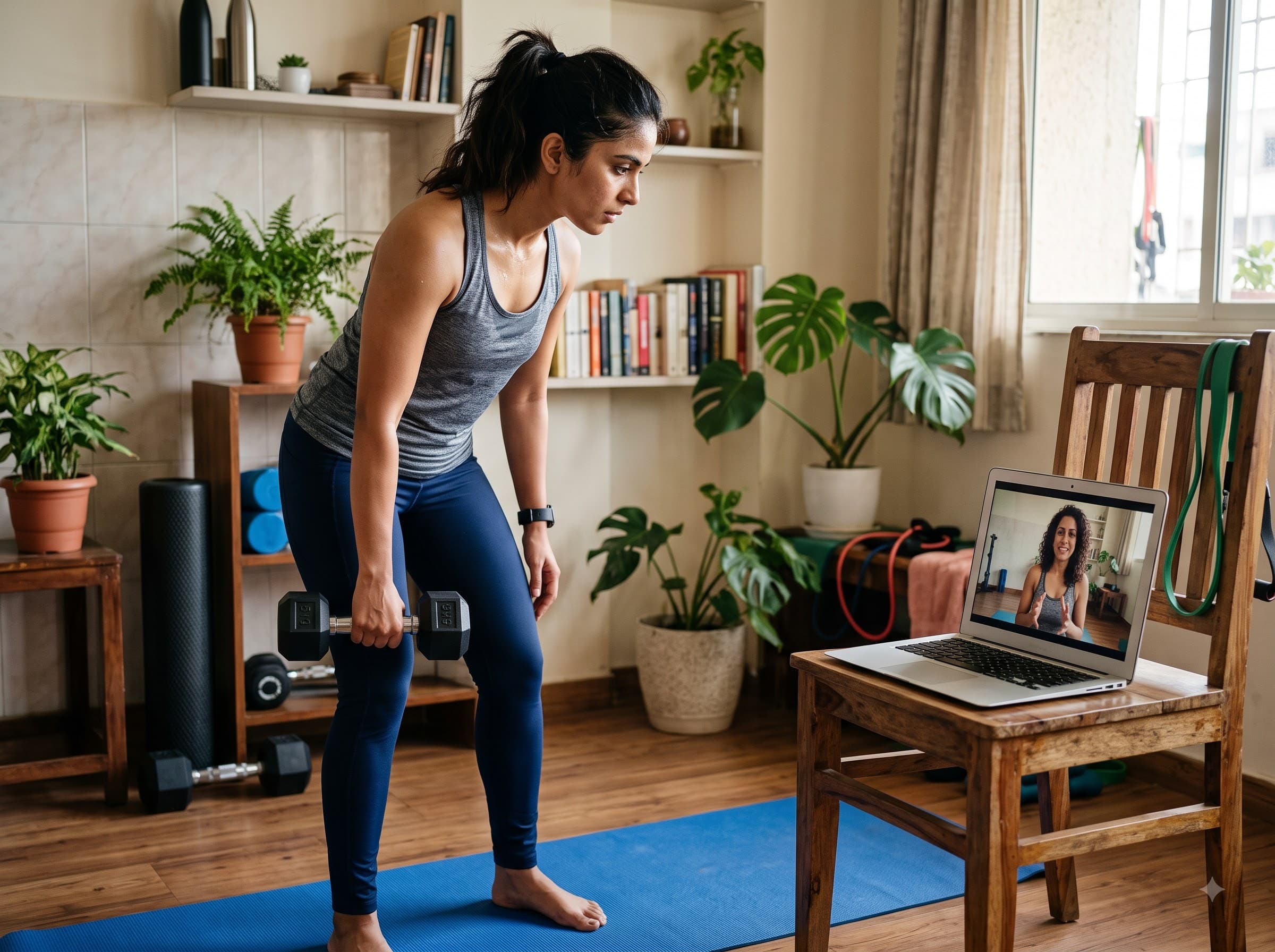
Live coaching means a coach is present while you train, usually over video. The defining feature is that a correction can happen mid-set: your knees drift, the coach says so, and the next rep is different. You are also, in practice, more likely to turn up, because someone is expecting you at a specific time.
Asynchronous coaching means you train on your own and the coach responds afterwards, to a log, a set of numbers, or a clip you upload. It is cheaper to deliver, far more flexible around an unpredictable schedule, and works perfectly well for someone whose technique is already sound and who mainly needs programming and accountability.
Why the timing of feedback matters
Consider a beginner learning to squat. On the first working set the knees track slightly inward. It is a common pattern and not dangerous by itself. The question is what happens next.
With a coach watching, it is addressed on the second rep. The remaining sets are done differently, and the version your body learns is the corrected one. Without a coach watching, the session is completed as it started, and the pattern is repeated across every set. If a clip is reviewed two days later, the feedback is accurate but arrives after the fact, so it applies to the next session rather than the one already done.
The honest framing is not that the second scenario causes injury. It is that it takes longer, because you spend part of the process unlearning something that a live correction would have prevented from settling in. For light accessory work this hardly matters. For loaded squats, hinges and presses, it matters considerably more.
Where each model genuinely fits
Live coaching is worth prioritising if you are new to lifting, are returning after a long gap or an injury, are training heavy compound lifts, cannot yet tell from feel whether a rep was good, or know from experience that you skip sessions nobody is expecting you at.
Asynchronous coaching is often sufficient if you have a couple of years of consistent training behind you, are working mostly with machines and lighter accessory work, have a schedule too unpredictable to commit to fixed session times, or mainly need programming and someone reviewing your numbers.
The common case: most people are best served by a combination rather than a pure version of either. Live contact for technique and programme changes, asynchronous contact for the rest of the week. What you want to avoid is paying for what you assumed was the first and receiving the second.
Coaching that does this for you
Reading is step one - a coach turns it into a plan built around your body, food & schedule.
100% online · Indian meal plans · weekly progress reviews · daily WhatsApp support.
Start Your Journey →What this looks like in practice
For context on how the two are usually combined, YourTrainer's coaching for Indians abroad runs on three tiers, and the difference between them is largely how much live contact is included:
| Plan | Live contact | Between sessions |
|---|---|---|
| Starter - $79/mo | Bi-weekly form video review, monthly progress call | WhatsApp check-ins 3x/week, weekly workout programme |
| Core - $129/mo | Weekly form video review, weekly video call | Daily WhatsApp accountability, lifestyle coaching, priority response |
| Elite - $199/mo | Twice-weekly video reviews, twice-weekly calls | Daily WhatsApp and voice notes, direct messaging anytime, specialist coach |
The tiers are described in full on the coaching for Indians abroad page. The point of listing them here is not the pricing but the shape: the thing that scales with cost is how often a person actually looks at you training.
Claims worth being sceptical about
- "Live" that turns out to be a group class. A coach leading twenty people cannot correct twenty people's technique. That is a class, which is a fine thing to buy, but it is not form coaching.
- "Live" that turns out to be pre-recorded. Following along with a video is not the same as being watched.
- Live sessions with no actual correction. Being counted at and encouraged is not coaching. You should be told specific things to change.
- Unnamed coaches. If nobody will tell you who you will be working with or what they are qualified in before payment, that is worth weighing.
- Guaranteed timelines. Nobody can promise a fixed number of kilos in a fixed number of weeks, and anyone who does is telling you something about their honesty rather than their coaching.
A reasonable way to decide
Work out which of the two things you are actually short of. If you know what to do and simply are not doing it consistently, you need accountability, and asynchronous coaching may be sufficient. If you are unsure whether what you are doing is correct, you need eyes on you, and no amount of written feedback fully substitutes for that. Most people underestimate how much of the second they need in the first year and overestimate it later.
Related articles
- How to Choose a Personal Trainer in India: 7 Questions and the Red Flags
- Online vs In-Person Personal Trainer in India (2026)
- Personal Trainer Certifications in India, Decoded
- Is a Personal Trainer Worth It in India? Honest Cost-vs-Results
- Personal Trainer Cost Per Month in India (2026)
- Online Personal Trainer Cost in India 2026 (Full Pricing Guide)
Want a plan built around your actual week, not an ideal one? YourTrainer coaches Indians abroad with live 1-on-1 video sessions, Indian-food meal plans and WhatsApp accountability. Start Your Journey.
Sources
- Guidelines on physical activity and sedentary behaviour (2020) · World Health Organization
- ISSN Position Stand: Protein and Exercise · Journal of the International Society of Sports Nutrition (2017)
Figures for Indian foods follow IFCT 2017 (ICMR-NIN). Coaching guidance on this site is educational and is not a substitute for medical advice. See how we use sources.
Did you find this helpful?

About Anish Agarwal
Founder & Head Coach, YourTrainer · NASM & K11 Certified Personal Trainer · 6+ years experience
Anish Agarwal is a NASM and K11 certified personal trainer with 6+ years of experience coaching fat loss, body transformation, strength, and nutrition for clients across India. He founded YourTrainer to make expert, science-based coaching accessible online and in Bengaluru. More about Anish.
Online 1-on-1 Coaching
Start Your Journey
Get a personalised training + Indian nutrition plan built around your goal, coached online, anywhere in India or abroad.
★★★★★ Trusted by 1,000+ transformations across India & abroad
Free 30-min discovery call · No obligation