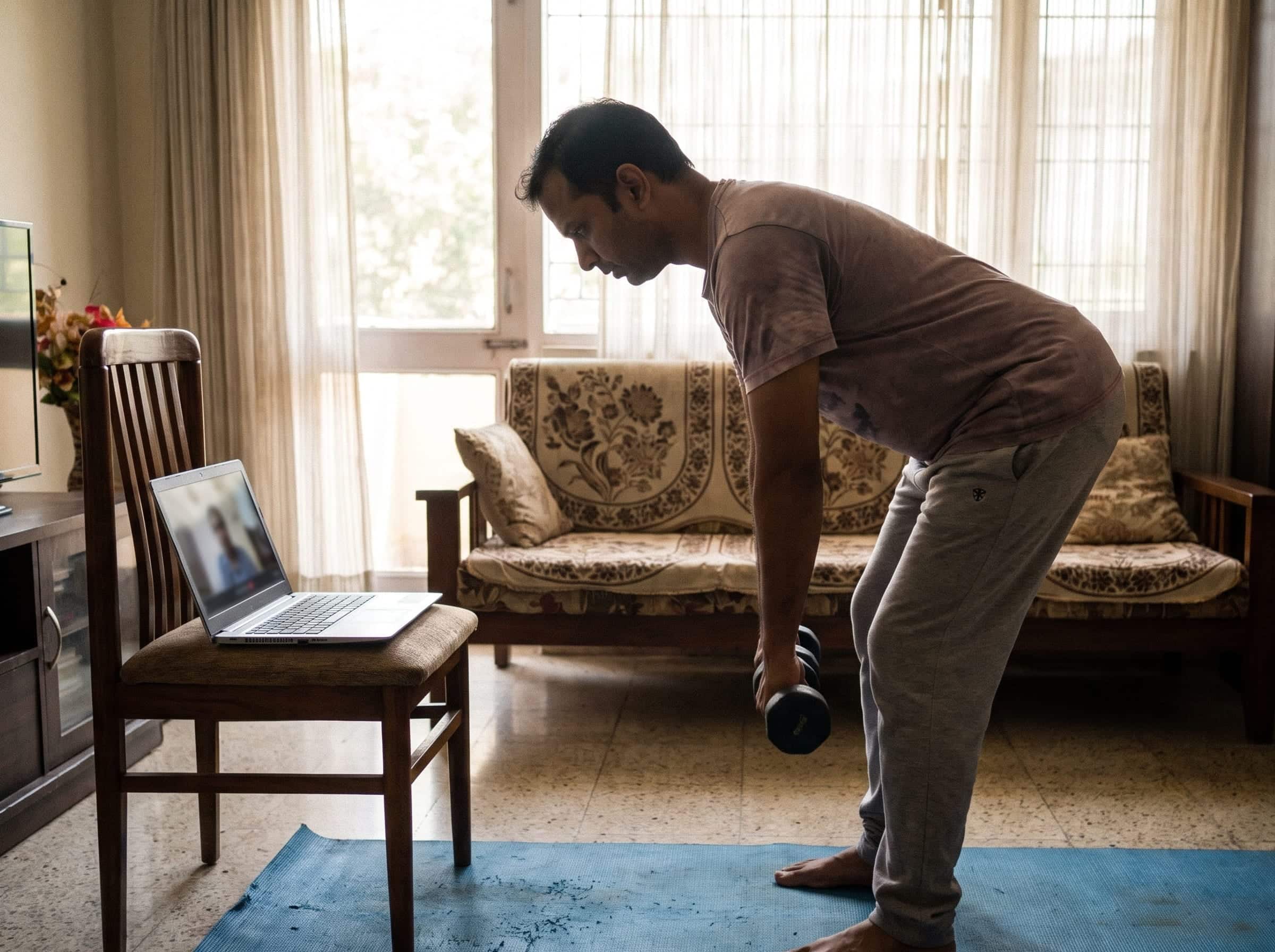
How to Help Your Parents in India Stay Strong When You Live Abroad
Signs your parent is getting weaker, a 2 minute strength check you can do on a video call, fall-proofing the home, and how to find help that lasts.
When your parents live in India and you live in Dallas, London or Dubai, you see them in short bursts. A two week visit once a year, and video calls in between. That is often how children notice the change: on this visit Papa holds the wall on the stairs, or Mummy stopped going to the market alone. This guide covers what to look for, a simple strength check you can run on a video call, and how to set up help that keeps going after you fly back.
The short answer
Watch for the early signs: using the arms to get up, holding furniture to walk, going out less. Do the 30-second chair stand test on a video call to see where your parent stands. Then make the home safer, talk to their doctor, and get them strength and balance work at least twice a week from someone who keeps showing up.
Signs your parent is getting weaker
- They push down on the armrests or the table to get up from a chair.
- They hold furniture or the wall while walking around the house.
- They walk more slowly, or stop to rest on stairs they used to climb easily.
- They go out less, or avoid places where they might have to walk far.
- They have had a fall, or a near fall they did not mention at first.
None of these is an emergency on its own. Together, they usually mean leg strength and balance are slipping, and both can be trained at any age.
A two minute check on a video call
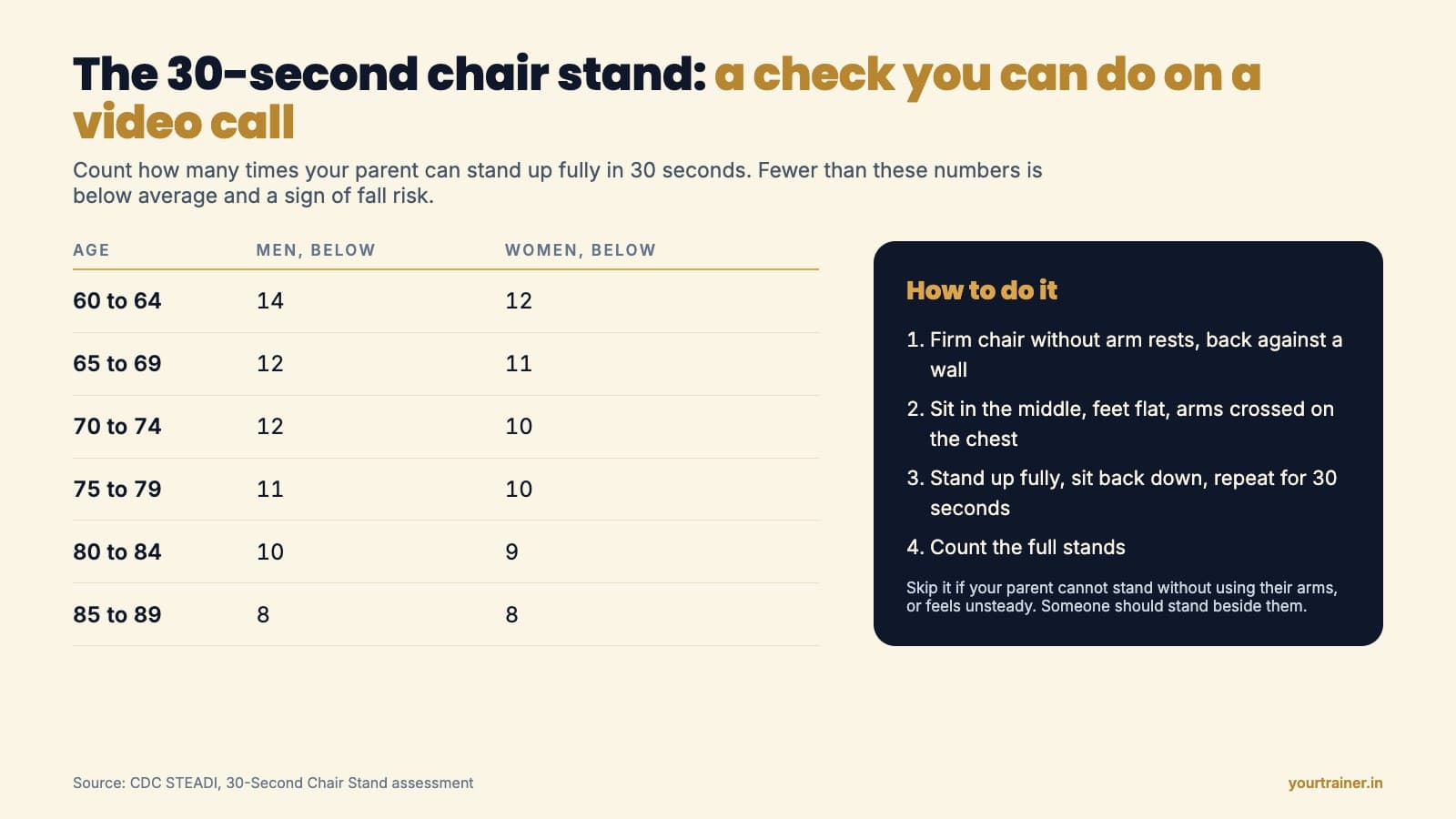
The 30-second chair stand is a test the US CDC uses in its STEADI falls programme. It measures leg strength, and a low score points to a higher risk of falls. You can run it over a video call with someone at home standing beside your parent.
- Use a firm chair without armrests, pushed back against a wall.
- Your parent sits in the middle of the seat, feet flat, arms crossed on the chest.
- On "go", they stand up fully and sit back down, again and again, for 30 seconds.
- Count the full stands.
If the count is below these numbers for their age, it is below average:
| Age | Men: below average | Women: below average |
|---|---|---|
| 60 to 64 | fewer than 14 | fewer than 12 |
| 65 to 69 | fewer than 12 | fewer than 11 |
| 70 to 74 | fewer than 12 | fewer than 10 |
| 75 to 79 | fewer than 11 | fewer than 10 |
| 80 to 84 | fewer than 10 | fewer than 9 |
| 85 to 89 | fewer than 8 | fewer than 8 |
Skip the test if your parent cannot stand up without using their arms, feels dizzy, or is unsteady. That already tells you what you need to know, and it is a good reason to speak to their doctor. Repeat the test every couple of months to see whether things are improving.
Coaching that does this for you
Reading is step one. A coach turns it into a plan built around your body, food & schedule.
100% online · Indian meal plans · weekly progress reviews · daily WhatsApp support.
Start Your Journey →Make the home safer this visit
The NHS lists simple changes that cut the risk of falls at home. Most can be done in a weekend:
- Clear clutter, loose wires and rugs that slide.
- Put a non-slip mat in the bathroom and fit grab rails near the toilet and the shower.
- Fit rails on steps, and check the lighting on stairs and on the way to the bathroom at night.
- Slippers and shoes that fit well and grip, not loose chappals on a wet floor.
- A mobile phone kept on them, so they can call if they do fall.
- Enough water and regular meals, since skipping either can cause light-headedness.
How much activity they actually need
The WHO advises adults over 65 to build up to 150 to 300 minutes of moderate activity a week, with muscle strengthening on at least 2 days. Those with poor mobility should add balance and strength work on 3 or more days to help prevent falls. The NHS adds two simple points: be active every day, even lightly, and break up long spells of sitting.
For a parent who mostly sits, that starts small. Sit to stand from a chair, wall push-ups, heel raises holding the kitchen counter, standing on one foot beside the counter, and a daily walk that grows from 10 minutes to 30. Strength comes back with practice. A small amount done every week beats a long session done once.
Talk to their doctor before they start
Ask three things. Is it safe for them to start strength and balance exercise? Is there any movement to avoid, for example after a knee replacement or with a heart condition? And do any of their medicines, such as some for diabetes or blood pressure, need care around exercise? Write down the answers and share them with whoever will be coaching your parent.
Food that supports strength
Muscles need protein to rebuild after exercise, and many older adults eat less of it as appetite drops. The simple fix is a protein food at every meal from the kitchen they already know: dal, curd, paneer, eggs, chana, fish or chicken. Keep sweets and fried snacks for occasions rather than every evening with tea.
Choose help that keeps showing up
The most common complaint from children living abroad is that the help stops. The trainer comes for a week, the physio's plan gets lost, the daily walk fades once the visit ends. Before you hire anyone, ask:
- Who exactly will work with my parent, and will it be the same person each time?
- Have they worked with older adults with diabetes, blood pressure or joint pain?
- How will I know how sessions are going, and what happens if one is missed?
- Will the plan change as my parent gets stronger, or is it one sheet of exercises?
Match the help to the need. A physiotherapist is right after an injury, a fracture or surgery. An eldercare service is right for nursing, daily personal care or medicine management. A coach is right for regular strength, balance and walking once the doctor is happy for your parent to exercise.
If you want a coach for your parent, we offer 1-on-1 video coaching for parents at home in India, booked and paid by you, with updates to you if your parent agrees. Every member pays the same price, billed in Indian rupees. If your parents live with you abroad instead, see our fitness plan for Indian parents in the US. Or Start Your Journey and tell us about them.
Sources
- US Centers for Disease Control and Prevention, STEADI: 30-Second Chair Stand assessment.
- NHS: How to prevent falls, and physical activity guidelines for older adults.
- World Health Organization: guidelines on physical activity and sedentary behaviour, 2020.
Did you find this helpful?

About Anish Agarwal
Founder & Head Coach, YourTrainer · NASM & K11 Certified Personal Trainer · coaching since 2022
Featured in Dietitians.io, Fitness Interview, NRI Pulse, The MASALA Study. Press and media
Anish Agarwal is a NASM and K11 certified personal trainer coaching fat loss, body transformation, strength, and nutrition for clients across India since 2022. He founded YourTrainer to make expert, science-based coaching accessible online and in Bengaluru. Coach Anish's profile and the YourTrainer story.
Online 1-on-1 Coaching
Start Your Journey
Get a personalised training + Indian nutrition plan built around your goal, coached online, anywhere in India or abroad.
Trusted by 1,000+ clients coached across India & abroad
Free 30-min discovery call · No obligation