Strength Training With Lower Back Pain: What Our Coaches Change (and the Exercises We Keep)
Lower back pain is the most listed condition on our intake forms. The 6 swaps and cues coaches use for deadlifts, squats, hip thrusts and push-ups.
Before anyone joins YourTrainer they fill an intake form with a list of health conditions. We expected PCOS or thyroid to top it, since those are the pages people find us on. The most ticked box is lower back pain, ahead of PCOS, obesity and thyroid. So we went back to the October class recordings to see what coaches actually do with a member who says "my back".
Method: intake conditions from a sample of YourTrainer member profiles, shown as ranks. Coaching examples and quotes are from recorded one-to-one classes, 8 September to 12 October 2026, members anonymised. Pain-in-class share is from the Aug to Sep 2026 class sample.
The short answer
You can train. Our coaches change four things: the hinge pattern (shorter range, dumbbells on the thighs), the squat (wall or chair, 90 degrees), the core work (dead bugs and planks instead of sit-ups), and the load. Then they ask for a pain score after every set. Sharp or above 7 out of 10 stops the set. Dull ache continues.
Our data
#1
lower back pain, the most listed intake condition
#2 to #4
PCOS, obesity and thyroid, tied
68%
of recorded classes had some pain or discomfort moment
10%
of classes mentioned lower back pain or history
From our own recorded classes
Source: YourTrainer intake profiles (ranks only) and recorded classes, Aug to Oct 2026
Six things coaches changed on camera this month
| What happened in class | What the coach did | The cue, verbatim |
|---|---|---|
| Member felt lower back strain during dumbbell Romanian deadlifts (3 Oct) | Shortened the range, dumbbells kept on the thighs, glutes squeezed at the top | "Keep the dumbbells always close to your legs." "Your glutes should go straight back. It should not go down." |
| Member struggled with deadlift form and felt tension in the lower back (8 Oct) | Switched to hip hinge drills without weight, then hip raises with back support | "Only hinging from your hip." "Don't bend your knees that much, soft knees." |
| Member rated back pain 7 out of 10 during squats (7 Oct) | Paused squats, moved to flat bench chest press for the day | "Don't give pressure around the lower back." |
| Member with an old back injury (8 Oct) | Modified every lift, avoided the moves that aggravate, kept the session | Coach offered modified exercises and avoided aggravating moves |
| Member felt hip thrusts in the neck and lower back (3 Oct) | Lowered the top position, chin tucked, torso stable | "Keep the torso stable and don't over-use the lower back." |
| Member reported lower back soreness in push-ups and flies (9 Oct) | Hands set back, core braced, range shortened | "Brace your core as if someone is punching you in the stomach." |
The pain scale rule
Every set in our classes ends with a number. "How difficult, 1 to 10?" is about effort, and 7 to 9 is the target. For pain there is a second question, and a different rule.
Sharp and short is joint. Dull and lingering is muscle. Muscle ache is worked through. Joint pain stops the set.
A pain score of 7 or more stops the exercise for the day. On 7 October a member rated squats 7 out of 10 and the coach moved to chest press. The session was not cancelled, the exercise was.
Pain the next morning changes the plan. "If you are not recovering within 24 to 48 hours, your body is not getting proper recovery, and we change the plan."
Tell the coach during the set, not after. "Report any discomfort during the workout." On a video call the coach can only see the shape, not the feeling.
Train around it, with a coach
Most lower back pain gets better with the right exercise, not rest. The right load is what a coach is for.
Form before load, a back check after every set, and steady core and hip strength, coached live over video, alongside your doctor or physio.
Start Your JourneyStart from here:Lower back pain strength coaching
The swap table
| Usual exercise | Back-friendly version our coaches use | What you should feel |
|---|---|---|
| Deadlift from the floor | Dumbbell Romanian deadlift, short range, dumbbells on the thighs | Hamstrings and glutes, not the lower back |
| Deep back squat | Wall-supported squat or chair squat to 90 degrees | Front of thighs and glutes |
| Lunges | Backward lunges with a hand on a wall, small steps | Front thigh of the front leg |
| Sit-ups, leg raises | Dead bugs, bird dogs, elbow plank, side plank | Deep core; the back stays flat on the mat |
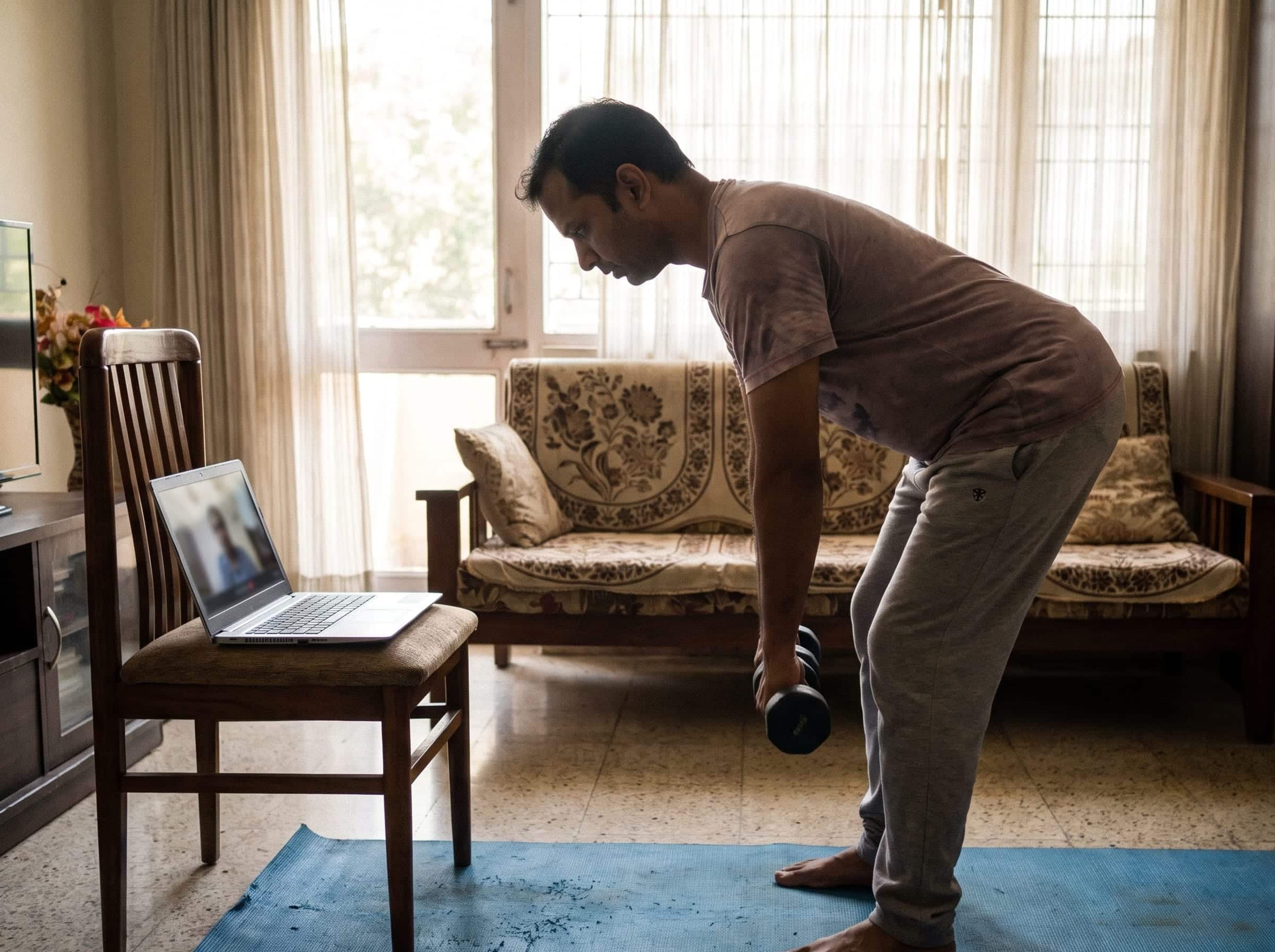
| Bent-over row | Single-arm row with one hand and one knee on a bench or chair | Mid-back and lat, back supported |
| Burpees, jump squats | Step-ups, marching, high knees in place | Legs and lungs, no impact |
| Hip thrust with a high top position | Glute bridge on the floor, feet a little out, chin tucked | Glutes, not the back |
Coach's tip: A hinge is a hip movement. If the dumbbells drift forward and the back rounds, the move has become a bend. Keep the weight touching your legs the whole way.
What the 23 hours look like
Most of our members with back pain sit for 8 to 10 hours. In class the fix is 1 hour; the homework is the rest of the day.
- Steps. "I want you to do a minimum 5k steps at home in a day. It takes 20 min. Walk around your living space. That's a non-negotiable." (coach, in chat)
- Stretch homework. From a coach's chat to a member: glute stretch, hamstring stretch with a band, calf stretch, foam rolling for glutes, hamstrings, mid-back and quads.
- Desk posture. Hamstring tightness from desk sitting came up in class with three stretch variants and a daily homework set.
- Sleep. Back pain and 5 to 6 hour sleep arrive together in the recordings. Pain, poor sleep, then a worse session. The coach asks about sleep before the warm-up for that reason.
- Weight. Several members with back pain also listed obesity. Losing 5 kg changes the load on the spine on every step, which is why the food plan is part of the back plan.
Member story
Meera, 40s, working mother
Lower back history on the intake form, trains 3 days a week on video
- Started with bodyweight hinges and wall squats; Romanian deadlifts added with 2 kg dumbbells only once the hinge was clean.
- Load went up by the rule: form holds, pain under 4, add the next dumbbell.
- By October: 86.7 to 84 kg, and "people who met me after a while said you are doing something".
- No class was cancelled for the back. Two exercises were, on two days.
From her recorded classes and chats, Sep to Oct 2026. Name changed. One person's result; results vary.
"If you are not recovering within 24 to 48 hours, your body is not getting proper recovery, and we change the plan." (Coach Gokul, in class)
When to see a doctor first
Online coaching is the wrong first stop if the pain shoots down a leg, if there is numbness or weakness in a foot, if it started with a fall, or if it wakes you at night. One member on our intake listed a slip disc; that member trains, but after a physiotherapist's clearance and with the plan shared. Read personal trainer vs physiotherapist for where the line is.
A first week you can do today
| Day | Session (20 to 30 minutes) |
|---|---|
| Day 1 | 5,000 steps. Cat-cow x10, bird dog x8 each side, glute bridge x12, wall squat to 90 degrees x10, dead bug x8 each side. Two rounds. |
| Day 2 | Walk 30 minutes. Hamstring and glute stretches 30 seconds each, twice. |
| Day 3 | Repeat day 1. Add a single-arm row with a water bottle or light dumbbell, one hand on a chair, x10 each side. |
| Day 4 | Walk. Foam roll glutes and mid-back if you have a roller. |
| Day 5 | Day 1 plus a short-range Romanian deadlift with 2 to 3 kg dumbbells kept on the thighs, x8. Pain score after every set. |
Want a coach who watches your hinge on camera and scores every set?
Start Your JourneyRelated reading
Did you find this helpful?

About Anish Agarwal
Founder & Head Coach, YourTrainer · NASM & K11 Certified Personal Trainer · 5+ years coaching
Featured in NRI Pulse, Dietitians.io, Fitness Interview, The MASALA Study. Press and media
Anish Agarwal is a NASM and K11 certified personal trainer coaching fat loss, body transformation, strength, and nutrition for clients across India, with 5+ years coaching. He founded YourTrainer to make expert, science-based coaching accessible online and in Bengaluru. Coach Anish's profile and the YourTrainer story.
Online 1-on-1 Coaching
Start Your Journey
Get a personalised training + Indian nutrition plan built around your goal, coached online, anywhere in India or abroad.
Trusted by 1,000+ clients coached across India & abroad
Free 30-min discovery call · No obligation