
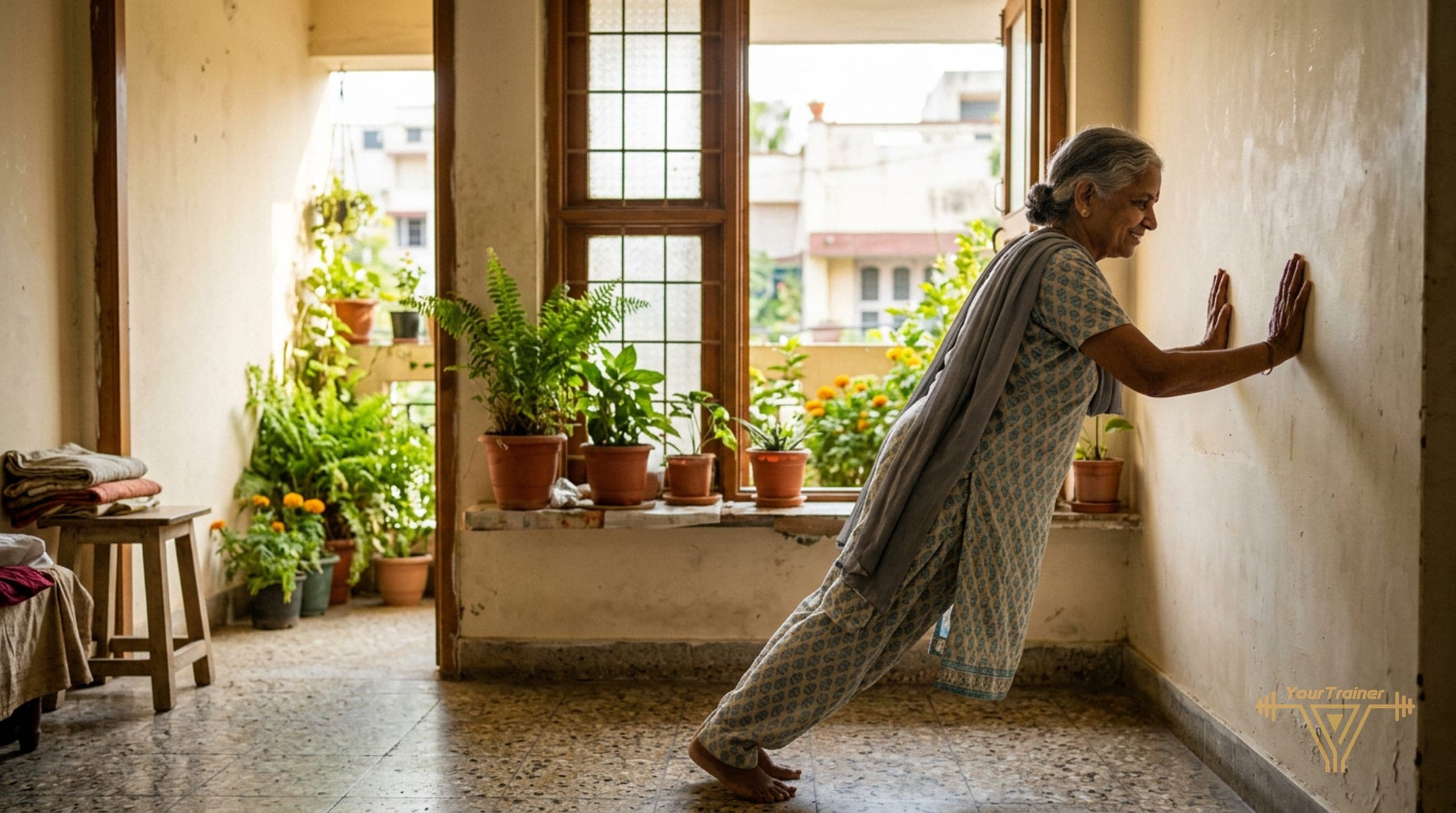
For your parents in India
A Personal Trainer for Your Parents in India, Booked by You
You book and pay, from anywhere in the world. Your parent trains 1-on-1 at home in India with a YourTrainer coach on video: strength from a chair, balance, walking and Indian food, planned around their doctor's advice. With your parent's permission you stay updated on progress. The fee is set on a free call, the same for every member, billed in Indian rupees. Start Your Journey
Most people who live away from their parents worry about the same things. Is anyone checking on them? Is the help they have actually turning up? And are they getting weaker every year, one stiff knee or one fall at a time? A coach cannot replace a visit home. A coach can make sure your parent moves well every week, with someone who notices when something changes.
- 1-on-1 sessions at home, on video
- A plan built around their doctor's advice
- You stay updated, with their permission
What a week looks like
A sample week for a parent starting out
- MonStrength from a chair with the coach: sit to stand, wall push-ups, band rows
- TueWalk, 15 to 30 minutes, plus a few minutes of balance practice at the counter
- WedSession with the coach: balance, mobility, and a check on how the knees and back feel
- ThuWalk and balance practice
- FriStrength from a chair with the coach, a little harder if the last week felt easy
- SatEasy walk, ideally with family or friends
- SunRest
Fit check
Who it suits, and who it does not
It suits you if
- Your parent sits for most of the day and you want them moving safely.
- They have diabetes, blood pressure or joint pain, and their doctor is happy for them to exercise.
- They have had a fall or a scare and want to feel steady on their feet again.
- You want regular, reliable sessions, not a trainer who stops coming after a week.
It is not the right fit if
- Your parent needs nursing, daily personal care or medicine management. An eldercare service fits that better.
- They have chest pain, dizziness or a recent surgery their doctor has not cleared.
- They do not want to do it. Coaching only works when the parent says yes.
- You want a group class. Sessions are 1-on-1.
Our own data
Why this matters after 60
Self-reported diagnoses from the Longitudinal Ageing Study in India, the largest survey of older adults in the country [1].
The training science
What health bodies advise for people over 65
The WHO advises adults over 65 to build up to 150 to 300 minutes of moderate activity a week and to do muscle strengthening on 2 or more days. People with poor mobility should add balance and strength work on 3 or more days to help prevent falls [2].
The NHS tells adults over 65 to speak to a GP first if they have not exercised for some time or have a medical condition, to be active every day, and to break up long spells of sitting [3].
The ACSM position stand on resistance training advises raising the load in small steps only when the planned repetitions become easy [4]. For an older parent, that can mean weeks of chair work before any weights.
For you
How it works if you live away
You book the free call and tell us about your parent: their age, health, what worries you and what they enjoy. You can join the call with them or speak to us first on your own. Once you sign up, you pay for the plan, and we send your parent their session links.
With your parent's permission, you stay updated on how the sessions are going and what the coach is changing.
For your parent
What your parent actually does
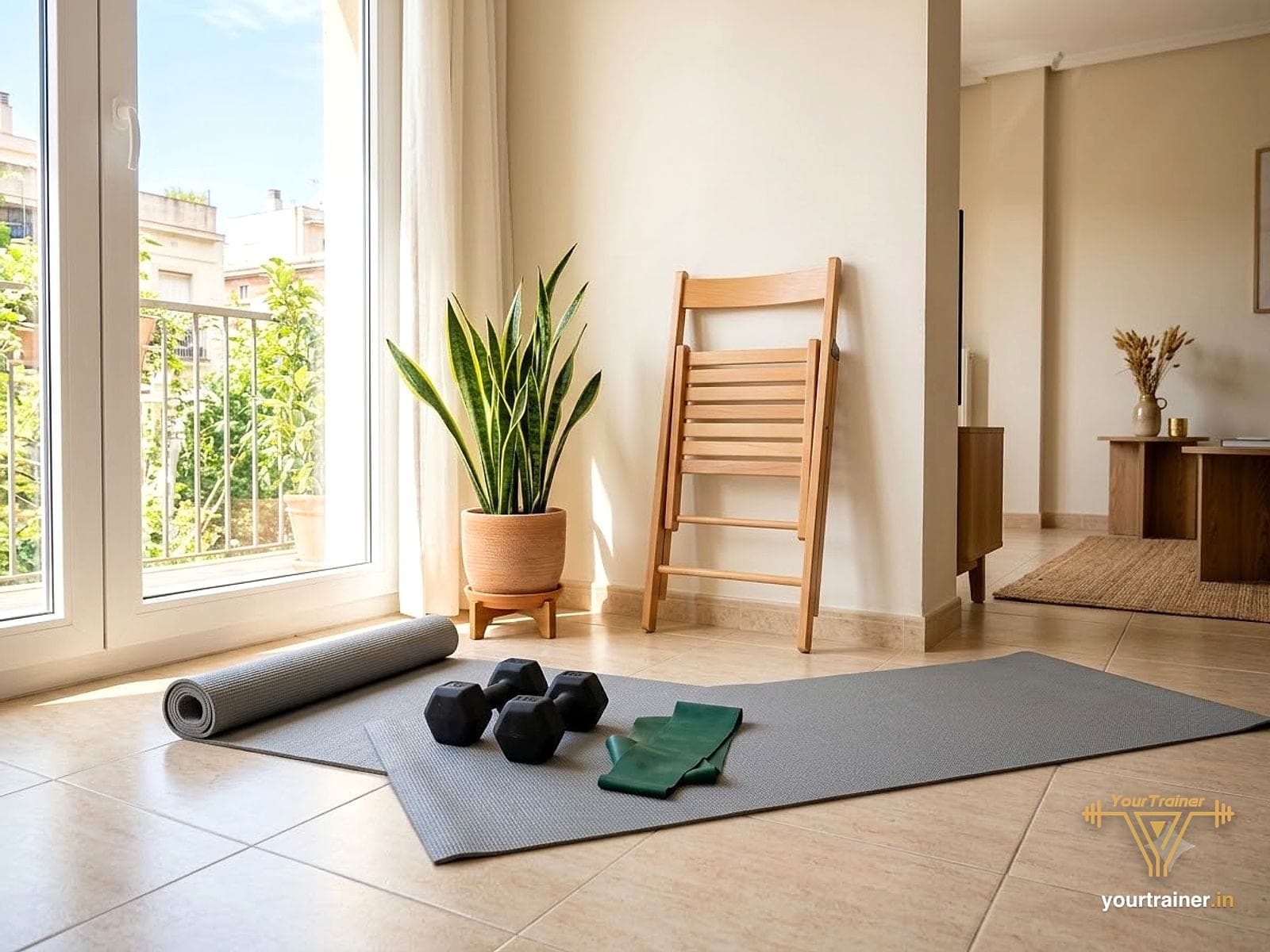
Sessions happen at home on a phone or laptop, with a sturdy chair, a wall and a light resistance band. No gym and no travel. The coach starts with movements your parent already does every day, getting up from a chair, climbing a step, carrying a bag, and makes them stronger and steadier.
Food advice works with what is cooked at home: dal, roti, rice, sabzi, curd, eggs or paneer. The usual change is more protein at each meal and fewer sweets between meals, not a new diet.
Safety
Doctor first, then a slow start
Before the first session we ask about heart conditions, blood pressure, diabetes, joint replacements, recent surgery and falls. If their doctor has given advice on exercise, the plan follows it. Medicines stay with the doctor.
In every session the coach watches for breathlessness, dizziness or pain, and stops when something is not right. A chair or a counter is always within reach for balance work.
Where to go next
Related coaching and guides
FAQ
Questions children ask before they book
Yes. You book the free call, join it with or without your parent, and pay for the plan yourself. Your parent trains at home in India with their coach on video. Every member pays the same price, billed in Indian rupees.
Sessions run on Zoom or Google Meet. Your parent taps the link we send before each session, and the coach walks them through it on the first call. Someone at home can help set up the phone for the first few sessions.
For most people, yes, once their doctor agrees. We ask about conditions, medicines and recent surgery before the first session, and the plan avoids anything their doctor rules out. The coach does not change medicines. That stays with the doctor.
Yes, if your parent agrees. You can stay updated on how sessions are going and what the coach is changing, so you are not relying on a quick phone call to find out.
Yes. Ask for a female coach on the free call and we will match your mother with one.
Tell us your parent's language on the free call. We match a coach who speaks it wherever we can.
No. We coach exercise and food. If your parent needs nursing, help with daily tasks, medicine management or emergency cover, an eldercare service is the right choice, and our coaching can sit alongside it.
The fee depends on how many sessions a week your parent needs, and it is set on the free call. Every member pays the same price, billed in Indian rupees, whether you pay from India or from abroad.
Tell us about your parent on a free call.
Their age, their health, what worries you and what they enjoy. We will say honestly whether 1-on-1 coaching is right for them, and if it is, we will match a coach who suits them.
Sources
Where the numbers come from
- [1] Perianayagam A, Bloom D, Lee J et al. Cohort Profile: The Longitudinal Ageing Study in India (LASI). International Journal of Epidemiology. 2022;51(4):e167. Wave 1, 2017 to 2018, self-reported diagnoses among adults aged 60 and over. pmc.ncbi.nlm.nih.gov/articles/PMC9365624/ (checked 26 Oct 2026)
- [2] World Health Organization. WHO guidelines on physical activity and sedentary behaviour, 2020. Adults 65 and over: 150 to 300 minutes of moderate activity a week, muscle strengthening on 2 or more days, balance and strength activity on 3 or more days for those with poor mobility. www.who.int/publications/i/item/9789240015128 (checked 26 Oct 2026)
- [3] NHS. Physical activity guidelines for older adults (page updated 26 Feb 2025). www.nhs.uk/live-well/exercise/physical-activity-guidelines-older-adults/ (checked 26 Oct 2026)
- [4] American College of Sports Medicine. Progression models in resistance training for healthy adults (position stand). Med Sci Sports Exerc. 2009;41(3):687-708. doi.org/10.1249/mss.0b013e3181915670 (checked 21 Oct 2026)