Late-Night India Calls and Midnight Snacking: A Fitness Plan for US Tech NRIs
If your workday ends with a 10 PM call to the India team, your eating and training schedule is the problem, not your willpower. How to anchor meals and workouts around the calls you cannot move.
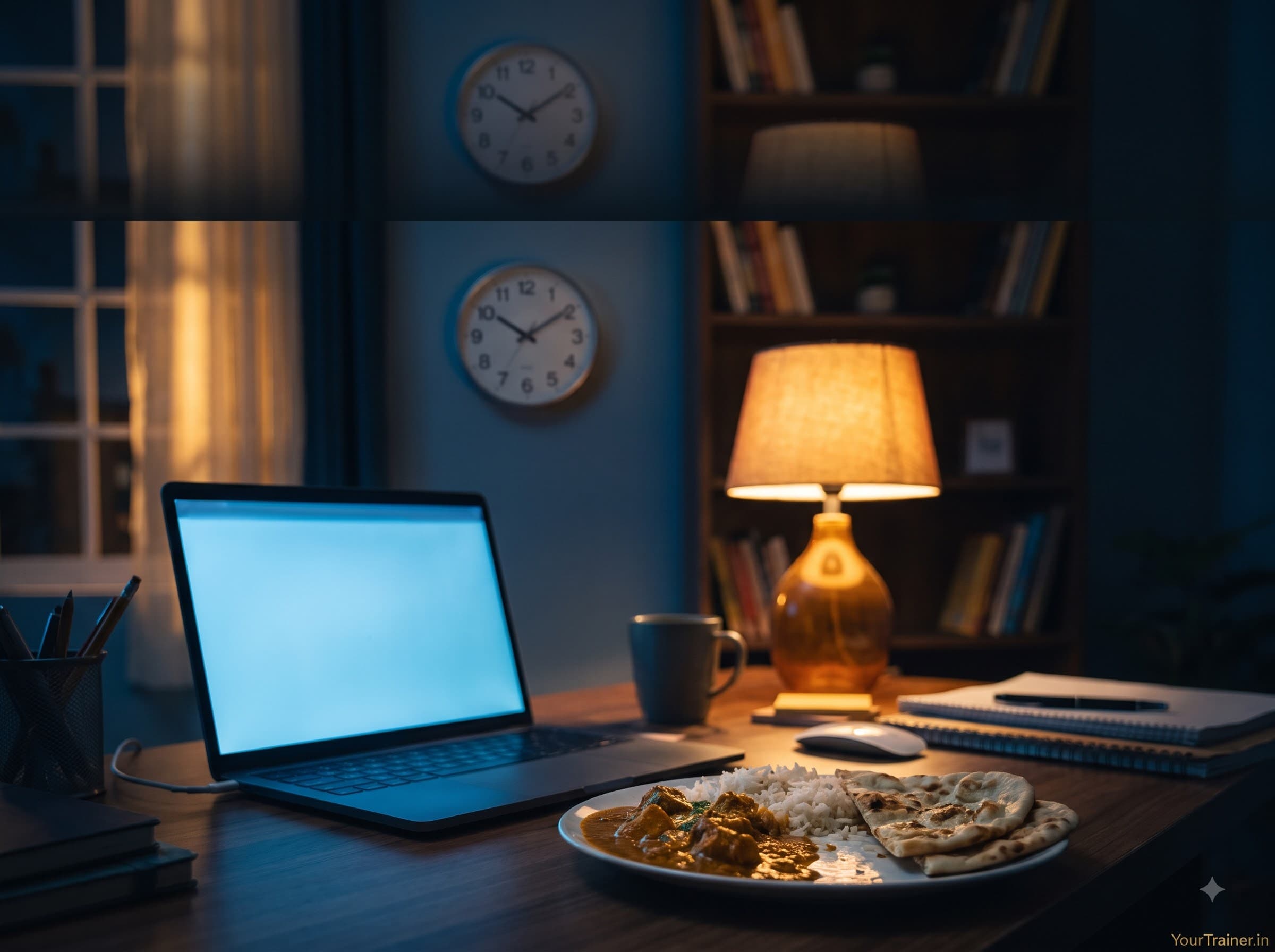
Quick answer: If you take late-night calls with an India-based team, weight gain usually comes from a broken schedule rather than a lack of discipline. Dinner gets skipped while you wait for the call, a large meal lands near midnight, sleep shifts later, and the morning workout disappears. The fix is to anchor meals to the call rather than the clock: a real meal about 90 minutes before it starts, something small afterwards only if you are hungry, and strength training moved to the windows that are actually reliable such as lunch hours and weekend mornings.
Building a week that survives late calls
The pattern almost every late-call week follows
The shape of the problem is remarkably consistent across people doing this. You finish the US workday around six, but the India call is at nine or ten, so you hold off on a proper dinner because eating on a call is awkward and you assume you will eat after. The call runs long. By the time it ends you are tired and properly hungry, so whatever is quickest and largest gets eaten close to midnight. You sleep badly on a full stomach, the alarm for the morning gym session gets dismissed, and the same sequence repeats two to four nights a week.
Nothing in that chain is a willpower failure. It is a scheduling collision between a US working day and an Indian one, and it responds much better to a change in structure than to a resolution to try harder.
Anchor the meal to the call, not the clock
The single highest-leverage change is to stop treating dinner as a fixed clock event and start treating it as something that happens a set distance before the call. If the call is at 9 PM, eat around 7:30 PM. If the call moves to 10 PM, dinner moves too. The point is to reach the end of the call without being so hungry that the post-call meal becomes the biggest one of the day.
A workable pre-call meal has protein and some carbohydrate and does not need to be elaborate:
- Curd or Greek yogurt with fruit and a handful of nuts
- A paneer or egg sandwich on whole wheat
- Dal with rice, or rajma and roti from what the family already ate
- Leftover sabzi with two rotis and a side of curd
- Eggs with toast if dinner has already been cleared away
The point of the pre-call meal: it exists so that the post-call meal can be small. If you eat properly at 7:30, a cup of milk or a bowl of curd after the call is genuinely enough. If you skip it, no amount of intention keeps the midnight meal small.
After the call, keep it small or skip it
If you are genuinely hungry when the call ends, eat something small. Curd, a glass of milk, a piece of fruit, or a few nuts will settle things without giving you a full meal to sleep on. What tends to backfire is the second proper dinner: it makes sleep less comfortable, and it usually means you are not hungry for breakfast, which pushes the whole eating pattern later again the next day.
Give yourself a bit of buffer between that last thing and sleep if you can. Even twenty or thirty minutes of not looking at a screen helps you actually wind down after two hours of being switched on.
Coaching that does this for you
Reading is step one - a coach turns it into a plan built around your body, food & schedule.
100% online · Indian meal plans · weekly progress reviews · daily WhatsApp support.
Start Your Journey →Put training where the week is actually reliable
The instinct after a few bad weeks is to schedule a 6 AM gym session as a corrective. On six hours of sleep this rarely survives contact with reality: you snooze it, feel guilty, and the guilt does nothing for your training. It is far more effective to look honestly at your calendar and find the windows that hold up even in a bad week.
- Lunch hours, twice a week. A 30 to 40 minute session in the middle of the day is not competing with the call schedule at all, and you are already awake and fed.
- One weekend morning. This is usually the only slot in the week with no time pressure, so it is a good place for the longest session.
- Keep sessions short. Thirty to forty focused minutes done consistently beats an hour planned and skipped. Compound movements first, accessories only if time remains.
Two or three sessions a week done nearly every week will build strength and hold onto muscle while you lose fat. That is a genuinely sufficient dose, and it is achievable on a late-call schedule in a way that five planned sessions is not.
Sleep is the constraint everything else runs into
Late calls compress the sleep window, and short sleep makes appetite harder to read, training feel heavier, and consistency harder to sustain. You usually cannot fix the call time, but you can protect what is left: keep the post-call meal light, dim screens once the call is done, and treat nights without a call as an opportunity to sleep longer rather than to stay up. Weekends are worth protecting for the same reason.
Why an India-based coach fits this particular schedule
This is a logistics point rather than a claim that Indian coaches are better. IST daytime overlaps with the US morning, which means a check-in about last night's call, what you ate, and how you slept can happen while both people are already awake and working. Live sessions land at reasonable hours on both ends. If you are working with someone in your own timezone, the same conversation often has to happen at an hour that is inconvenient for one of you.
There is a second, more practical benefit: a coach who already works with Indian food does not need to be talked through what roti, dal, poha or curd are before your meal plan can be adjusted. YourTrainer's coaching for Indians abroad is built around both of those things.
What to change first
- Move dinner to roughly 90 minutes before the call starts, whatever time that is this week.
- Decide in advance that the post-call meal is small, and know what it will be.
- Put two 30-40 minute strength sessions into lunch hours and one into a weekend morning.
- Stop scheduling early-morning training on nights you were on a call past 11 PM.
- Protect sleep on the nights that do not have calls rather than using them to catch up on other things.
Give it three or four weeks before judging it. The first thing that usually improves is how you feel in the mornings, followed by the consistency of training, and then the trend on the scale.
Related articles
- The NRI Weight-Gain Trap: How to Eat Indian & Stay Lean Abroad
- Sleep & Fat Loss: You Can't Out-Diet Bad Sleep
- Zone 2 Cardio for NRI Professionals: The Fat-Loss Base You're Missing
- Cortisol & Belly Fat: How Stress Causes Weight Gain
- Indian Portion Sizes in Grams & Calories: Katori, Roti, Rice & Dal
- Personal Trainer Cost Per Month in India (2026)
Want a plan built around your actual week, not an ideal one? YourTrainer coaches Indians abroad with live 1-on-1 video sessions, Indian-food meal plans and WhatsApp accountability. Start Your Journey.
Did you find this helpful?

About Anish Agarwal
Founder & Head Coach, YourTrainer · NASM & K11 Certified Personal Trainer · 6+ years experience
Anish Agarwal is a NASM and K11 certified personal trainer with 6+ years of experience coaching fat loss, body transformation, strength, and nutrition for clients across India. He founded YourTrainer to make expert, science-based coaching accessible online and in Bengaluru. More about Anish.
Online 1-on-1 Coaching
Start Your Journey
Get a personalised training + Indian nutrition plan built around your goal, coached online, anywhere in India or abroad.
★★★★★ Trusted by 1,000+ transformations across India & abroad
Free 30-min discovery call · No obligation