GLP-1 and Gym Strength: Keep Muscle on Mounjaro or Wegovy (India)
Keep muscle on Mounjaro, Wegovy or Ozempic: protein per kg, a sample high-protein day, 3 strength sessions a week, and what our coaching classes showed.
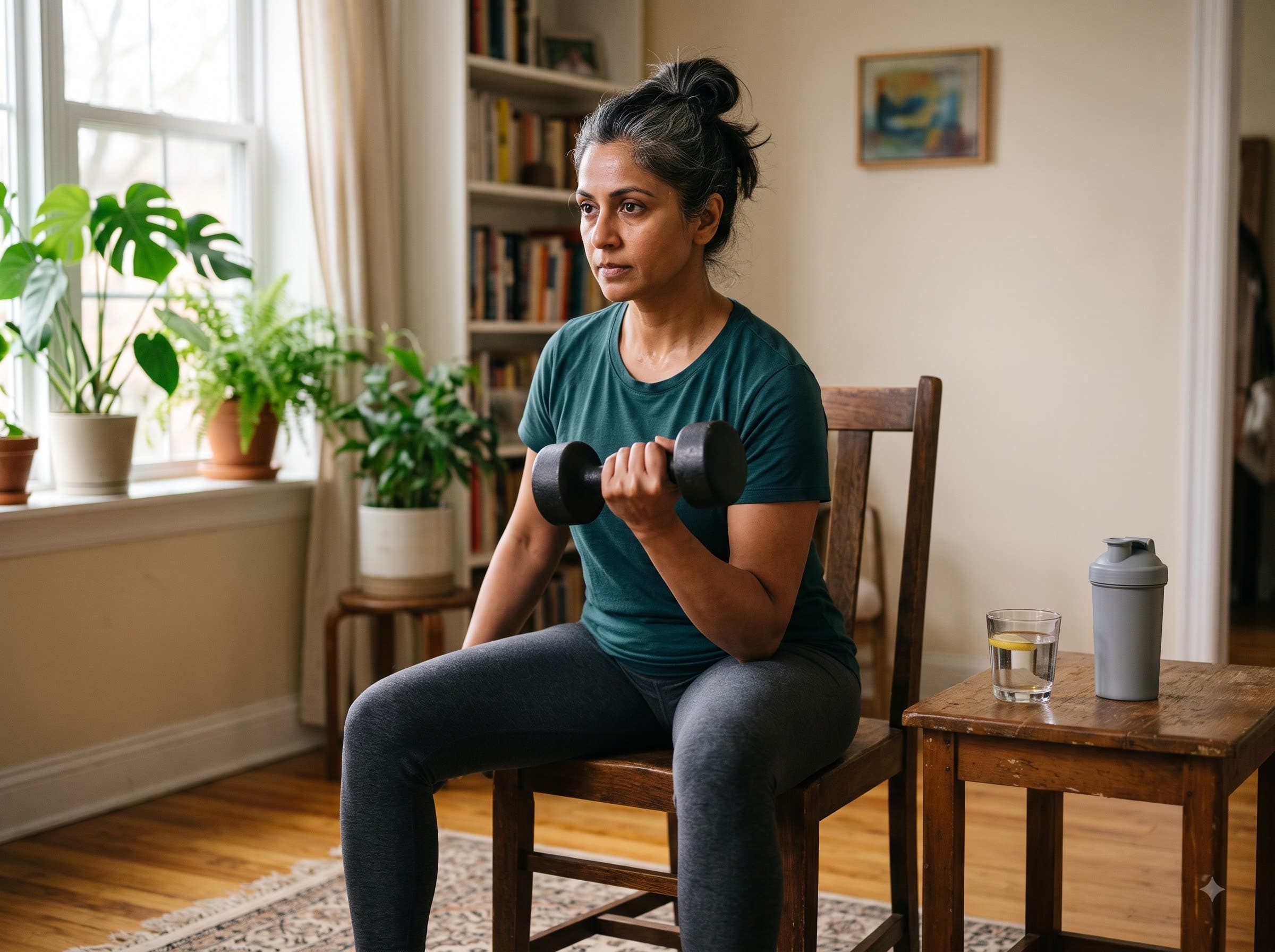
Only about 2% of the online coaching case studies we sampled mentioned GLP-1 medication use. It is a small, early observation from real coaching sessions, not a clinical study, but it's enough to highlight something trainers are noticing: strength can dip when weight loss happens fast. In one session, a coach noted weakness during a GLP-1 user's arm work. It's worth talking about, because if you're on Wegovy, Mounjaro, or another GLP-1, strength training becomes even more important, not less.
What we're seeing in classes
The broader context from our analysis: load progression showed up in 75% of the sessions reviewed, meaning heavier weights, more reps, or a harder difficulty rating within the session. Coaches judge this progression by feel and by the 1-10 difficulty scale they use in every session (aiming for 7 to 9 in the target zone). GLP-1 medication didn't come up often, but when it did, one coach's note stood out: during arm work, the client seemed weaker than expected.
This is not surprising from an exercise-science angle. GLP-1s work by suppressing appetite and signaling fullness, which is effective for weight loss, but it also means eating less overall. When you eat less, your body needs to be intentional about where those calories go. If protein intake drops too low alongside the weight loss, the body will break down muscle for fuel, especially muscle you're not actively using under load.
The Numbers
Method Note
This case study draws on a sample of YourTrainer coaching sessions held between 17 August and 7 September 2026, reviewed in detail as case studies. GLP-1 medication came up in only 2% of them, so this is a small, early observation, not a clinical finding. Treat it as one coach's real-world note, not a study. Client identities are not disclosed.
Why strength training matters more on GLP-1
When you're on a GLP-1 like Wegovy or Mounjaro, appetite suppression is doing the heavy lifting for weight loss. But appetite suppression doesn't distinguish between fat and muscle, it just means you're eating less. Without active, loaded resistance training to signal "keep this muscle," your body will shed it as part of the weight loss process.
The coaches we've worked with target protein intake deliberately because of this. For women, that's typically 80 to 110g per day. For an active 80kg man, it's 120 to 160g. These targets aren't arbitrary, they're calibrated to support muscle retention during training. If you're on GLP-1 and eating significantly less, you need to front-load those fewer calories with protein, so the amino acids are there when your muscles need repair after a workout.
Strength training itself is the other half of the equation. Resistance under load sends the signal to your body: "This muscle is being used; don't break it down." The coach we heard from in our sample noticed the weakness during upper-body work, which is exactly where you'd see muscle loss first if someone has dropped protein intake and isn't training that area intensely enough.
What we're hearing from coaches
In the broader context of our sampled sessions, progression is the norm; it showed up in three out of four classes. When it doesn't happen, it's usually because intensity was too low, or recovery/nutrition wasn't there. GLP-1 medication adds a variable: even if someone is consistent in the gym, if their total food intake has dropped sharply and protein didn't come along with it, strength gains stall or reverse.
This isn't a reason to avoid GLP-1s or to skip the gym. It's a reason to be intentional: if you're on Ozempic, Wegovy, Mounjaro, or a similar medication, your gym work and your protein intake become more important, not less, precisely because you're eating less overall.
Practical takeaways if you're on GLP-1
Prioritize protein. Because you're eating less, make sure protein is in every meal. Eggs, yogurt, paneer, chicken, fish, pulses, these should be familiar, not occasional.
Train all major muscles, consistently. Don't skip arm and shoulder days just because upper-body isn't where weight loss is happening. The goal is to signal to your body that these muscles are being used and should be kept.
Track the difficulty, not just the weight. If a lift that used to feel like a 7 now feels like a 5, that's useful feedback, it tells you energy or protein might be running short, not that you're getting weaker in a permanent sense.
Be patient with progression. You might not see new PRs while on GLP-1 medication, and that's normal. The win is holding your strength while losing weight. Once you're off the medication (if you plan to be), strength typically comes back quickly because the muscle is still there.
Coaching that does this for you
Reading is step one. A coach turns it into a plan built around your body, food & schedule.
100% online · Indian meal plans · weekly progress reviews · daily WhatsApp support.
Start Your Journey →Protein Target on GLP-1
Aim for 1.6 to 2.2 g of protein per kg of your goal bodyweight, not your current weight. For a 70 kg goal, that is 112 to 154 g a day.
| Goal bodyweight | At 1.6 g per kg | At 2.2 g per kg |
|---|---|---|
| 50 kg | 80 g | 110 g |
| 60 kg | 96 g | 132 g |
| 70 kg | 112 g | 154 g |
| 80 kg | 128 g | 176 g |
| 90 kg | 144 g | 198 g |
Our protein guidance follows the ISSN position stand on protein and exercise (see sources at the end of this article). For monthly costs by drug, see GLP-1 cost in India 2026.
Protein first when your appetite is low
- At every meal, eat the protein first, before carbs and vegetables. Your appetite window is small, so fill it with protein.
- Go soft and liquid when eating is hard: Greek yogurt, curd, paneer, eggs, whey shakes, dal, tofu and soft soya chunks.
- Spread protein across 3 meals and 1 or 2 snacks. Trying to reach 140 g in two sittings usually leaves you feeling unwell.
- A salad or smoothie bowl is high in fibre and low in protein. Add paneer, eggs, dal or whey to it.
For full meal templates, see our Indian diet on GLP-1 guide.
A sample high-protein day on low appetite
| Meal | Vegetarian | Non-vegetarian | Protein |
|---|---|---|---|
| Breakfast | 2 eggs + 100 g Greek yogurt + 1 idli | Paneer scramble (150 g) + 1 roti | 28 to 32 g |
| Mid-morning | Whey shake (25 g) + banana | Whey shake (25 g) + berries | 25 g |
| Lunch | Moong dal (200 g) + 100 g curd + cucumber | Grilled chicken (150 g) + dal + 1 roti | 30 to 35 g |
| Evening | Paneer and capsicum (100 g) + steamed veggies | Tofu curry (150 g) + brown rice | 18 to 22 g |
| Dinner | Soya chunks + tomato-onion (100 g cooked) + 1 roti | Fish fry or boiled eggs (120 g) + greens | 20 to 26 g |
Total: roughly 121 to 140 g of protein, all soft and easy to digest.
Protein in common foods
| Food | Portion | Protein |
|---|---|---|
| Paneer | 100 g | 14 to 16 g |
| Greek yogurt | 150 g | 15 to 18 g |
| Chicken breast, cooked | 100 g | 31 g |
| Eggs | 2 whole + 1 white | 18 to 20 g |
| Masoor dal, cooked | 1 katori (about 150 ml) | 10 to 12 g |
| Whey isolate | 1 scoop (about 30 g) | 25 to 30 g |
Figures for Indian foods follow IFCT 2017 (ICMR-NIN).
Strength Training 3 Times a Week
High protein alone is not enough. Heavy resistance work tells your body to keep muscle while you eat less. A full-body plan works well:
| Day | Focus | Key exercises |
|---|---|---|
| Monday | Lower body | Squats or leg press, deadlifts, lunges, calf raises. 3 sets of 6 to 10 reps. |
| Wednesday | Upper body (push) | Chest press, shoulder press, tricep dips, push-ups. 3 sets of 6 to 10 reps. |
| Friday | Upper body (pull) | Rows, assisted pull-ups, bicep curls, face pulls. 3 sets of 6 to 10 reps. |
No gym is needed: dumbbells, resistance bands or bodyweight work. Add 1 to 2 kg every 2 weeks, or 1 to 2 more reps, to keep progressing. On GLP-1, lighter weights for 8 to 12 reps with good form also work, because you are already in a calorie deficit.
Preventing Ozempic Face
"Ozempic face" is the hollow, aged look some people notice after fast weight loss. It is not caused by the drug alone. Fat and muscle in the face are lost quickly, and the skin has less time to adjust. Speed matters, and so does what you eat and lift during the loss.
- Lose more slowly. Our guidance is 0.5 to 1% of bodyweight a week. Faster loss gives the face and skin less time to adapt.
- Keep protein high and keep training. The protein and strength plan above is the plan that protects facial volume and muscle.
- Drink water on a schedule. Aim for 3 to 4 L a day with electrolytes. Thirst signals can be dulled on GLP-1.
- Ask a dermatologist about skin care. Topical retinoids and other treatments need a prescription and a skin check. Procedures can help once sagging is present, but they do not fix the muscle lost underneath.
Our full side effects guide covers nausea, constipation and hair shedding on Mounjaro.
Sources
- ISSN Position Stand: Protein and Exercise · Journal of the International Society of Sports Nutrition (2017)
Related articles
- Mounjaro Price in India 2026: Cost & Results
- Drinking Alcohol on Ozempic or Mounjaro: What Actually Happens
- Missed Your Mounjaro or Ozempic Dose? What to Actually Do
Ready to build muscle while managing your weight, on your terms? YourTrainer coaches Indians, worldwide, with live 1-on-1 video sessions, Indian-food meal plans and WhatsApp accountability. Start Your Journey.
Coaching guidance on this site is educational and is not a substitute for medical advice. See how we use sources.
Did you find this helpful?

About Anish Agarwal
Founder & Head Coach, YourTrainer · NASM & K11 Certified Personal Trainer · 5+ years coaching
Featured in NRI Pulse, Dietitians.io, Fitness Interview, The MASALA Study. Press and media
Anish Agarwal is a NASM and K11 certified personal trainer coaching fat loss, body transformation, strength, and nutrition for clients across India, with 5+ years coaching. He founded YourTrainer to make expert, science-based coaching accessible online and in Bengaluru. Coach Anish's profile and the YourTrainer story.
Online 1-on-1 Coaching
Start Your Journey
Get a personalised training + Indian nutrition plan built around your goal, coached online, anywhere in India or abroad.
Trusted by 1,000+ clients coached across India & abroad
Free 30-min discovery call · No obligation