
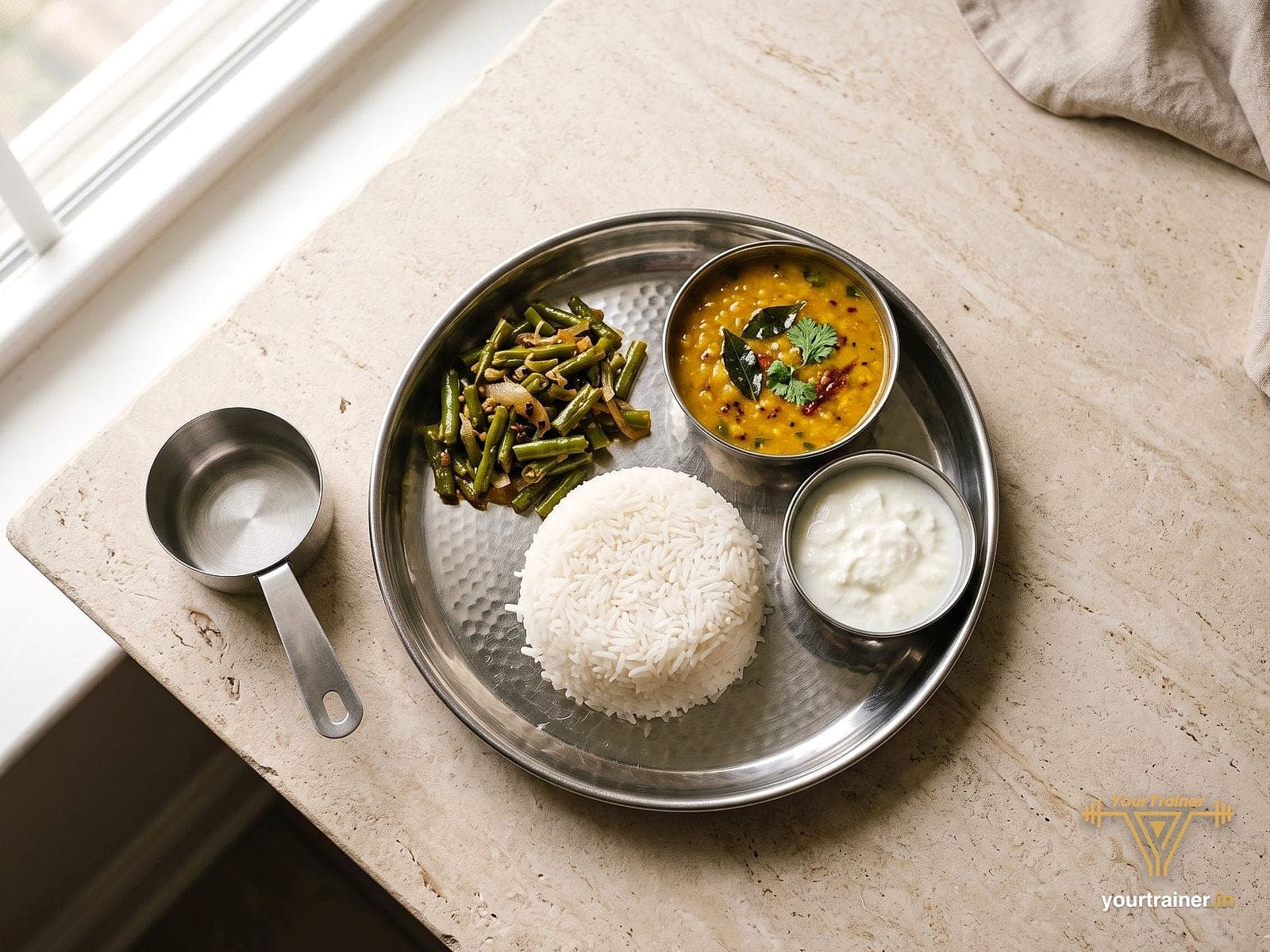
PCOS food · India
PCOS Indian Diet Plan: Food Swaps and a Sample Day
PCOS diet in India works best as a pattern, not a list of banned foods: protein at every meal from dal, chana, curd, paneer, eggs or fish; fibre from vegetables and whole grains; measured rice or roti; and fewer refined carbs and sweet drinks. Coaching turns this into a plan you can eat, alongside your doctor. Start Your Journey
Most Indian kitchens already hold the building blocks of a PCOS diet: dal, sprouts, curd, vegetables and roti. The change is in how they are put together. This page sets out the principles, an Indian plate, a sample day for vegetarians and for non-vegetarians, the foods to favour and to limit, and how coaching adjusts the plan.
- A sample day, veg and non-veg
- Foods to favour and limit, with reasons
- A nutritionist plan reviewed with your coach
Fit check
Who it suits, and who it does not
It suits you if
- You have PCOS, or you suspect it, and you want a food plan you can keep to with Indian food.
- You eat vegetarian, or you eat eggs, fish or chicken, and you want both covered.
- You want to understand your plate before you change everything at once.
- Your doctor knows about the change to your diet, and is part of the plan.
It is not the right fit if
- You want a diet that promises to cure PCOS or fix your periods on its own.
- You are trying to conceive and need fertility advice. See your doctor first.
- You want a crash diet with very few calories and no doctor involved.
- You are on medicines that need food timing or a dose change. Your doctor decides that.
Our own data
How to start: log one week before you change anything
- Log your food for seven days.Do not change anything yet. Write down what you actually eat and drink.
- Mark the meals with no protein food.A rice or roti meal with no dal, egg, curd or paneer is usually the first gap to close.
- Change one meal first.Breakfast or the rice-only lunch is the easiest place to start.
- Review it with your coach after two weeks.Hunger, energy, sleep and cycle changes tell you what to adjust.
The training science
What the guidelines say, and what they do not
The 2023 international evidence-based guideline keeps healthy lifestyle, emotional wellbeing and quality of life at the centre of care, and asks clinicians to be aware of weight stigma [1].
The Exercise and Sports Science Australia position statement calls lifestyle interventions first-line in PCOS management [2]. Food and training work together, and neither replaces medical care.
No food cures PCOS, and no food sets your cycle on its own. Medicines and treatment for irregular periods or fertility are decided with your doctor.
Four principles
Build the plate, not a banned list
The Indian plate
What one balanced plate looks like
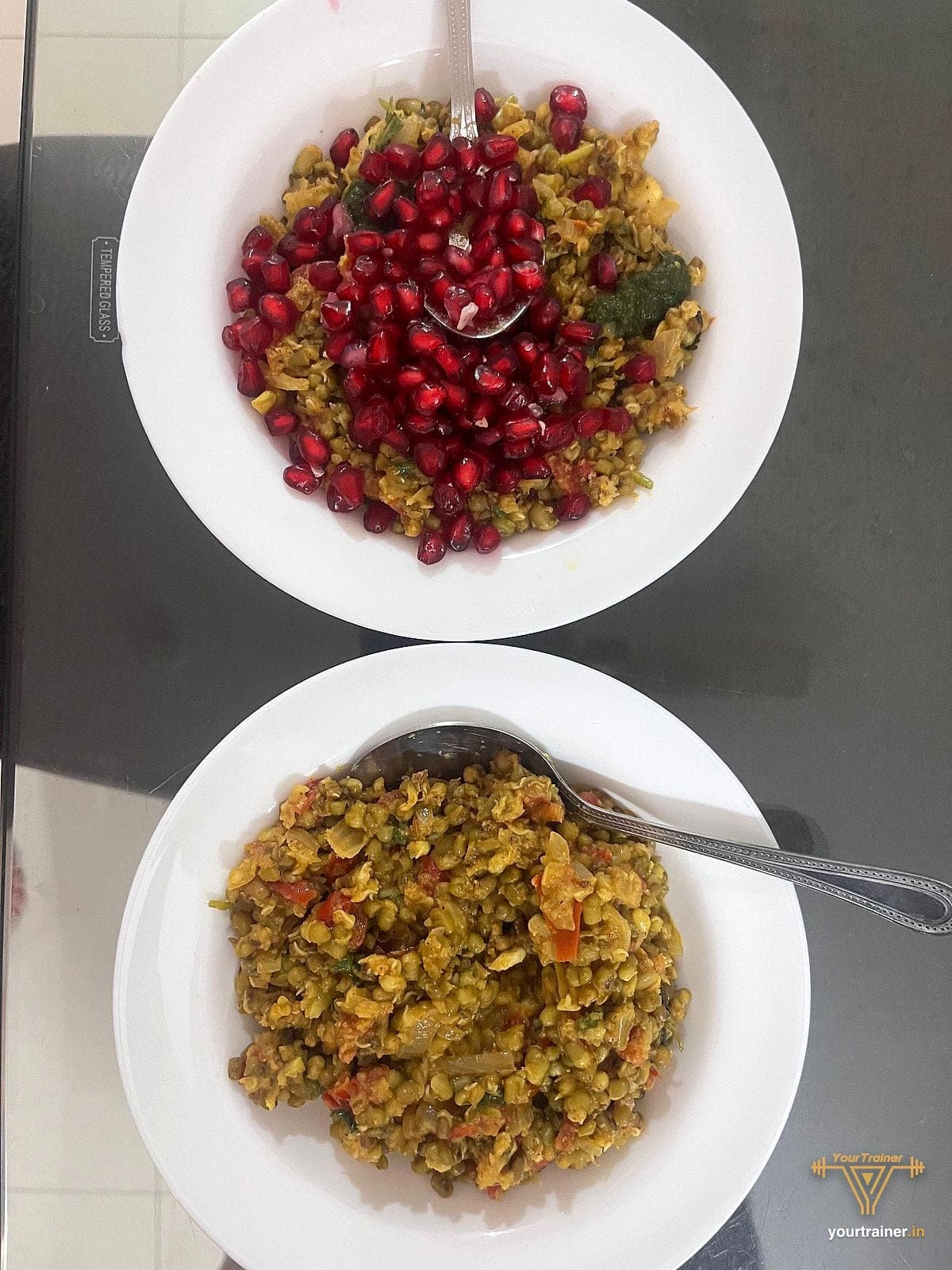
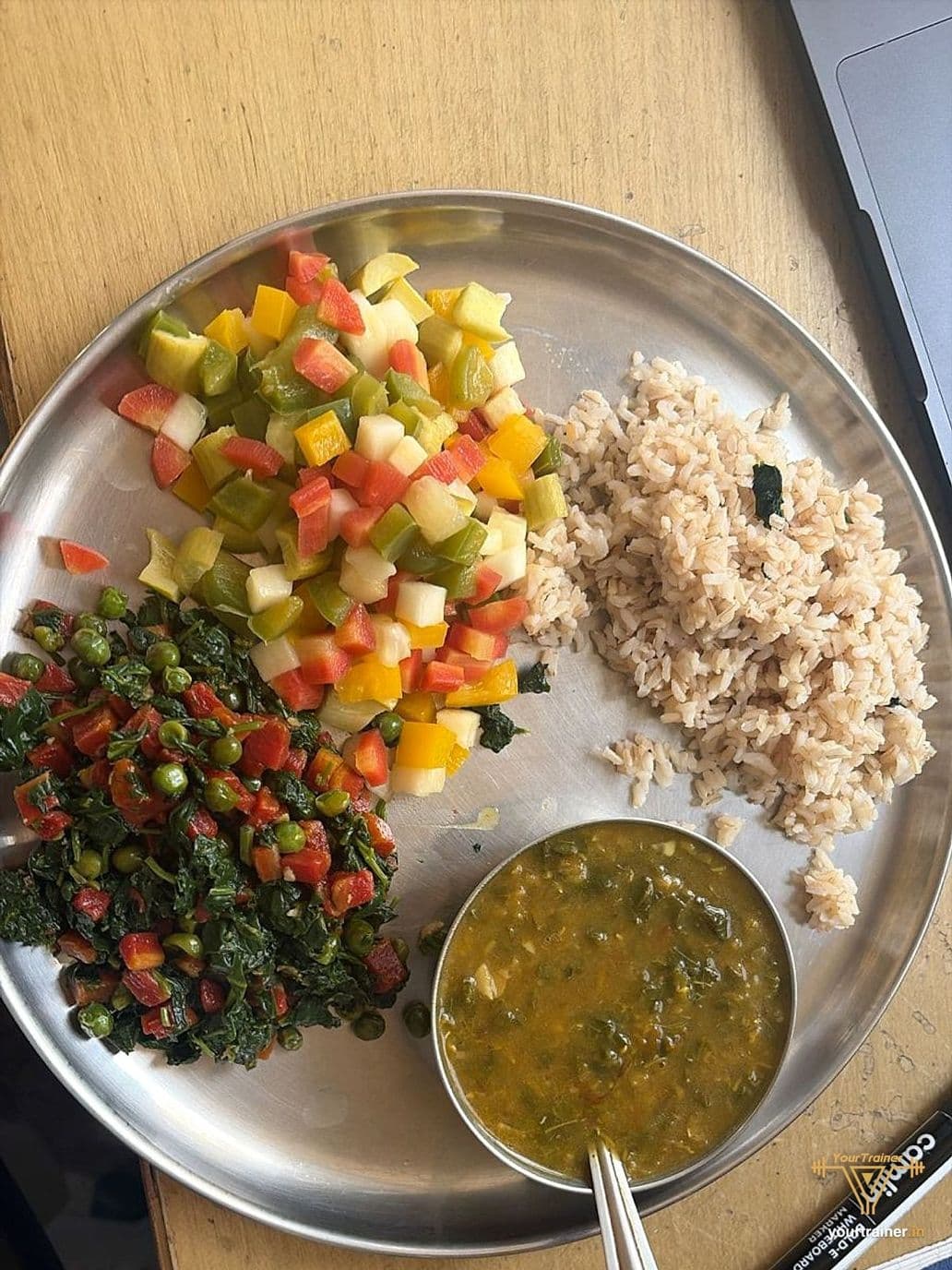
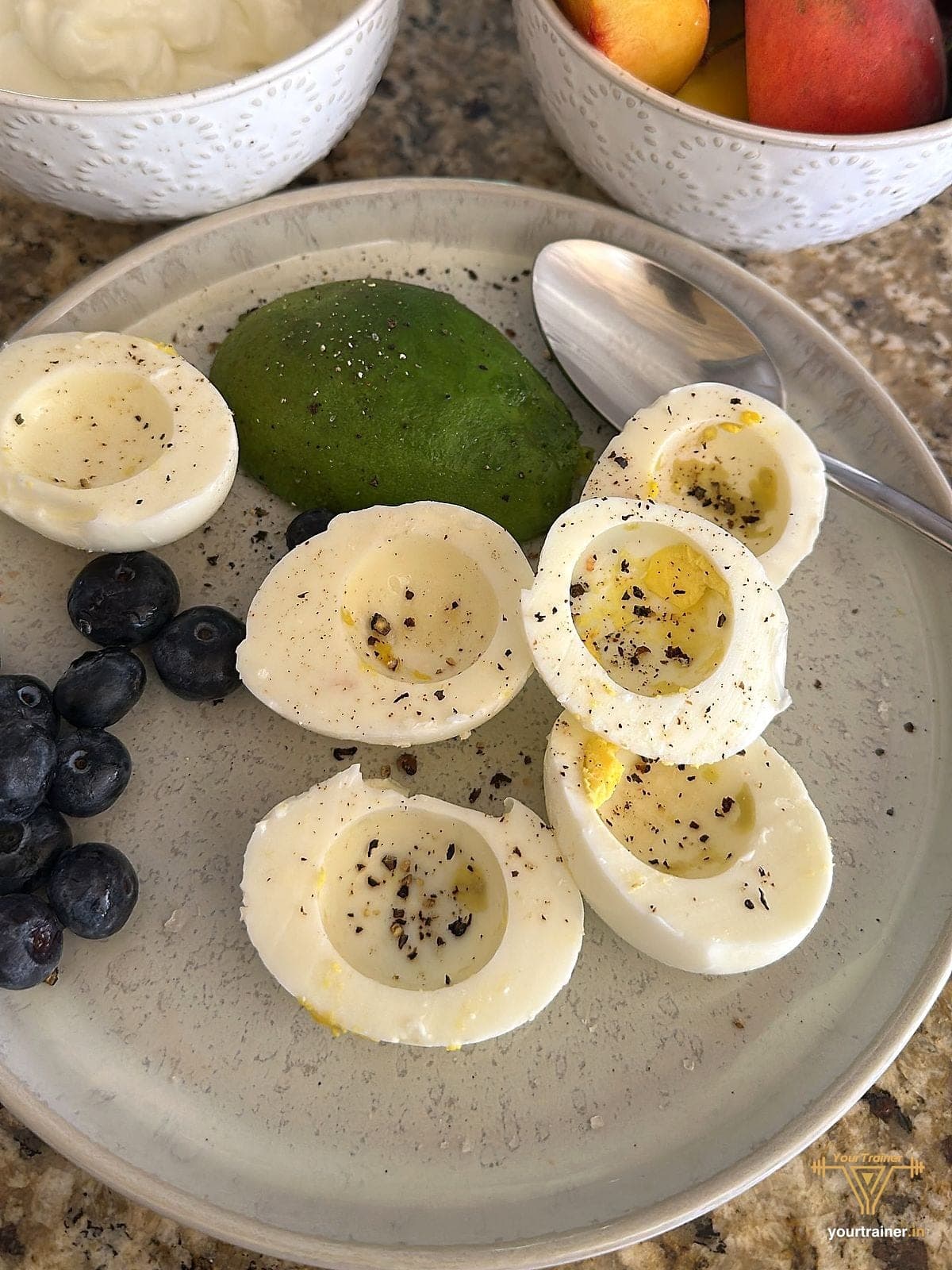
Half the plate is vegetables, a quarter is protein, and a quarter is a whole grain. A spoon of curd or a piece of fruit on the side is fine. This is a starting point, and your coach adjusts it to your appetite and your goal.
A sample day
Vegetarian and non-vegetarian
| Meal | Vegetarian | Non-vegetarian |
|---|---|---|
| Breakfast | Two moong dal chillas with mint chutney and a bowl of curd | Two eggs as bhurji with vegetables, and one multigrain roti |
| Mid-morning | A guava or a small apple, with 10 almonds | A guava or a small apple, with 10 almonds |
| Lunch | One katori of brown rice or two rotis, one katori of dal, a vegetable sabzi, cucumber salad and a small bowl of curd | One katori of brown rice or two rotis, a palm-sized portion of chicken or fish curry, a vegetable sabzi and a salad |
| Evening | Roasted chana or a sprouts chaat with lemon | A boiled egg, or roasted chana |
| Dinner | Two multigrain rotis, one katori of rajma or chole, a bowl of mixed vegetables and a salad | Two multigrain rotis or one katori of brown rice, grilled fish or chicken tikka, a sabzi and a salad |
A palm-sized portion of protein is a simple guide. Your nutritionist adjusts the portions from your food log, your goal and your doctor's advice.
Favour and limit
Foods to favour, and foods to limit
Favour
- Dal, chana, rajma and moong. Protein and fibre in one bowl, so the meal digests more slowly.
- Vegetables and salad at lunch and dinner. More volume on the plate for fewer calories.
- Brown rice, millets, whole wheat or multigrain roti. Whole grains carry more fibre than polished white rice or maida.
- Curd, paneer, eggs, fish or chicken. Protein that keeps you full between meals.
- Nuts, seeds and roasted chana. A filling snack in place of fried ones.
Limit
- Sweet drinks, packaged juice and sweet chai. Sugar with no fibre, so it reaches your blood fast.
- Mithai and bakery items. Refined flour and sugar together, usually in a large portion.
- Maida breads, samosas, pakoras and fried snacks. Refined carbs with a lot of oil.
- Large portions of white rice at night. A big, fast carb load when you are least active.
- Packaged snacks with added sugar. Read the label. Many look healthy and carry a lot of sugar.
How a plan is delivered
How coaching adjusts the plan
You start with a week of food logs. A nutritionist builds your plan from that log, your goal and any results your doctor has shared with you. The plan comes as a PDF, and your coach goes through it with you on your first call.
Each week, your coach checks how you are doing. After about two weeks we adjust portions and swaps based on hunger, energy, sleep, your training and any change in your cycle. We keep what you can repeat and drop what you cannot.
Your doctor stays in charge of medicines, tests and any treatment for PCOS. We do not change medicines or doses, and we work around your medical plan.
When to see your doctor
Get medical advice before, or instead of, a diet change
- Very heavy bleeding, or bleeding between periods.
- Irregular periods that have not settled, or a long gap without a period.
- Dizziness, fainting, or a fast change in weight.
- You are pregnant, or you are trying to conceive.
- You take medicines for PCOS, diabetes or blood pressure, and want to change how you eat.
Where to go next
Sample weeks, workouts and the PCOS hub
FAQ
Questions about PCOS food
There is no single best diet. Most plans we use share one base: protein at each meal, plenty of fibre from dal, sprouts, vegetables and whole grains, measured rice or roti, and fewer refined carbs and sweet drinks. The Indian plate lets you keep the foods you know.
Yes, in a measured portion with protein and vegetables. For most people, brown rice or millet is a better choice than polished white rice. The portion matters more than the grain name.
Often, yes. Dal, chana, rajma, moong, sprouts, curd, paneer and soya cover most meals. Plan protein at breakfast and lunch as well as dinner. Eggs and fish help if you eat them.
Not by default. Curd and paneer are useful protein for many vegetarians. If a dairy food seems to affect your skin or digestion, tell your coach and your doctor.
It can help some people with cycles and symptoms, but it does not cure PCOS or guarantee regular periods. Your doctor decides any treatment for irregular periods.
Yes, but tell your doctor about the change first. Your coach works around your medical plan and does not change medicines or doses.
Yes. The sample day on this page shows the pattern for vegetarian and non-vegetarian days. Your full plan is a nutritionist-built PDF based on your food log and goals, and it is reviewed with your coach.
Start with a week of food logs, and we will build your plan.
Log what you eat for a week without changing it. Tell us your goal, your cycle pattern and any medicines, as much as you want to share. We will say honestly whether our plan is the right fit.
Sources
Where the numbers come from
- [1] Teede HJ, Tay CT, Laven JJE et al. Recommendations from the 2023 International Evidence-based Guideline for the Assessment and Management of Polycystic Ovary Syndrome. Fertility and Sterility. 2023;120(4):767-793. doi.org/10.1016/j.fertnstert.2023.07.025 (checked 25 Oct 2026)
- [2] Sabag A, Patten RK, Moreno-Asso A et al. Exercise in the management of polycystic ovary syndrome: a position statement from Exercise and Sports Science Australia. Journal of Science and Medicine in Sport. 2024;27(10). doi.org/10.1016/j.jsams.2024.05.015 (checked 25 Oct 2026)