Body Recomposition on Indian Food: Lose Fat and Gain Muscle at the Same Time
Possible, for the right people. Who recomposition works for, the maintenance-calories protocol on Indian meals, and why the scale is the wrong scoreboard.
Quick Answer
Body recomposition, losing fat and building muscle simultaneously, is real but selective: it works for beginners, returners after a long break, and people at higher body fat, and it barely works for lean experienced lifters. The protocol is almost boring: eat at maintenance calories (within 200 either side), push protein to 1.8 to 2.2 g per kg, strength train 3+ days with progressive overload, and sleep. The catch is psychological: the scale barely moves by design, so you must score the game on waist, strength log, and photos, or you will quit a plan that is working.
Who It Works For (Be Honest With Yourself)
| You are | Recomp potential |
|---|---|
| New to lifting (first year) | Excellent, newbie gains fund both directions |
| Returning after 6+ months off | Excellent, muscle memory accelerates regain |
| Higher body fat, low muscle (skinny-fat) | Excellent, fat stores fund the build |
| Lean and training seriously 2+ years | Poor, pick a bulk or cut instead |
That third row is half of urban India. The skinny-fat South Asian pattern, normal weight, soft middle, low muscle, is precisely the body recomposition was made for: a bulk adds fat it does not need, a cut shrinks muscle it cannot spare.
The Protocol
Calculate on the TDEE calculator, eat within 200 kcal of it. Not a deficit, not a surplus. Food quality matters more here than in a bulk, you have no calorie slack for junk.
1.8 to 2.2 g per kg. Indian mapping: 70 kg person needs 126 to 154 g, that is eggs or paneer at breakfast, dal plus chicken or soya at lunch, a dense protein dinner, curd or chana between. The recipe hub operationalizes it.
3+ days, compound lifts, progressive overload logged weekly. Cardio stays light-to-moderate, walking is ideal. The training IS the signal that decides maintenance calories become muscle instead of staying fat.
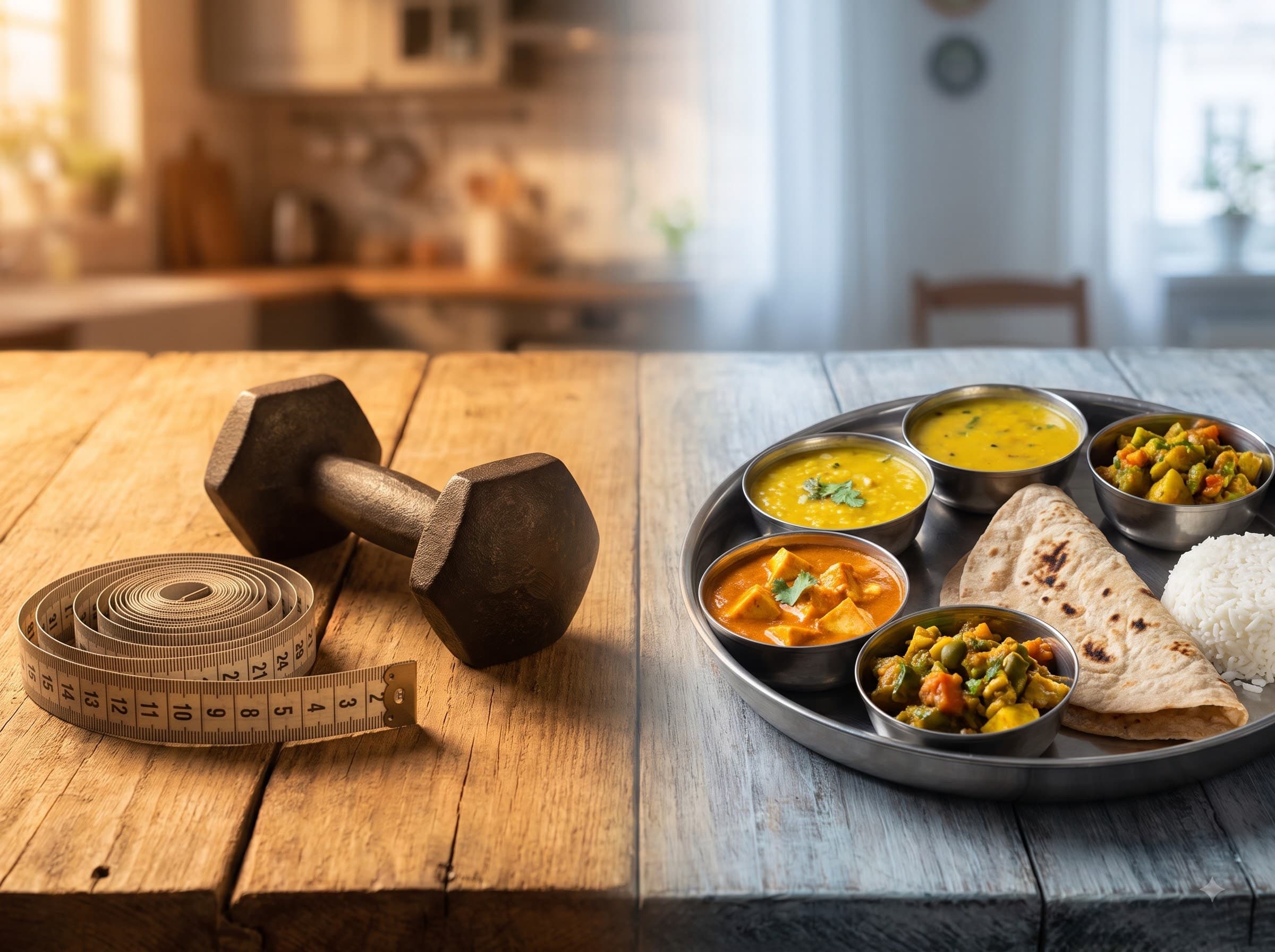
Waist tape monthly, strength log weekly, photos every 8 weeks. The scale holding still while the waist drops and lifts climb is not a plateau, it is the entire point.
Recomp quitters almost always quit because "the weight isn't moving", the one metric designed not to move. Losing 3 kg of fat while gaining 3 kg of muscle is a dramatic visual change and a scale flatline. Choose your scoreboard before you start.
After 6 to 12 months of successful recomp you graduate: lean enough and trained enough that progress slows. That is the moment for a proper lean bulk from the complete guide, not a failure of recomp, its graduation.
Coaching that does this for you
Reading is step one. A coach turns it into a plan built around your body, food & schedule.
100% online · Indian meal plans · weekly progress reviews · daily WhatsApp support.
Start Your Journey →Recomposition for Beginners and the Skinny-Fat
If you are new, returning, or skinny-fat, you do not have to choose between losing the belly and building the frame: maintenance calories, top-range protein, progressive lifting, and the right scoreboard do both at once. Slower than either phase alone, but you look better every month and never have to diet off a bulk. It is the highest-sanity path for most Indian beginners.
Go Deeper
- The Complete Indian Muscle-Building Guide
- The Skinny-Fat South Asian Problem
- Not Gaining Muscle? The 6-Point Diagnostic
- Hitting 100g Protein as a Vegetarian
- Start Your Journey
Coach Anish, YourTrainer
Sources
- Guidelines on physical activity and sedentary behaviour (2020) · World Health Organization
- ISSN Position Stand: Protein and Exercise · Journal of the International Society of Sports Nutrition (2017)
Figures for Indian foods follow IFCT 2017 (ICMR-NIN). Coaching guidance on this site is educational and is not a substitute for medical advice. See how we use sources.
Did you find this helpful?

About Anish Agarwal
Founder & Head Coach, YourTrainer · NASM & K11 Certified Personal Trainer · coaching since 2022
Featured in Dietitians.io, Fitness Interview, NRI Pulse, The MASALA Study. Press and media
Anish Agarwal is a NASM and K11 certified personal trainer coaching fat loss, body transformation, strength, and nutrition for clients across India since 2022. He founded YourTrainer to make expert, science-based coaching accessible online and in Bengaluru. Coach Anish's profile and the YourTrainer story.
Online 1-on-1 Coaching
Start Your Journey
Get a personalised training + Indian nutrition plan built around your goal, coached online, anywhere in India or abroad.
Trusted by 1,000+ clients coached across India & abroad
Free 30-min discovery call · No obligation