Festival and Wedding Season Eating: The Strategy That Actually Works
Diwali, Navratri, Eid and six weddings in a season. How to get through India's festival calendar without abandoning the plan or pretending to refuse everything.

Quick answer: Aim to maintain weight during festival season rather than lose it. Keep training and protein constant, eat a protein-led meal before events instead of arriving hungry, and control the two real drivers of festival weight gain: all-day mithai grazing and alcohol. A typical Indian wedding dinner runs 1,800 to 2,800 calories.
Key Numbers
Why Most Festival Advice Fails
The standard advice is to eat before you go, take small portions and avoid sweets. It fails for a specific reason: it treats a two-month social season as a series of isolated meals, when it is actually a sustained change in environment.
Between Navratri and the end of wedding season, an urban Indian household can face six to fifteen high-calorie social events, plus continuous mithai in the house, plus disrupted training schedules from travel. No amount of willpower at any single dinner addresses that.
What works is changing the goal for the period, and defending two or three specific behaviours rather than trying to control everything.
Change the Goal First
Trying to run a calorie deficit through Diwali and wedding season is how people end the season having abandoned the plan entirely. The realistic target for a six to eight week festival window is maintenance.
This is not a concession, it is strategy. Holding your weight through a period that usually adds 2 to 3 kg is a genuine win, and it leaves the plan intact for January. Attempting to lose and failing usually means stopping training too.
Defend These Three Things
1. Training frequency. Not intensity, not duration, frequency. Three sessions a week, even short ones, maintains muscle and keeps the identity intact. The people who come out of festival season fine are almost never the ones who ate perfectly, they are the ones who kept training.
2. Protein intake. Festival food is overwhelmingly carbohydrate and fat. Keeping protein at your normal target improves satiety at events and protects muscle if some fat gain happens. Curd, paneer, eggs and dal at home meals do this.
3. Morning meals. You cannot control the wedding dinner. You can fully control breakfast and lunch. Keeping those protein-led and normal absorbs a lot of the evening damage.
Coaching that does this for you
Reading is step one. A coach turns it into a plan built around your body, food & schedule.
100% online · Indian meal plans · weekly progress reviews · daily WhatsApp support.
Start Your Journey →The Mithai Problem, Specifically
The single largest contributor to festival weight gain is not the celebration meals. It is the box of mithai on the kitchen counter for three weeks, eaten in ones and twos without any decision being made.
For calories and sugar in each sweet, piece by piece, see our Diwali sweets calorie guide.
| Sweet | Calories | Per day for 2 weeks |
|---|---|---|
| 1 gulab jamun | 150 | 2,100 |
| 1 laddu (besan) | 200 | 2,800 |
| 2 pieces jalebi | 195 | 2,730 |
| 1 katori kheer | 240 | 3,360 |
| 1 rasgulla | 106 | 1,484 |
Two sweets a day for two weeks is roughly 4,000 to 5,000 extra calories, which is close to a kilogram of fat, from something nobody experiences as eating.
The fix is environmental rather than motivational: keep mithai out of open sight, distribute it faster, and if you want a sweet, plate it and sit down rather than taking it in passing. Rasgulla is also the lowest-calorie common mithai by a reasonable margin, since it is syrup and chhena rather than fried.
The Wedding Playbook
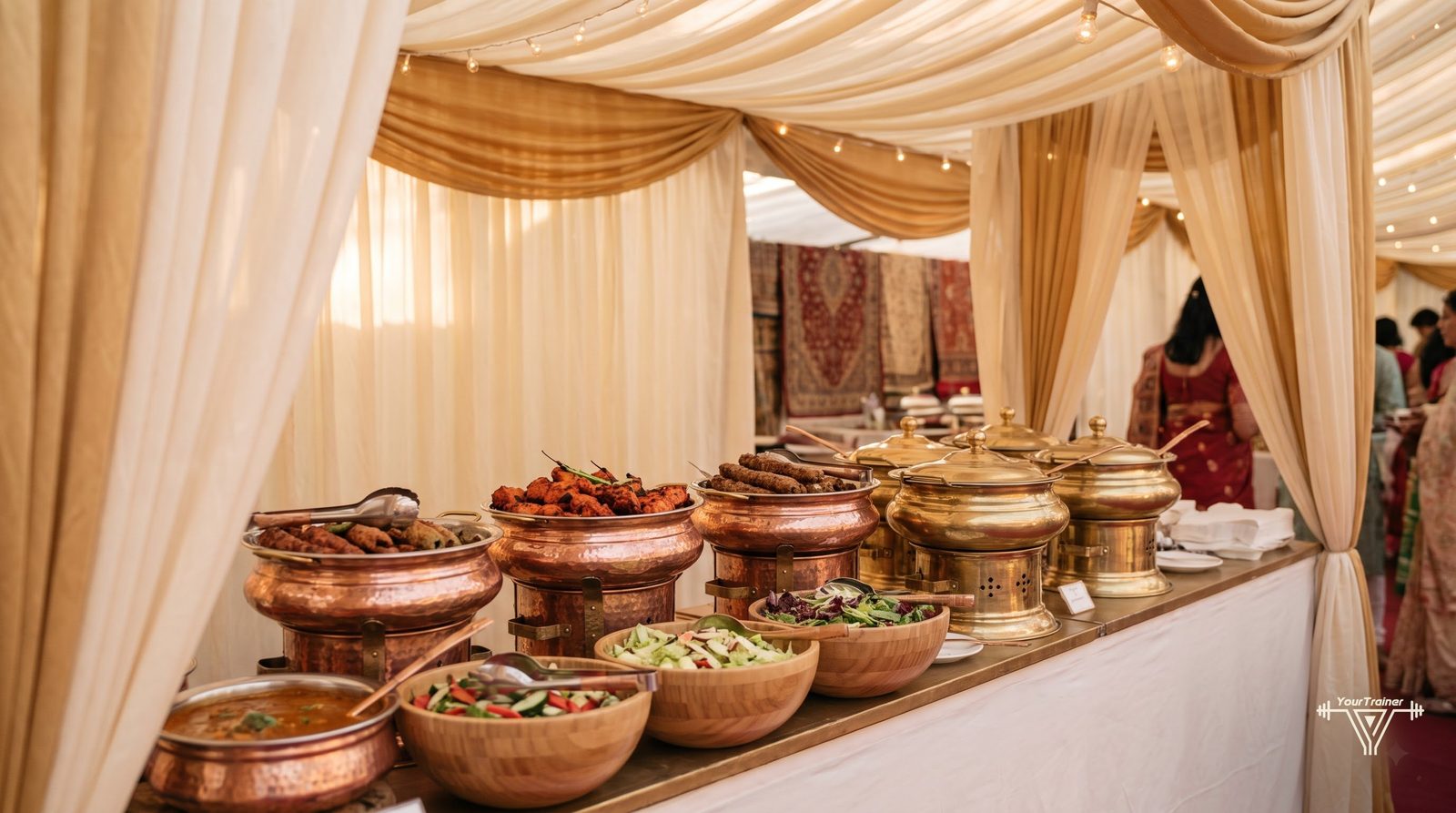
- Eat a normal protein-led lunch. Arriving hungry reliably increases total intake.
- Do one lap before taking anything. Deciding what is actually worth it beats taking a bit of everything.
- Start at the tandoori and salad end. Tandoori chicken and paneer tikka carry the protein without the cream.
- Pick either alcohol or dessert. Both together is routinely 700 to 900 calories on top of dinner.
- Do not compensate the next day by starving. It sets up the same cycle. Return to normal eating instead.
Navratri, Honestly
Fasting periods are often assumed to produce weight loss and frequently do not. Sabudana khichdi is dense, farali items are commonly deep fried, and the eating pattern shifts toward large evening meals.
If you observe the fast, the useful priorities are curd, fruit, paneer, makhana and nuts over fried farali snacks, and keeping the evening meal a normal size rather than a compensatory one.
Afterwards
Most of the scale movement during festival season is water and glycogen from higher carbohydrate and salt intake. It resolves within a week of normal eating. Actual fat gain across a two week festival period is usually 0.5 to 1.5 kg.
That takes three to six weeks to reverse at a sensible pace, which you can model in the weight loss timeline calculator. Resist the urge to crash diet in response, since that is what turns a small seasonal gain into an annual cycle.
Related reading: why you are not losing weight in a deficit, stress and belly fat, and the wedding fitness plan.
Sources
- Indian Food Composition Tables (IFCT) 2017 · ICMR, National Institute of Nutrition
- Nutrient Requirements for Indians (RDA and EAR) · ICMR, National Institute of Nutrition
- Healthy diet · World Health Organization
- Dietary profiles and associated metabolic risk factors in India (ICMR-INDIAB survey) · Nature Medicine
Figures for Indian foods follow IFCT 2017 (ICMR-NIN). Coaching guidance on this site is educational and is not a substitute for medical advice. See how we use sources.
Did you find this helpful?

About Anish Agarwal
Founder & Head Coach, YourTrainer · NASM & K11 Certified Personal Trainer · coaching since 2022
Featured in Dietitians.io, Fitness Interview, NRI Pulse, The MASALA Study. Press and media
Anish Agarwal is a NASM and K11 certified personal trainer coaching fat loss, body transformation, strength, and nutrition for clients across India since 2022. He founded YourTrainer to make expert, science-based coaching accessible online and in Bengaluru. Coach Anish's profile and the YourTrainer story.
Online 1-on-1 Coaching
Start Your Journey
Get a personalised training + Indian nutrition plan built around your goal, coached online, anywhere in India or abroad.
Trusted by 1,000+ clients coached across India & abroad
Free 30-min discovery call · No obligation