Which Dal Has the Most Protein? 10 Indian Dals Ranked, per 100 g and per Katori
Which dal has the most protein? Masoor leads at 9 g per 100 g, then chana and rajma. 10 dals ranked per 100 g and per katori, plus the bowl members logged.

Per 100 g cooked, masoor dal gives about 9 g of protein, chana 8.9 g, rajma 8.7 g, urad 7.5 g, moong 7 g and toor 6.8 g. But the bowl of dal our members actually logged, usually thinner than the lab sample, came to a median of 150 kcal and 9 g of protein. A bowl of dal is a good start on protein, not the whole answer: dal meals with curd, paneer, eggs or chicken alongside reached 23.4 g of protein, dal meals without them 15.6 g.
Dal in real Indian meals
43%
of members in the sample logged dal
150 kcal, 9 g
the typical bowl of dal as members logged it
76%
of dal was eaten at lunch
55%
of dal meals were with rice
From our members' own food logs
Source: A sample of member food logs from the YourTrainer app, 19 April to 17 September 2026. Members only, aggregated, using the app's food-database values for the portion logged. Lunch and dinner only; a meal is everything one member logged for that meal on one day
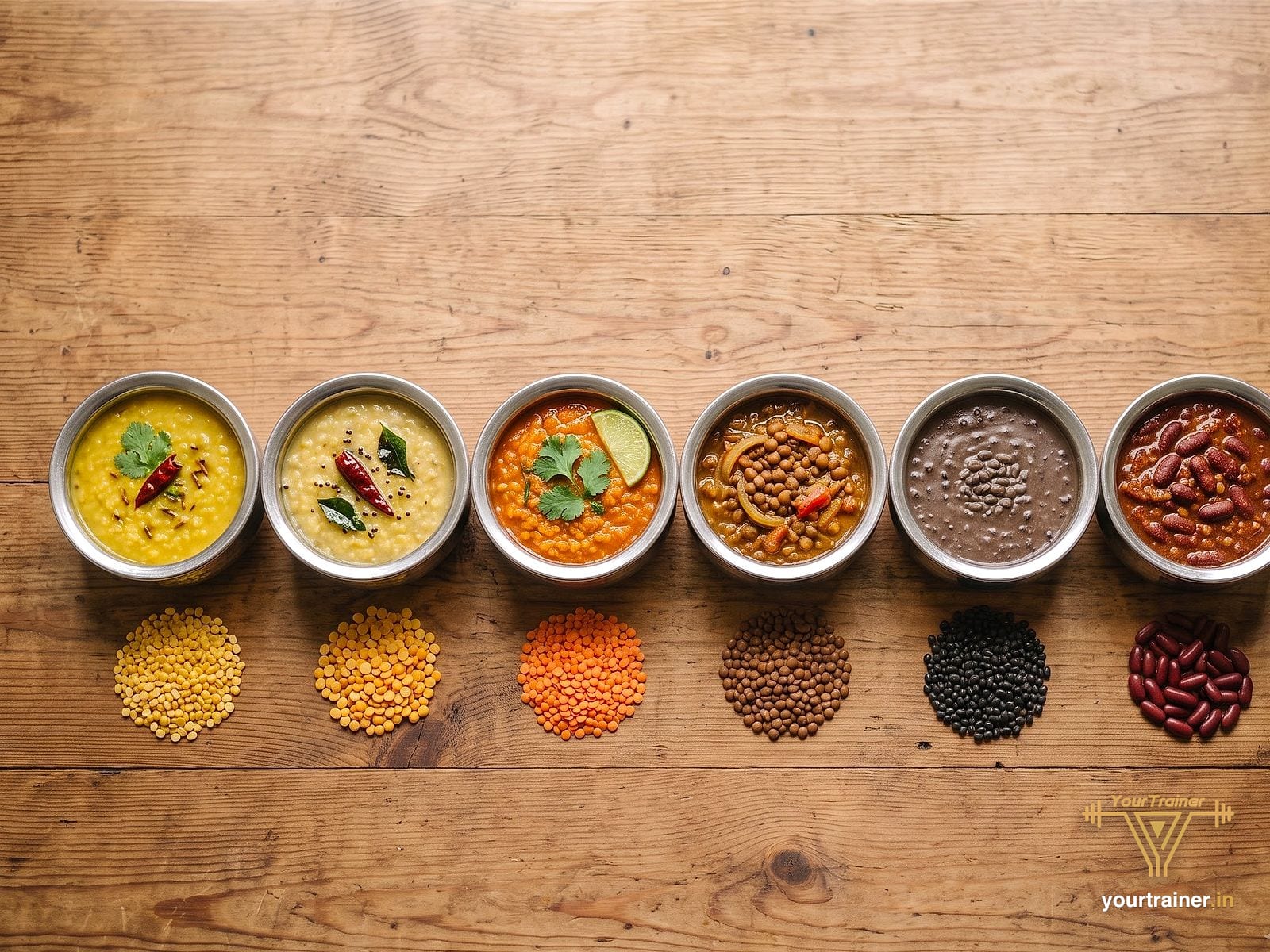
Which dal has the most protein? 10 dals ranked
Masoor dal has the most protein of the everyday dals, about 9 g per 100 g cooked, followed closely by chana and rajma. Toor, the most common dal, is last of the ten. These are laboratory values for the cooked, drained seed. Split dal is close to the whole seed per gram. A katori here is 150 g of thick cooked dal; a bowl of home dal holds more water than this, so treat the katori column as the upper end.
| Dal | Protein per 100 g | Calories per 100 g | Protein per katori | Calories per katori |
|---|---|---|---|---|
| Masoor (red lentil) | 9.0 g | 116 kcal | 13.5 g | 174 kcal |
| Chana (chickpea) | 8.9 g | 164 kcal | 13.3 g | 246 kcal |
| Rajma (kidney bean) | 8.7 g | 127 kcal | 13.0 g | 190 kcal |
| Matar (split peas) | 8.3 g | 118 kcal | 12.5 g | 177 kcal |
| Val (hyacinth bean) | 8.1 g | 117 kcal | 12.2 g | 176 kcal |
| Matki (moth bean) | 7.8 g | 117 kcal | 11.7 g | 176 kcal |
| Lobia (black-eyed pea) | 7.7 g | 116 kcal | 11.6 g | 174 kcal |
| Urad (black gram) | 7.5 g | 105 kcal | 11.3 g | 158 kcal |
| Moong (mung bean) | 7.0 g | 105 kcal | 10.5 g | 158 kcal |
| Toor / arhar (pigeon pea) | 6.8 g | 121 kcal | 10.1 g | 182 kcal |
Source: USDA FoodData Central (SR Legacy), mature seeds boiled without salt, per 100 g cooked
- Masoor7.9 g
- Moong7.6 g
- Chana7.6 g
- Toor6.7 g
- Urad6.4 g
- Rajma6.4 g
Source: USDA FoodData Central (SR Legacy), mature seeds boiled without salt, per 100 g cooked
Masoor gives the most protein for the fewest calories. Chana gives a similar amount of protein but more calories, which suits a muscle-gain week better than a fat-loss week. Toor, the most common everyday dal, is the lowest of the ten for protein, but the gap between any two of them is small next to how much dal you serve.
Turn the numbers into meals
Knowing the calories is the easy part. Eating to them through a normal Indian week is where most people slip.
A YourTrainer coach plans your week around the dal, roti, rice and sabzi you already eat, reviews your plate photos and adjusts every week. It runs fully online, so it works the same in Bengaluru or Boston.
Start Your JourneyCoached online, wherever you live:Online personal trainer in India·Coaching for Indians in the USA·Online coaching for NRIs
Eating or training around a condition?Diabetes and pre-diabetes·PCOS·Knee pain·Lower back pain·High cholesterol
What a real bowl of dal gives you
Nutrition labels describe dal cooked the way a laboratory cooks it. Home dal has more water, sometimes a tadka of ghee, and comes in whatever bowl is nearest. That is why the bowl our members logged is the more useful number for planning a day.
| Measure | Calories | Protein |
|---|---|---|
| 100 g cooked masoor, lab value | 116 kcal | 9.0 g |
| 100 g cooked toor, lab value | 121 kcal | 6.8 g |
| 1 bowl of dal, as members logged it | 150 kcal | 9 g |
Gold dot: from our own coaching data. Other figures are public, with their sources.
Source: USDA FoodData Central (SR Legacy), mature seeds boiled without salt, per 100 g cooked; logged bowl from A sample of member food logs from the YourTrainer app, 19 April to 17 September 2026. Members only, aggregated, using the app's food-database values for the portion logged
Coach's tip: thicker dal means more protein in the same bowl. Cook with less water, or add a spoon of roasted chana or a handful of sprouts.
Dal alone vs dal with a protein food
Protein in a lunch or dinner with dal
23.4 g
with curd, paneer, eggs, chicken or soya as well
15.6 g
with dal as the only protein source
18.0 g
median across all dal meals
From our members' own food logs
Source: A sample of member food logs from the YourTrainer app, 19 April to 17 September 2026. Members only, aggregated, using the app's food-database values for the portion logged. Lunch and dinner only; a meal is everything one member logged for that meal on one day
A bowl of dal on its own gives about 9 g, close to half of the 20 g per meal our coaches aim for. A katori of curd or 50 g of paneer closes most of the gap. Dal protein is also low in methionine, and rice is low in lysine, which dal supplies. Eating the two together across the day is why dal chawal works as a protein meal, as long as the dal portion is generous.
Which dal is best for weight loss?
- Masoor and moong: the most protein per calorie, and quick to cook on a weeknight.
- Toor: fine as the everyday dal; make it thicker or add a protein side.
- Chana and rajma: filling and high in fibre, but more calories per bowl. Keep the portion to one katori.
For daily totals by food, use the Indian food calorie calculator or the 60-dish calorie chart.
Quick answers
How much protein is in toor dal?
About 6.8 g per 100 g cooked (USDA). A typical bowl of dal in our members' logs gave about 9 g of protein and 150 kcal.
Which dal has the most protein?
Of 10 common Indian dals, masoor (red lentil) is highest at about 9 g per 100 g cooked, just ahead of chana at 8.9 g and rajma at 8.7 g. Moong has 7 g and toor 6.8 g, the lowest of the ten. A 150 g katori of thick masoor dal gives about 13.5 g.
Is one bowl of dal enough protein for a meal?
Usually not. In our members' logs, dal meals without another protein food reached 15.6 g of protein. Adding curd, paneer, eggs or chicken took the median to 23.4 g.
Read next
How we counted
- Reference values: USDA FoodData Central, SR Legacy, mature seeds boiled and drained, per 100 g.
- Real meals: a sample of member food logs from the YourTrainer app, 19 April to 21 September 2026. Members only, aggregated. Dal includes toor, moong, masoor, sambar, rajma and chole entries.
- A meal is everything one member logged for lunch or dinner on one day. The bowl value is a paired median from the same entries.
More in our full food-log study.
Did you find this helpful?

About Anish Agarwal
Founder & Head Coach, YourTrainer · NASM & K11 Certified Personal Trainer · 5+ years coaching
Featured in NRI Pulse, Dietitians.io, Fitness Interview, The MASALA Study. Press and media
Anish Agarwal is a NASM and K11 certified personal trainer coaching fat loss, body transformation, strength, and nutrition for clients across India, with 5+ years coaching. He founded YourTrainer to make expert, science-based coaching accessible online and in Bengaluru. Coach Anish's profile and the YourTrainer story.
Online 1-on-1 Coaching
Start Your Journey
Get a personalised training + Indian nutrition plan built around your goal, coached online, anywhere in India or abroad.
Trusted by 1,000+ clients coached across India & abroad
Free 30-min discovery call · No obligation