Home Gym Gear Our Clients Actually Use, Ranked: Case Studies
We counted the equipment in a sample of coached home sessions: dumbbells in 78%, bands in 15%, kettlebells in 5%. The weights clients own, real progressions and what to buy first.
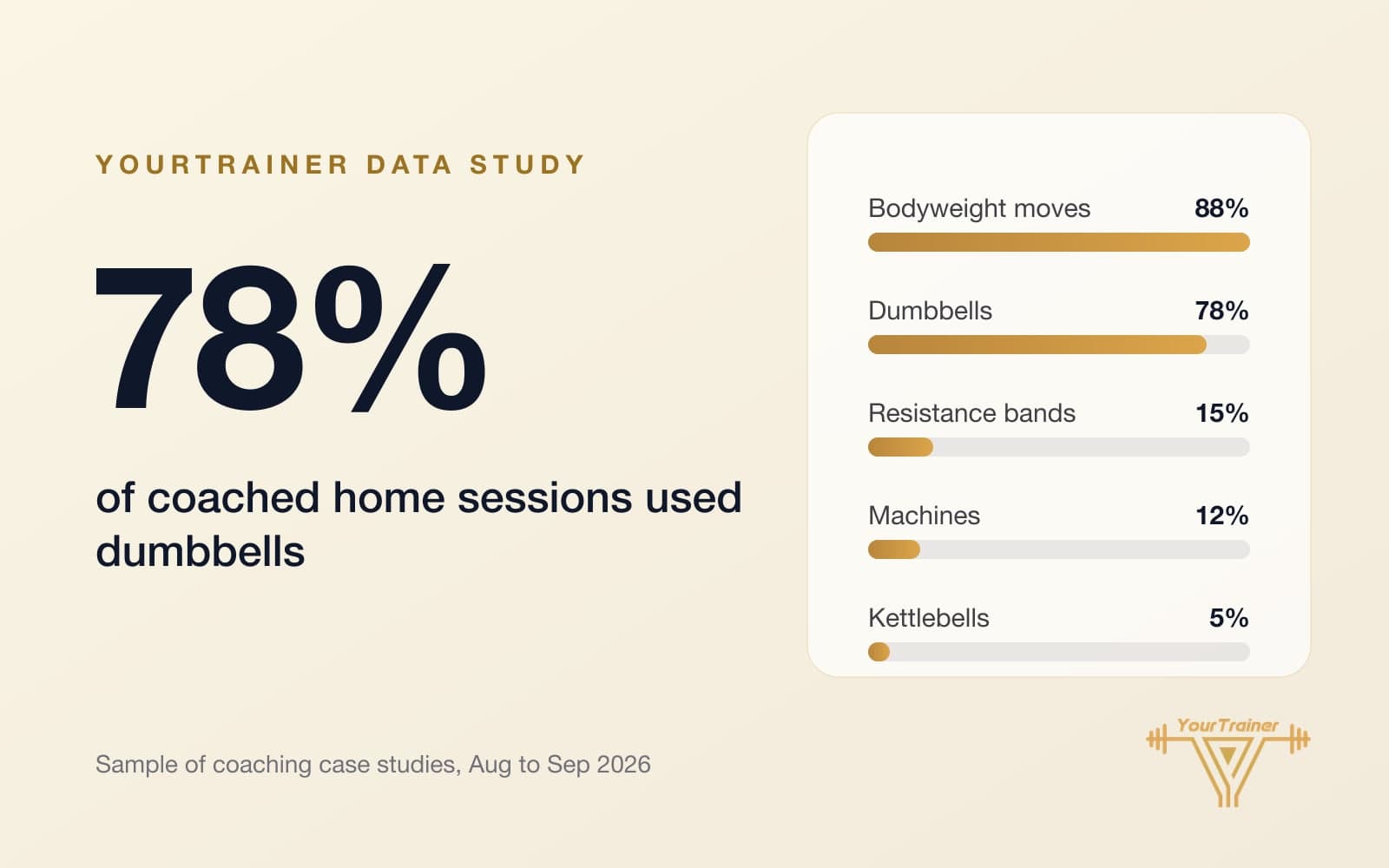
In a sample of coached home sessions, bodyweight moves were used in 88% and dumbbells in 78%. Resistance bands appeared in 15%, machines in 12% and kettlebells in 5%. Before you buy home gym equipment, it is worth knowing what gets used once a coach is actually programming your workouts. We reviewed a sample of YourTrainer coaching sessions as case studies, 17 August to 7 September 2026, and counted the equipment in every one that had an exercise list.
The data at a glance
88%
of sampled sessions used bodyweight moves
78%
of sampled sessions used dumbbells
15%
of sampled sessions used resistance bands
2.5 to 5 kg
the dumbbells most clients owned
Source: A sample of YourTrainer coaching sessions reviewed as case studies, 17 Aug to 7 Sep 2026, client names removed; equipment counted in the sampled sessions with an exercise list
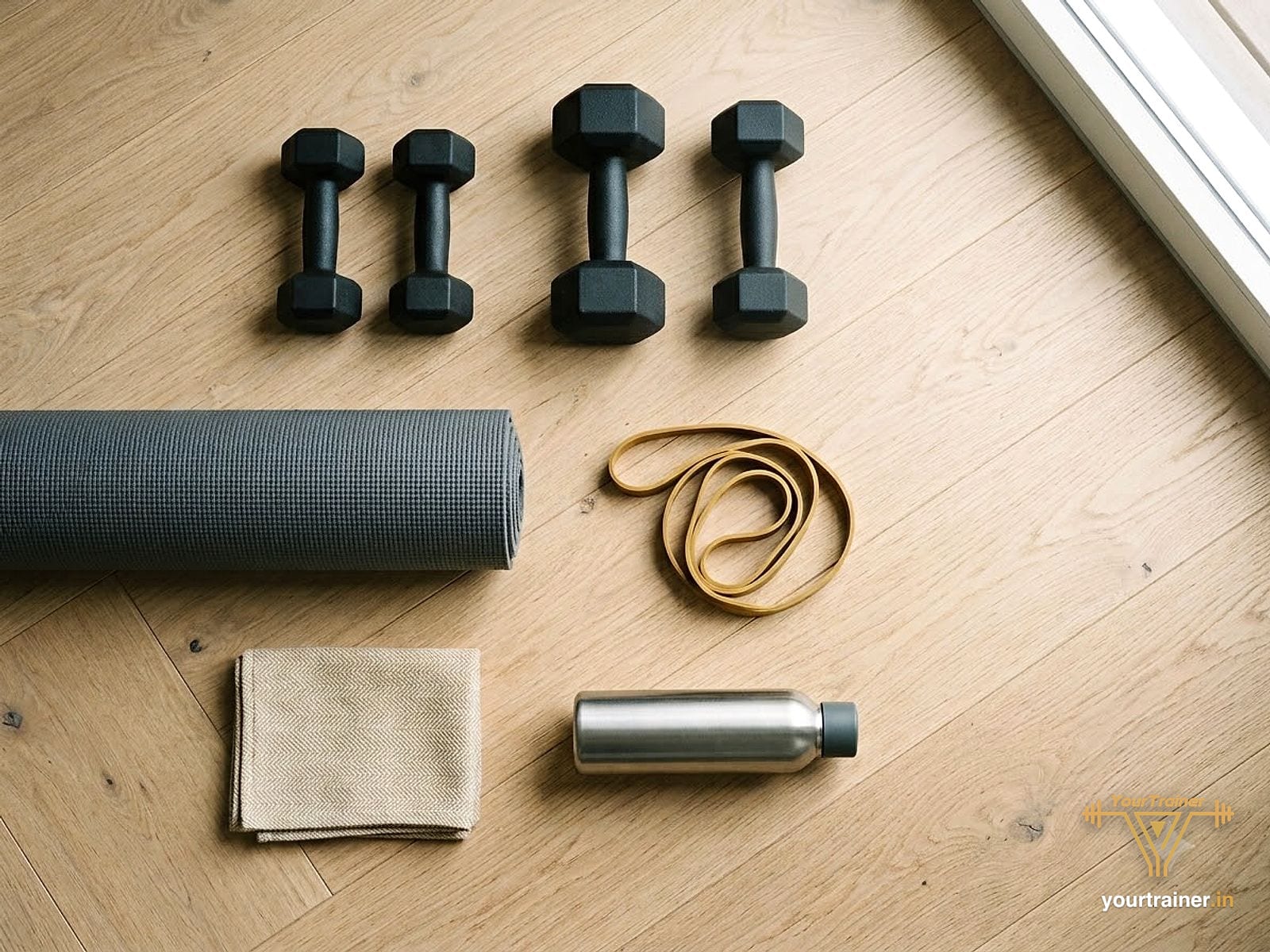
Home gym equipment, ranked by real use
- Bodyweight only moves88%
- Dumbbells78%
- Resistance bands15%
- Machines (office, apartment or hotel gym)12%
- Kettlebells5%
Source: A sample of YourTrainer coaching sessions reviewed as case studies, 17 Aug to 7 Sep 2026, client names removed; equipment counted in the sampled sessions with an exercise list
Two things did almost all the work: your own bodyweight and a pair of light dumbbells. Everything else was occasional. Bands were mentioned in 30% of sessions but programmed in only 15%, and clients often described their bands as poor quality. Machines showed up when a client happened to be in an office, apartment or hotel gym.
The dumbbell weights clients actually own
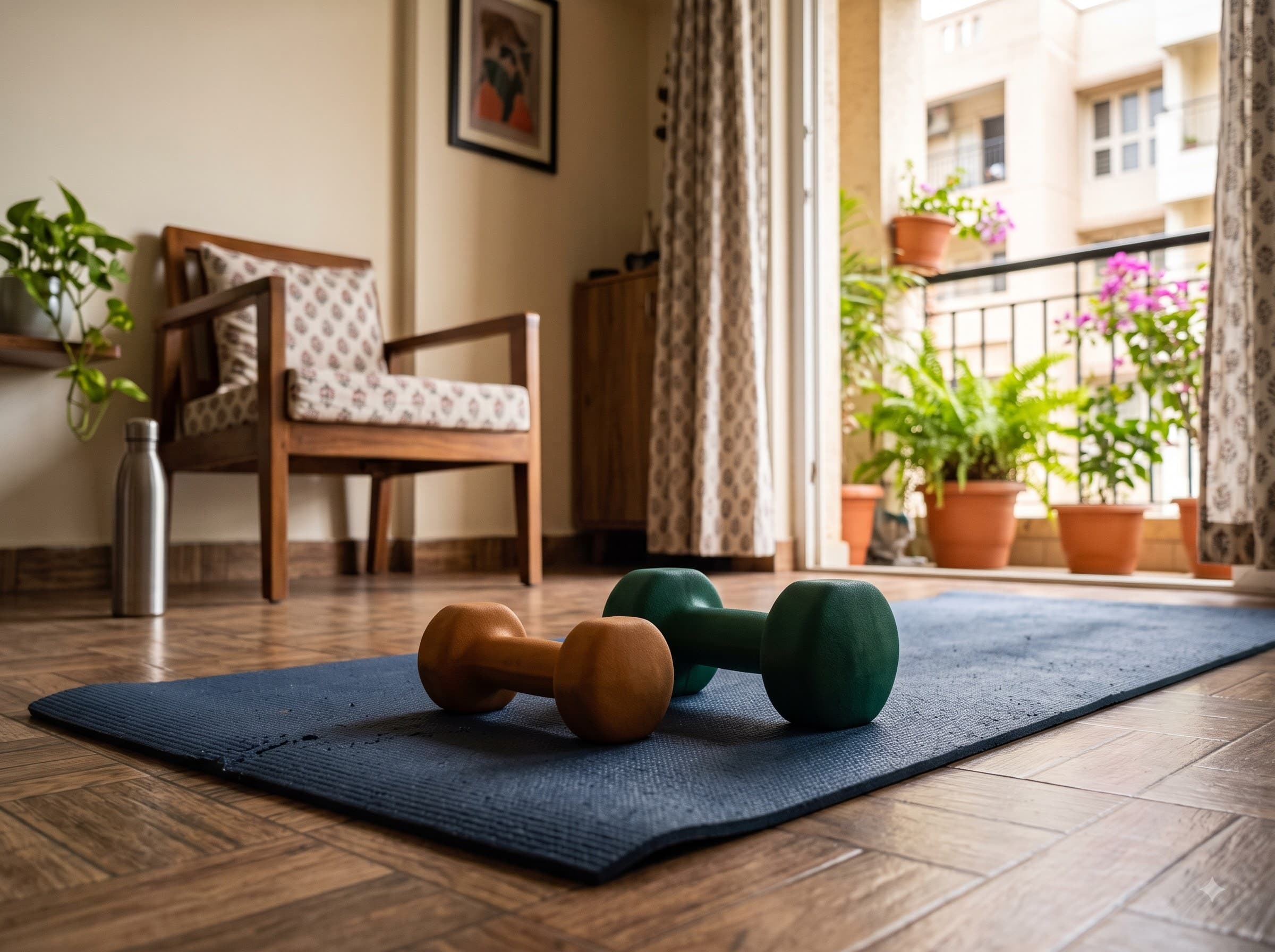
The typical home set was 2.5 kg and 5 kg, or 8 lb and 10 lb. A few had 10 to 12.5 kg dumbbells or an adjustable set. One complete beginner was told to start with 1 kg and buy 2.5 to 5 kg for the next 30 days. The home gym buying guide has prices and what to skip.
Light weights still progressed
The weight or difficulty went up in 75% of sessions, even with small home sets. Examples from the case studies:
| Exercise | Progression |
|---|---|
| Goblet squat | 8 lb to 10 to 20 lb in 16 days |
| Chest press | 5 to 7.5 to 10 kg |
| Dumbbell bench press | 15 to 20 to 25 to 30 lb |
| Leg extension | 11 to 18 kg |
Source: A sample of YourTrainer coaching sessions reviewed as case studies, 17 Aug to 7 Sep 2026, client names removed
The light dumbbell progressions post has more real progressions like these.
Coaching that does this for you
Reading is step one - a coach turns it into a plan built around your body, food & schedule.
100% online · Indian meal plans · weekly progress reviews · daily WhatsApp support.
Start Your Journey →What coaches programmed with that equipment
| Movement | Share of sessions |
|---|---|
| Plank variations | about 34% |
| Squat variations | about 29% |
| Shoulder press or thrusters | about 21% |
| Bicep or hammer curls | about 18% |
| Rows | about 18% |
| Push-up variations | about 17% |
| Mountain climbers | 17% |
| Deadlift or RDL variations | about 16% |
| Glute bridge or hip thrust | 13% |
Source: A sample of YourTrainer coaching sessions reviewed as case studies, 17 Aug to 7 Sep 2026, client names removed; equipment counted in the sampled sessions with an exercise list
Planks and squats led because they need little or no equipment. Mountain climbers were common and also the move clients most often avoided, because of wrist pain.
Improvised equipment that worked
When the equipment ran out, coaches used the room: a sofa edge for hip thrusts, stairs, a chair, a wall and even a piano stool. One client held weight plates with three fingers to train a weak grip.
Protein for home training
Equipment builds the stimulus, protein builds the muscle. Whey was the third most-logged food in our app's food logs, at 24 g of protein a scoop. These are the portions members actually logged.
| Food | Typical portion | Calories, protein |
|---|---|---|
| Whey protein | 1 scoop | 120 kcal, 24 g |
| Chicken breast | 150 g | 248 kcal, 46.5 g |
| Soya chunks | 75 g dry | 248 kcal, 39 g |
| Boiled eggs | 2 eggs | 156 kcal, 13 g |
| Dal | 1 bowl | 150 kcal, 9 g |
| Paneer | 50 g | 133 kcal, 9 g |
| Dahi (curd) | 100 g | 61 kcal, 4 g |
Source: A sample of member food logs from the YourTrainer app, 19 April to 17 September 2026. Members only, aggregated, each food logged by at least three members in the sample, using the app's food-database values for the portion logged
For the cheapest way to reach your number, see protein per rupee or work out your target with the protein calculator.
What to buy first, based on use
- A pair of light dumbbells, 2.5 kg and 5 kg for most beginners. They were used in 78% of sampled sessions.
- Nothing else until you have trained consistently for a month. Bodyweight moves covered 88% of sampled sessions.
- Bands only if they are good quality. Clients often described theirs as poor.
- Kettlebells and machines are optional. They appeared in only 5% and 12% of sessions.
Quick answers
What home gym equipment do I actually need?
A pair of light dumbbells. In a sample of coached home sessions, bodyweight moves were used in 88% and dumbbells in 78%, while bands appeared in 15% and kettlebells in 5%.
What weight dumbbells should a beginner buy?
Most of our clients trained with 2.5 kg and 5 kg dumbbells. A complete beginner can start at 1 kg and move to 2.5 to 5 kg within about 30 days.
Are resistance bands worth buying?
Only good ones. Bands were mentioned in 30% of our sessions but used in only 15%, and clients often described their bands as poor quality.
Where this data is used
- Cheap home gym equipment: what to actually buy
- Protein per rupee: cheapest sources, ranked
- Whey vs plant protein
- How many eggs a day are safe?
- How much protein should an Indian eat?
- Fitness after 40: real transformations
- Protein for Indians hub
- Muscle and strength hub
How we counted
- Case studies: a sample of YourTrainer coaching sessions reviewed as case studies, 17 August to 7 September 2026, with client names removed. Equipment and movements are counted in the sampled sessions that had an exercise list; shares marked "about" group close variations.
- Protein portions come from a sample of food entries logged by members in the YourTrainer app, using foods logged by at least 3 members.
- Only aggregates are published, with no client names.
More in the muscle and strength hub.
Did you find this helpful?

About Anish Agarwal
Founder & Head Coach, YourTrainer · NASM & K11 Certified Personal Trainer · 6+ years experience
Anish Agarwal is a NASM and K11 certified personal trainer with 6+ years of experience coaching fat loss, body transformation, strength, and nutrition for clients across India. He founded YourTrainer to make expert, science-based coaching accessible online and in Bengaluru. More about Anish.
Online 1-on-1 Coaching
Start Your Journey
Get a personalised training + Indian nutrition plan built around your goal, coached online, anywhere in India or abroad.
★★★★★ Trusted by 1,000+ transformations across India & abroad
Free 30-min discovery call · No obligation