Vitamin B12 Deficiency in Indian Vegetarians: Signs, Foods & Fixes
Why 30-40% of Indian vegetarians are B12 deficient, symptoms to watch, vegetarian food sources, and the right way to supplement safely. Complete guide for India + NRI.
⚠ Lifestyle education only. Not medical advice. Vitamin B12 deficiency is a medical condition; get tested and consult your doctor before starting supplements. The information here is for awareness; your doctor should guide diagnosis and treatment based on your blood tests.
Quick answer: Vitamin B12 is found almost entirely in animal foods, making Indian vegetarians (especially vegans) significantly more likely to be deficient. Common signs include persistent fatigue, tingling or numbness in hands and feet, brain fog, mood changes, mouth ulcers, sore tongue, and breathlessness. Vegetarian sources are limited to dairy (milk, curd, paneer), eggs (if eaten), and fortified foods like cereals and plant-based milks. Many vegetarians and most vegans need a B12 supplement (methylcobalamin 500–1000 mcg 2–3 times weekly or cyanocobalamin 1000 mcg weekly). Get a blood test first to confirm deficiency before supplementing, and ask your doctor about the right dose and form for your needs.
B12 Deficiency at a Glance
Why Indian Vegetarians Are at Risk for B12 Deficiency
Vitamin B12 is found almost exclusively in animal products. Your body doesn't make it; you must get it from food or supplements. For vegetarians, the sources shrink dramatically:
- Vegans: Zero natural dietary B12 unless they eat fortified foods
- Vegetarians who eat dairy and eggs: Can meet needs if they eat enough milk, curd, and eggs regularly
- Vegetarians who avoid eggs or dairy: Nearly guaranteed deficiency without supplementation
India compounds the problem. Studies suggest 30–40% of Indian vegetarians are B12 deficient, compared to 6% in the general U.S. population. Reasons include:
- Limited animal food intake: Many Indian vegetarian diets rely on plant proteins (dal, paneer, tofu) with less frequent dairy or egg consumption than Western vegetarian diets
- Low intrinsic factor: Some people have reduced stomach acid or intrinsic factor (needed to absorb B12), which worsens in aging and with certain medications like metformin
- Fortified food gaps: Fortified milk, cereals, and plant-based milks are not yet mainstream across all Indian households
- Gut health issues: Conditions like IBS, celiac, or past gastric surgery reduce B12 absorption
The result: many vegetarians and most vegans living in India need to supplement to maintain healthy B12 levels.
Signs You Might Be B12 Deficient
B12 deficiency develops slowly and symptoms can be subtle at first. Look for these signs:
| Symptom | Why It Happens |
|---|---|
| Persistent fatigue | B12 needed for red blood cell formation and energy metabolism |
| Tingling or numbness (hands, feet) | Nerve damage from low B12; can become permanent if untreated |
| Brain fog, poor concentration | B12 is essential for cognitive function and myelin formation |
| Mood changes, depression, anxiety | B12 affects serotonin and neurotransmitter production |
| Mouth ulcers, sore or swollen tongue | Inflammation of mucous membranes (glossitis) |
| Breathlessness with light activity | Reduced oxygen carrying (fewer healthy red blood cells) |
| Pale or yellowish skin, pale lips | Anemia from low red blood cell count or shortened cell lifespan |
Why early detection matters: B12 deficiency can damage your nervous system permanently if it goes untreated for months or years. If you experience tingling in your hands or feet, get tested immediately. Fatigue and brain fog are reversible with B12 correction, but nerve damage may not be.
Vegetarian B12 Sources (The Real List)
Here's what vegetarians can actually eat to get B12, with realistic amounts:
| Food | Serving | B12 (mcg) | Notes |
|---|---|---|---|
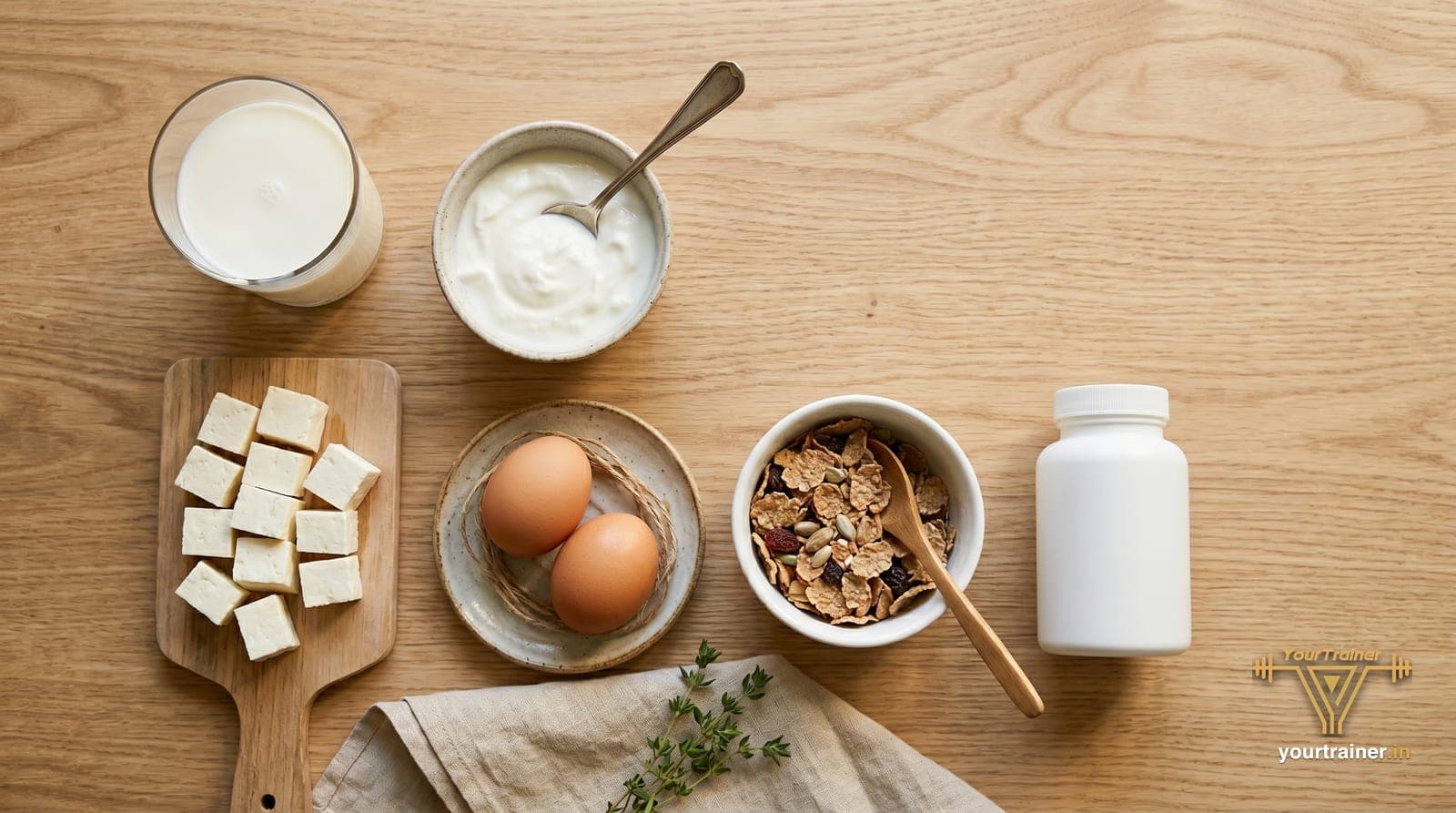
| Cow milk | 1 cup (240 ml) | 0.9–1.2 | Most reliable vegetarian source; daily dose is hard to meet on milk alone |
| Curd/Yogurt | 1 cup (200g) | 0.7–1.0 | Plain curd better than flavoured; probiotic benefit is a bonus |
| Paneer | 100g | 0.2–0.3 | Low B12 per serving; need large amounts (not practical daily) |
| Eggs (whole) | 1 large egg | 0.5–0.6 | If you eat eggs; one of the most efficient vegetarian sources |
| Fortified plant milk | 1 cup (240 ml) | 0.6–3.0 | Varies widely by brand; always check the label |
| Fortified cereals | 1 serving | 0.6–2.0 | Read labels; not all cereals are fortified in India |
| Nutritional yeast | 2 tbsp | 4.8–8.0 | Good vegan source if fortified; used as seasoning sprinkle; taste is acquired |
The realistic truth: Most Indian vegetarians cannot reliably meet their B12 needs through food alone. Even with 1 cup of milk daily and 2 eggs, you might only get 2.2 mcg - below the recommended 2.4 mcg daily. This is why supplementation is common and reasonable for vegetarians.
Coaching that does this for you
Reading is step one. A coach turns it into a plan built around your body, food & schedule.
100% online · Indian meal plans · weekly progress reviews · daily WhatsApp support.
Start Your Journey →How to Supplement B12 Safely
Step 1: Get a Blood Test
Before supplementing, ask your doctor for a serum B12 test (normal range is roughly 200–900 pg/ml, but symptoms can occur even at 300–500). Some labs also offer holotranscobalamin (active B12), which may be more specific. If you're getting started, a simple serum B12 test at any pathology lab costs ₹300–600.
Step 2: Choose Your Form
Two types are commonly used:
- Methylcobalamin: More popular in India; seems to feel faster, but scientific evidence for superiority is weak. Typical dose: 500–1000 mcg, taken 2–3 times weekly or daily as a supplement or injection.
- Cyanocobalamin: Older, cheaper, equally effective over time. Typical dose: 1000 mcg weekly (injections) or 1000–2000 mcg daily (oral).
Oral supplements work well if you have normal stomach acid and no absorption issues. Injections are needed if you have low intrinsic factor (pernicious anemia), past gastric surgery, or very low B12 with symptoms like nerve damage.
Step 3: Choose Your Delivery Method
- Oral tablets/sublingual lozenges: ₹200–400/month for 1000 mcg weekly or daily dosing. Over-the-counter; available at any pharmacy as brands like Weriton, Cytocal, or store generics. Convenient, no needles.
- Injections (IM): ₹500–1500 per shot, usually monthly. More reliable for severe deficiency or absorption issues. Your doctor or a nurse can administer it.
- Nasal spray/gel: Less common in India; pricier (₹1500–3000), prescribed for specific absorption issues.
Step 4: Dosing & Frequency
Your doctor will advise based on your blood level and symptoms. Typical starting regimens:
- Mild deficiency (B12: 200–300): 1000 mcg weekly oral for 4 weeks, then monthly or every 2 weeks
- Moderate deficiency (B12: 100–200): 1000 mcg weekly injections for 4–6 weeks, then monthly maintenance
- Severe deficiency with symptoms: 1000 mcg weekly injections for 6–12 weeks, then lifelong maintenance
- Vegan maintenance (no deficiency yet): 1000 mcg weekly oral or 2000 mcg daily, indefinitely
After 3 months on your regimen, ask for a repeat blood test to confirm your levels are normalizing.
B12 and Vitamin D: Test Both
Here's a critical connection: if you're an Indian vegetarian with low B12, you almost certainly have low vitamin D as well. Both are common in India, and both cause fatigue, weakness, and mood changes.
When you get your B12 test, also ask for a 25-hydroxy vitamin D test (cost: ₹400–600). Many people find that fixing both together - B12 supplement plus vitamin D (1000–2000 IU daily or 60,000 IU weekly) - transforms their energy and mood recovery.
NRI reminder: If you're an Indian living abroad, you have the same B12 deficiency risk if you're vegetarian. U.S., UK, Canada, and Europe all have fortified foods available (cereals, plant-based milks), which can help. Still consider a blood test and supplement if needed - don't assume you're covered.
B12, Energy & Training Recovery
For anyone training hard, B12 deficiency is especially problematic. B12 is essential for:
- Energy production: Needed for mitochondrial function; deficiency makes workouts feel harder
- Muscle recovery: Low B12 slows protein synthesis and muscle repair
- Endurance: Anemia from B12 deficiency reduces oxygen delivery to muscles
- Neurological recovery: B12 supports nervous system repair after intense training
If you're vegetarian and training regularly, maintaining healthy B12 is non-negotiable. Many athletes experience a dramatic difference in performance and recovery once they start supplementing.
Key Takeaways
- Vegetarians, especially vegans, are at high risk for B12 deficiency in India. About 30–40% of Indian vegetarians have low B12.
- Symptoms matter: Persistent fatigue, tingling in hands/feet, brain fog, and mood changes warrant a blood test.
- Food alone is rarely enough. Dairy and eggs help, but most vegetarians benefit from supplementation.
- Supplementation is safe and affordable. Oral B12 costs ₹200–400/month and is available without a prescription in India.
- Test before you start. A serum B12 test (₹300–600) confirms deficiency and helps your doctor choose the right dose.
- Test vitamin D too. Both B12 and D deficiencies are common in India; fixing both together speeds recovery.
- It matters for training. B12 supports energy, recovery, and performance. If you're training hard, don't skip this.
Ready to take control of your energy and recovery? Get tested this month. If you're vegetarian and struggling with fatigue, a simple B12 supplement might be the missing piece. And if you want a personalised plan for nutrition, supplementation, and training that actually works for your body, start a free discovery call with Coach Anish - we'll take into account your diet, deficiency risks, and your training goals.
Sources
- High prevalence of metabolic obesity in India: the ICMR-INDIAB national study · Indian Journal of Medical Research
- Appropriate body-mass index for Asian populations and its implications for policy and intervention strategies · WHO Expert Consultation, The Lancet (2004)
- Healthy diet · World Health Organization
Figures for Indian foods follow IFCT 2017 (ICMR-NIN). Coaching guidance on this site is educational and is not a substitute for medical advice. See how we use sources.
Did you find this helpful?

About Anish Agarwal
Founder & Head Coach, YourTrainer · NASM & K11 Certified Personal Trainer · 6+ years experience
Anish Agarwal is a NASM and K11 certified personal trainer with 6+ years of experience coaching fat loss, body transformation, strength, and nutrition for clients across India. He founded YourTrainer to make expert, science-based coaching accessible online and in Bengaluru. More about Anish.
Online 1-on-1 Coaching
Start Your Journey
Get a personalised training + Indian nutrition plan built around your goal, coached online, anywhere in India or abroad.
★★★★★ Trusted by 1,000+ transformations across India & abroad
Free 30-min discovery call · No obligation