Thyroid Diet for Indians: Foods to Eat & Avoid (Hypothyroidism)
Complete thyroid diet guide for Indian women and men. Learn which foods support levothyroxine treatment, how iodine/selenium/zinc work, why goitrogens are a myth, and how strength training preserves metabolism. Real Indian recipes and medication timing rules.
⚠ Lifestyle coaching information only. Not medical advice. Hypothyroidism requires thyroid medication (levothyroxine) prescribed by your doctor. Diet supports treatment but cannot replace it. Always coordinate any changes to your diet, supplements, or medication timing with your endocrinologist - especially if you take levothyroxine or have other metabolic conditions.
Quick answer: Hypothyroidism affects roughly 1 in 10 Indians, especially women. Your metabolism slows, making weight gain, fatigue, cold intolerance, and hair fall common. While no food cures hypothyroidism, a targeted Indian diet rich in iodine (iodised salt), selenium (seeds, fish, brazil nuts), zinc, iron, and vitamin D supports your treatment. Goitrogens like raw cabbage and cauliflower only matter in very large raw amounts - normal cooked Indian sabzi is completely fine. Timing your levothyroxine 30–60 minutes before breakfast and separating it by several hours from calcium, iron, and soy ensures optimal absorption. Strength training and adequate protein protect your metabolism while losing weight.
Thyroid Diet Essentials
What Happens When Your Thyroid Slows Down
Hypothyroidism (underactive thyroid) means your thyroid gland produces insufficient T3 and T4 hormones. These control your metabolic rate - how fast you burn calories at rest. When levels drop, everything slows:
- Metabolism drops 10–40% - weight gain despite unchanged eating, hard to lose fat without medication
- Fatigue and brain fog - constant tiredness, hard to focus, morning sluggishness
- Cold intolerance - always feeling chilly even in warm weather, poor circulation
- Hair loss and dry skin - thinning scalp hair, brittle nails, rough skin texture
- Digestion slows - constipation, bloating, gas, reduced stomach acid
- Mood dips - mild depression, anxiety, low motivation
This is why diet alone cannot fix hypothyroidism - you need thyroid replacement therapy (levothyroxine is first-line). But diet directly impacts how well your treatment works and how you feel. The right nutrients speed hormone production and absorption; the wrong choices interfere with your medication.
The 4 Nutrients Your Thyroid Needs Most
Why these four? Your thyroid is a tiny gland but metabolically expensive. It recycles iodine to make T3 and T4; selenium protects it from oxidative stress; zinc and iron enable hormone activation. Without these, even with levothyroxine, your free T3 and T4 won't rise optimally.
1. Iodine (The Most Critical)
Your thyroid cannot function without iodine. Indian iodine deficiency is widespread in non-coastal areas; this is why India added iodine to salt. Using iodised salt is your easiest fix - just 1/2 teaspoon (2.5g) daily provides the recommended 150 mcg. If you use rock salt, sea salt, or Himalayan salt instead of iodised, your iodine is near zero.
Best iodised salt picks: Look for "iodised salt" on the package. Common brands: Tata Salt, Aashirvaad, Sambhar. Cost difference vs rock salt is negligible (₹15–25 per kg).
2. Selenium (The Protector)
Selenium is a co-factor for thyroid peroxidase (TPO), the enzyme that makes T4. It also prevents Hashimoto's (autoimmune thyroiditis, the most common cause of hypothyroidism in India). Research suggests 50–100 mcg daily is optimal; deficiency accelerates thyroid attack.
India-friendly sources:
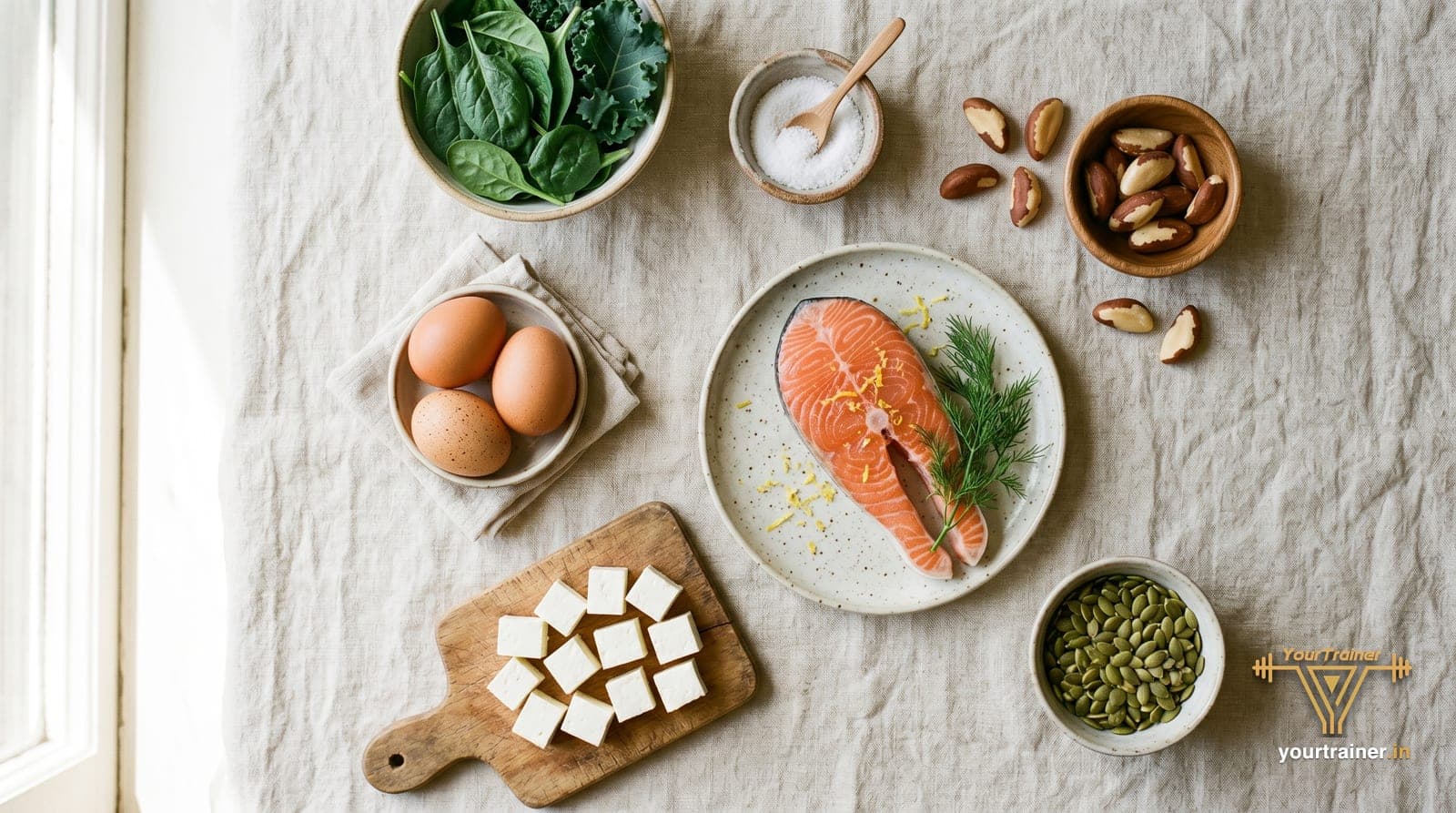
- Brazil nuts: 1–2 nuts = 60–100 mcg (easy but expensive, ₹400–500 per 100g)
- Sunflower seeds: 30g = 30 mcg (cheaper, ₹50/250g)
- Sesame seeds (til): 30g = 15 mcg (fried or in chikhalwali ladoo)
- Chicken: 100g = 30 mcg (affordable non-veg)
- Fish (salmon, mackerel): 100g = 50–70 mcg (best protein + selenium combo)
- Eggs: 2 eggs = 25 mcg
- Whole moong dal: 1 cup cooked = 10 mcg (cumulative)
3. Iron (For Conversion)
T4 (the inactive form you take as levothyroxine) must convert to T3 (the active form) in your tissues. This conversion requires iron. Iron-deficiency anemia is extremely common in Indian women and directly worsens hypothyroid symptoms even if your TSH is controlled.
Veg iron sources (harder to absorb, need vitamin C): Spinach (palak), fortified flour, lentils (moong, masoor), jaggery, dark leafy greens.
Non-veg iron sources (easy to absorb - heme iron): Red meat, chicken liver, fish, eggs.
Pro tip: Pair iron-rich meals with vitamin C (citrus, tomato, raw onion) to boost absorption. Avoid tea/coffee within 1–2 hours of iron-rich meals (tannins block absorption).
4. Zinc (The Immune Regulator)
Zinc deficiency worsens Hashimoto's (autoimmune thyroiditis) and slows T3 activation. It's also critical for hair regrowth - thyroid patients often lose hair partly due to zinc deficiency.
Indian sources: Pumpkin seeds (chutneys, toasted), chicken, fish, chickpeas (chana), sesame seeds, yoghurt, paneer.
Daily Target Micronutrients
Foods to Eat Freely for Thyroid Health
Seafood & Protein (Best Choices)
- Fish (salmon, mackerel, sardines): Iodine + selenium + omega-3s. Eat 2–3x weekly if you like seafood.
- Eggs: Iodine, selenium, zinc, complete protein. 2–3 daily is safe and affordable.
- Chicken breast: Lean protein, selenium, supports muscle retention during weight loss.
- Paneer & Greek yoghurt: Protein, calcium, iodine (if milk-based). Good veg option.
Seeds & Nuts (Nutrient Powerhouses)
- Sunflower & pumpkin seeds: Sprinkle on salad, add to chikhalwali, toast for snacking (selenium + zinc).
- Sesame seeds (til): Add to roti dough or chikhalwali (zinc + calcium).
- Flax seeds: Grind fresh, mix in dahi or add to roti (lignans + omega-3s).
Legumes & Grains (Build Slowly)
- Moong dal: Easy to digest, iodine, iron. Cook soft; avoid raw sprouted moong if you're sensitive.
- Masoor dal (red lentils): Iron, zinc, gentle on digestion. Frequent choice for dal.
- Whole wheat & millet: Zinc, B vitamins. Include variety instead of refined white flour.
- Brown rice, oats: Zinc, selenium. Gentle alternatives to white rice.
Vegetables (Cooked Is Key)
- Leafy greens (spinach, fenugreek): Iron, antioxidants. Cook well in ghee or oil (fat improves absorption).
- Sweet potato: Vitamin A supports T4-to-T3 conversion, selenium, potassium.
- Carrots, tomato, onion: Vitamin C boosts iron absorption; use in curries.
- Broccoli, cauliflower, cabbage: Fine in normal cooked amounts (see goitrogen section below).
Dairy & Fortified Foods
- Milk & curd: Iodine, calcium. Take at separate meals from levothyroxine (calcium blocks absorption).
- Fortified atta & rice: Iron and B vitamins. Choose "fortified" varieties when available.
Coaching that does this for you
Reading is step one. A coach turns it into a plan built around your body, food & schedule.
100% online · Indian meal plans · weekly progress reviews · daily WhatsApp support.
Start Your Journey →Foods to Eat in Moderation (Not Banned)
| Food Category | What to Watch | Why & How to Handle |
|---|---|---|
| Cruciferous veggies (raw) | Raw cabbage, raw broccoli, raw cauliflower | Contain goitrogens (compounds that slightly reduce iodine uptake), but only in VERY large raw amounts. Normal cooked sabzi (aloo gobi, cauliflower fry) poses zero risk. |
| Soy products | Tofu, soya chunks, soy milk | Soy phytoestrogens can slow iodine absorption (modest effect). If you eat soy, leave 4+ hours between soy and levothyroxine dose. Occasional use is fine. |
| High-fibre grains (excess) | Too much psyllium husk, whole wheat bran | Fibre can bind levothyroxine and reduce absorption. Eat balanced meals with fibre spread throughout the day, not bolused before/after levo dose. |
| Calcium supplements | All forms (citrate, carbonate) | Calcium binds levothyroxine and can reduce absorption by 30–40%. Take calcium 4+ hours after levo dose. Milk/curd at lunch/dinner is fine. |
The Levothyroxine Timing Gold Rule
If you take levothyroxine (Thyronorm, Eltroxin, etc.), this timing is non-negotiable for proper absorption:
- Take on an empty stomach, 30–60 minutes before breakfast
- Avoid calcium, iron supplements, magnesium supplements for at least 4 hours after (they bind to levo and reduce absorption)
- Avoid soy products for at least 4 hours after (phytoestrogens interfere)
- Coffee/tea okay at 30 min after (not immediately, but don't need to wait hours)
- Eat breakfast 30–60 min later: Your normal meal with any food is fine; just space it from the pill
- Your endocrinologist should recheck your TSH 6–8 weeks after any dose change to confirm proper absorption
Real example: Take your 50 mcg levothyroxine at 6 AM on an empty stomach. Breakfast at 6:45 AM can include milk, eggs, toast, anything. Your iron supplement? Take at lunch (4+ hours later). Your calcium cough drops? Not until dinner. This simple timing accounts for 30–40% of thyroid treatment failure.
Sample Day: Foods That Support Thyroid Treatment
Breakfast (6:45 AM, 45 min after levo)
Option A (Veg): Paneer bhurji (paneer 150g + onion + tomato + spinach) + 2 slices whole wheat toast + 1 tbsp ghee
Protein 20g, Iodine (paneer+salt), Iron (spinach), Selenium (whole wheat), Zinc (paneer)
Option B (Non-Veg): 2 eggs (scrambled or curry) + 1 bowl moong dal + 1 roti
Protein 22g, Iodine (eggs+salt), Selenium (eggs), Zinc (moong), Iron (moong)
Mid-Morning (10 AM)
Snack: Handful (30g) sunflower seeds + 1 apple
Selenium 30 mcg, Zinc 4 mg, Vitamin C (apple)
Lunch (1 PM)
Option A: Grilled chicken breast 150g + Masoor dal curry + Brown rice (1 bowl) + Mixed green salad with sesame seeds
Protein 35g, Selenium (chicken+dal), Iron (dal+sesame), Zinc (sesame+chicken)
Option B (Veg): Aloo gobi (potato + cauliflower cooked in oil) + Rajma (kidney beans) + Brown rice + Greek yoghurt side
Protein 18g, Iodine (salt+yoghurt), Zinc (rajma+seeds)
Evening Tea (4 PM)
Option: Chai with milk + 2 whole wheat rusk (or 1 roti + ghee)
Iodine (milk), Calcium (milk - 4+ hours from morning levo, so fine)
Dinner (8 PM)
Option A: Fish curry (salmon/mackerel 150g) + 2 roti + Spinach+tomato sabzi + Raita
Protein 30g, Iodine (fish+salt+yoghurt), Selenium (fish) 60 mcg, Omega-3s
Option B (Veg): Paneer tikka (150g) + Dal makhani (1 bowl) + Brown rice (1 bowl) + Cucumber raita
Protein 28g, Iodine (paneer+yoghurt+salt), Zinc (paneer)
Strength Training Protects Your Metabolism
Hypothyroidism naturally slows metabolism and makes weight loss harder. If you're trying to lose fat, diet alone rarely works - you'll also lose muscle and end up skinny-fat with poor results. Resistance training (weights, bodyweight, resistance bands) is essential:
- 3–4 sessions per week, 30–45 min each: Compound lifts (squats, deadlifts, chest press, rows) build and preserve muscle mass
- Protein intake 1.8–2.0g per kg body weight: If you weigh 65 kg, aim for 120–130g protein daily. This is easier with chicken, fish, eggs, paneer, and dal combined.
- Progressive overload: Each week, try to lift slightly heavier or do 1–2 more reps. This signals your body to keep muscle even in a calorie deficit.
- Consistency matters more than perfection: 3 medium workouts per week beat sporadic intense sessions. Your thyroid is sluggish; routine helps.
Why this works: Muscle tissue is metabolically active - it burns calories at rest. Preserving it while losing fat means your metabolism stays higher long-term, and you look lean rather than flabby.
For Indians in the USA & abroad: If you were diagnosed with hypothyroidism in India, your TSH labs are key. Don't assume a US-based doctor's "normal" range overlaps with Indian labs - labs differ slightly by region and method. Bring your Indian lab reports to your new doctor; ask them to retest TSH and free T4 to establish your baseline in your new location.
When to Talk to Your Doctor
Track these and bring them up at your next thyroid check-up:
- Persistent fatigue despite levothyroxine and good sleep - might signal low T3 or need for dose increase
- Ongoing hair loss after 3+ months of treatment - can indicate iron or zinc deficiency; ask for labs
- Weight gain despite calorie deficit and exercise - may need TSH recheck; absorption issues possible (check levothyroxine timing)
- Severe constipation or digestive slowness - sometimes thyroid patients benefit from slightly higher dose
- Brain fog and memory issues - common with hypothyroidism; recheck TSH, ask about T3 level
Most thyroid patients stabilise within 6–12 weeks of starting levothyroxine if the dose is correct and they take it properly. If you're still struggling, the issue is usually medication timing, nutrient deficiency, or need for dose adjustment - not the food itself.
Key Takeaways
- Iodised salt is non-negotiable: Use it daily. It's the single easiest fix for iodine deficiency and costs nothing extra.
- Selenium + zinc matter as much as iodine: Include seeds, eggs, fish, or chicken regularly - not as supplements, just in food.
- Levothyroxine timing is sacred: Empty stomach, 30–60 min before food, 4+ hours from calcium/iron/soy. A dose change on paper doesn't help if absorption is blocked.
- Goitrogens in cooked Indian sabzi are a myth: Normal curries are fine. Only raw, large amounts matter.
- Strength training + high protein preserve muscle during weight loss: Without these, you'll lose fat AND muscle and end up tired and weak.
- Labs every 6–12 months are standard: TSH should be retested after any dose change, and annually if stable. Your individual optimal TSH range matters - not just "normal."
Hypothyroidism is manageable. Millions of Indians live well-controlled lives with the right levothyroxine dose, proper medication timing, and supportive nutrition. Focus on consistency - the same iodised salt, the same protein sources, the same exercise routine - and your treatment will work.
Ready to take control of your thyroid health? At YourTrainer, our online thyroid coaching pairs personalised meal plans built from Indian foods with strength training and lifestyle support - so your treatment actually works. Whether you're in India managing weight gain or an NRI adjusting to a new country's food, we help you coordinate diet with your medication. Your first step is a free discovery call with Coach Anish to review your current levothyroxine dose, labs, and nutrition habits.
Sources
- High prevalence of metabolic obesity in India: the ICMR-INDIAB national study · Indian Journal of Medical Research
- Appropriate body-mass index for Asian populations and its implications for policy and intervention strategies · WHO Expert Consultation, The Lancet (2004)
- Healthy diet · World Health Organization
Figures for Indian foods follow IFCT 2017 (ICMR-NIN). Coaching guidance on this site is educational and is not a substitute for medical advice. See how we use sources.
Did you find this helpful?

About Anish Agarwal
Founder & Head Coach, YourTrainer · NASM & K11 Certified Personal Trainer · 6+ years experience
Anish Agarwal is a NASM and K11 certified personal trainer with 6+ years of experience coaching fat loss, body transformation, strength, and nutrition for clients across India. He founded YourTrainer to make expert, science-based coaching accessible online and in Bengaluru. More about Anish.
Coaching built for this
Want a plan like this done for you? These programs are matched to what you just read:
Online 1-on-1 Coaching
Start Your Journey
Get a personalised training + Indian nutrition plan built around your goal, coached online, anywhere in India or abroad.
★★★★★ Trusted by 1,000+ transformations across India & abroad
Free 30-min discovery call · No obligation